FRIDAY, OCTOBER 16th – SUNDAY, NOVEMBER 15th, 2026
OPENING RECEPTION: SATURDAY, OCTOBER 17th from 3-5 p.m.
Longyear Gallery of Margaretville is pleased to announce the opening of two new concurrent exhibitions, featured artist Sheila McManus’s solo show “Colors of the Year” and a Longyear Members’ Group Show. Opening on Friday, October 16th, these exhibitions will run through Sunday, November 15th with the Opening Reception on Saturday, October 17th from 3-5 p.m.
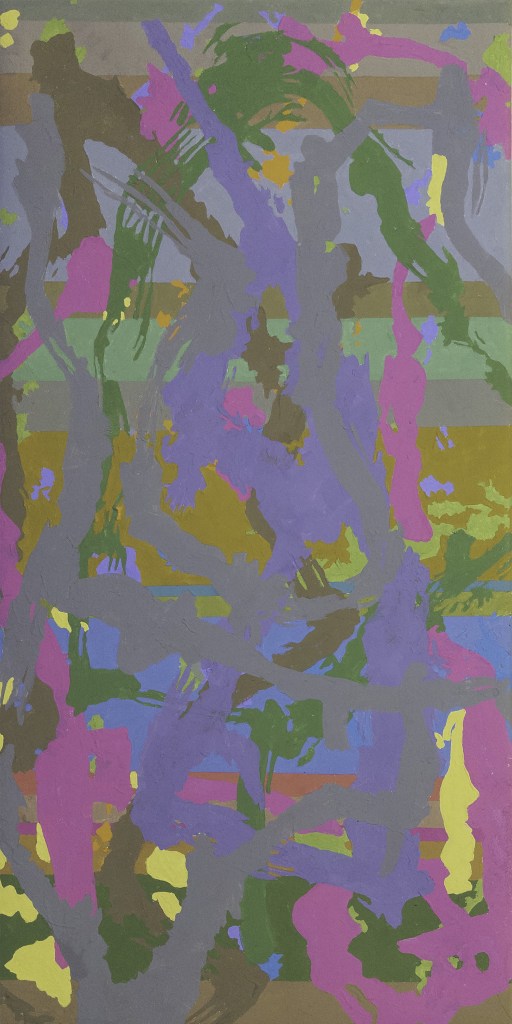
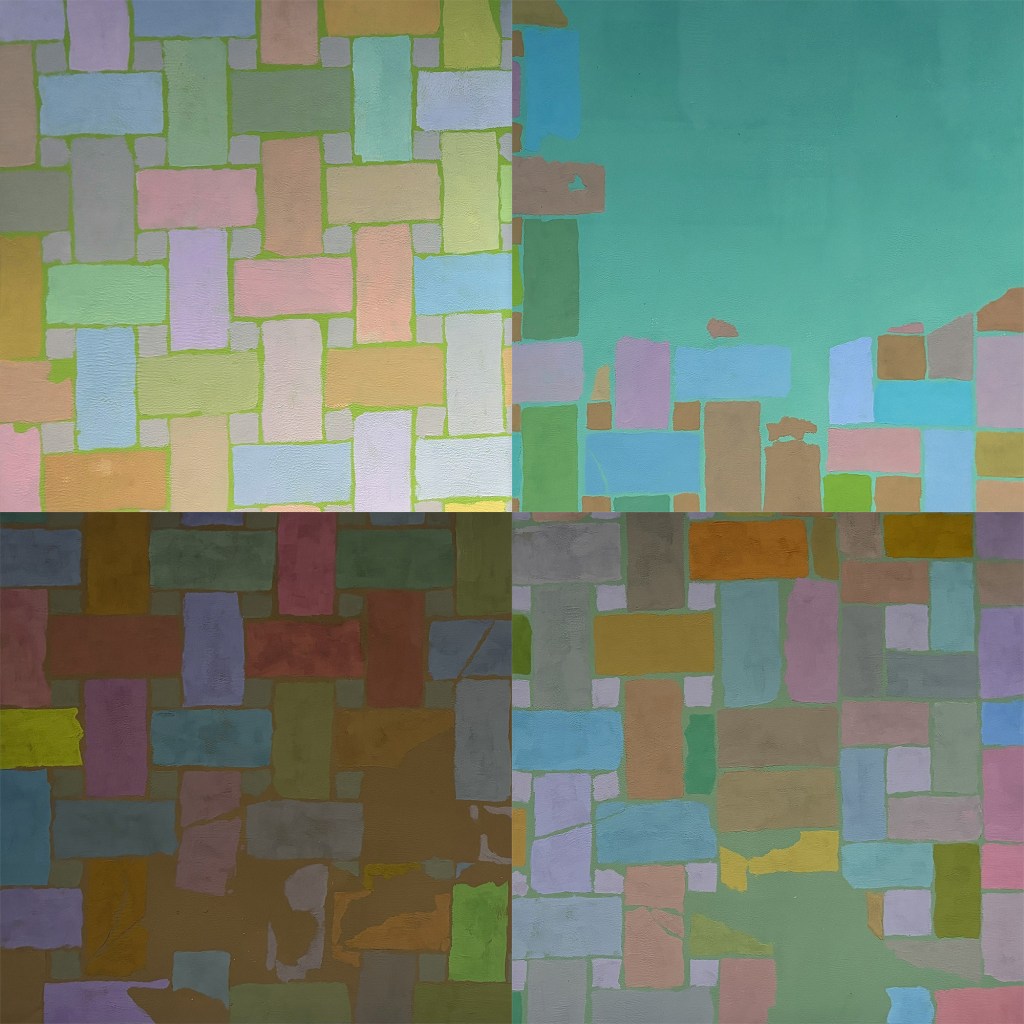
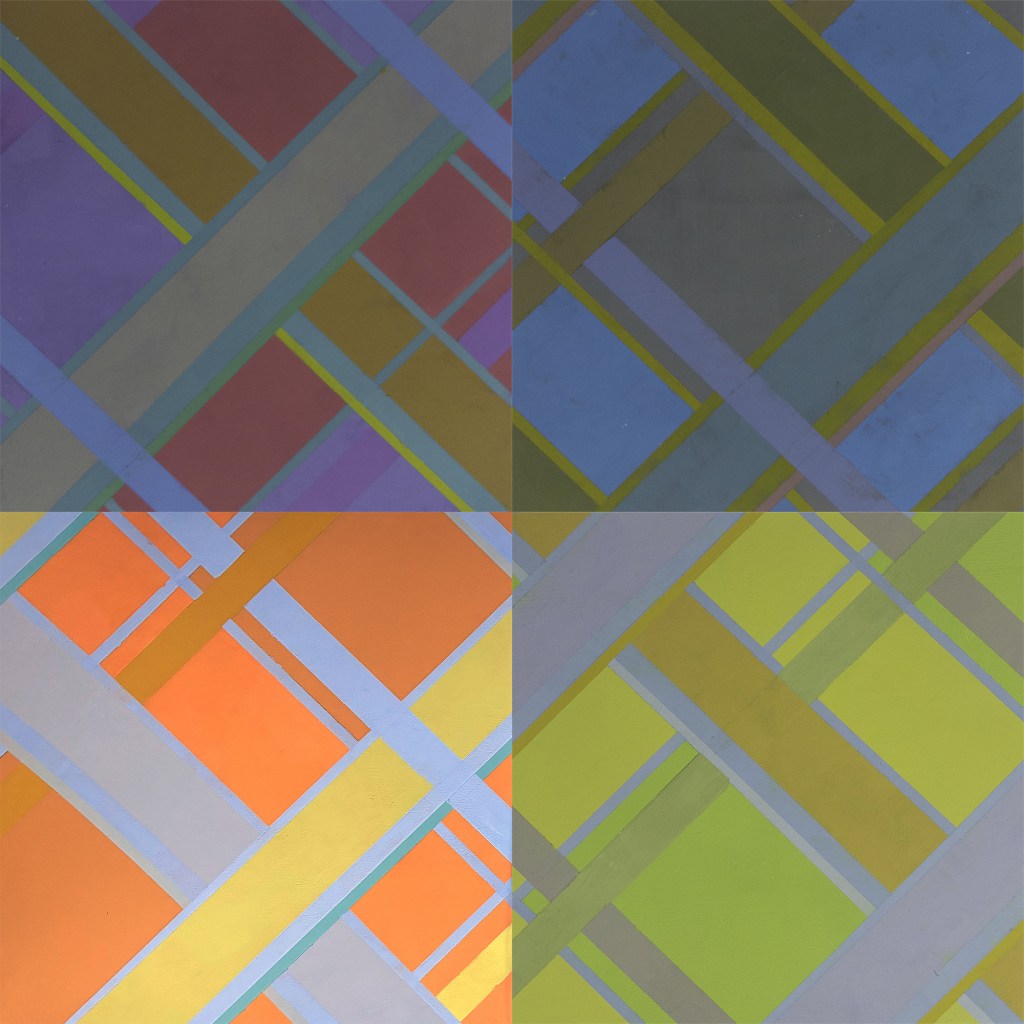
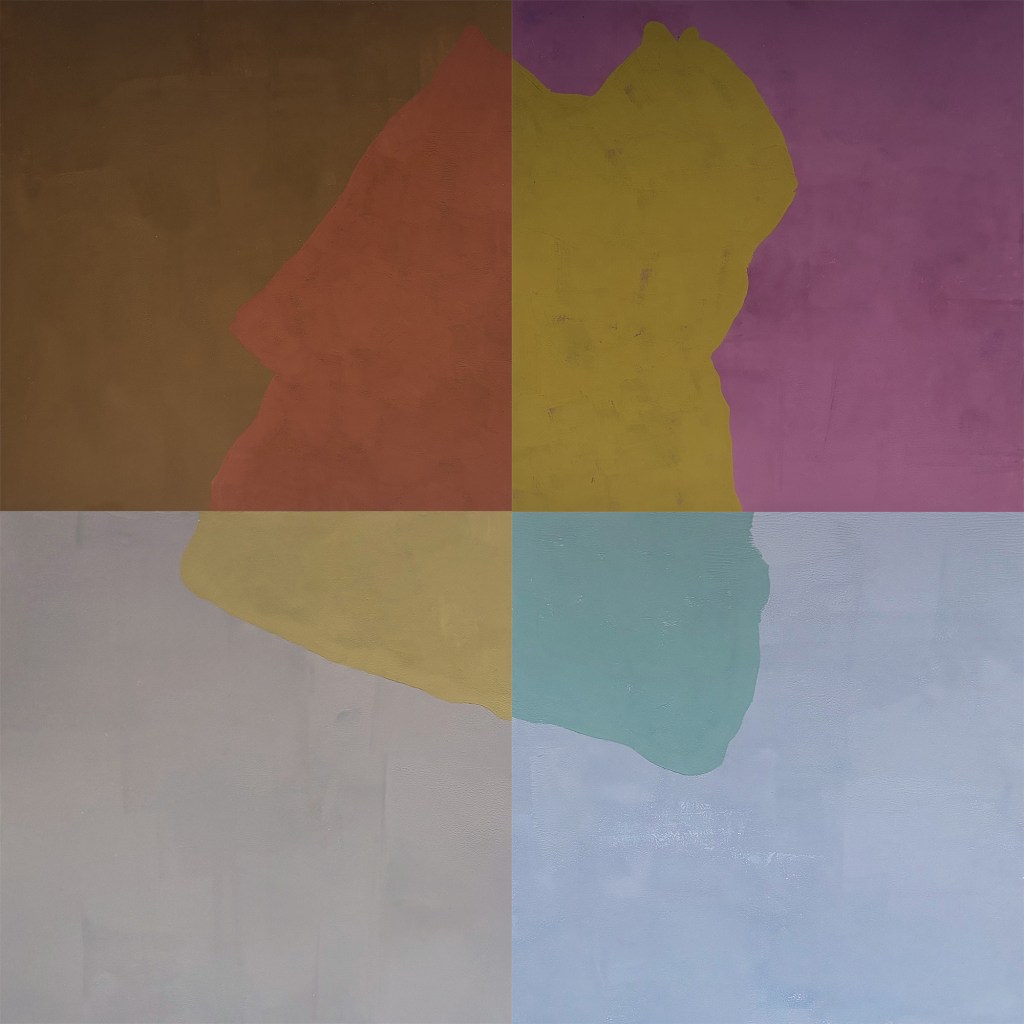
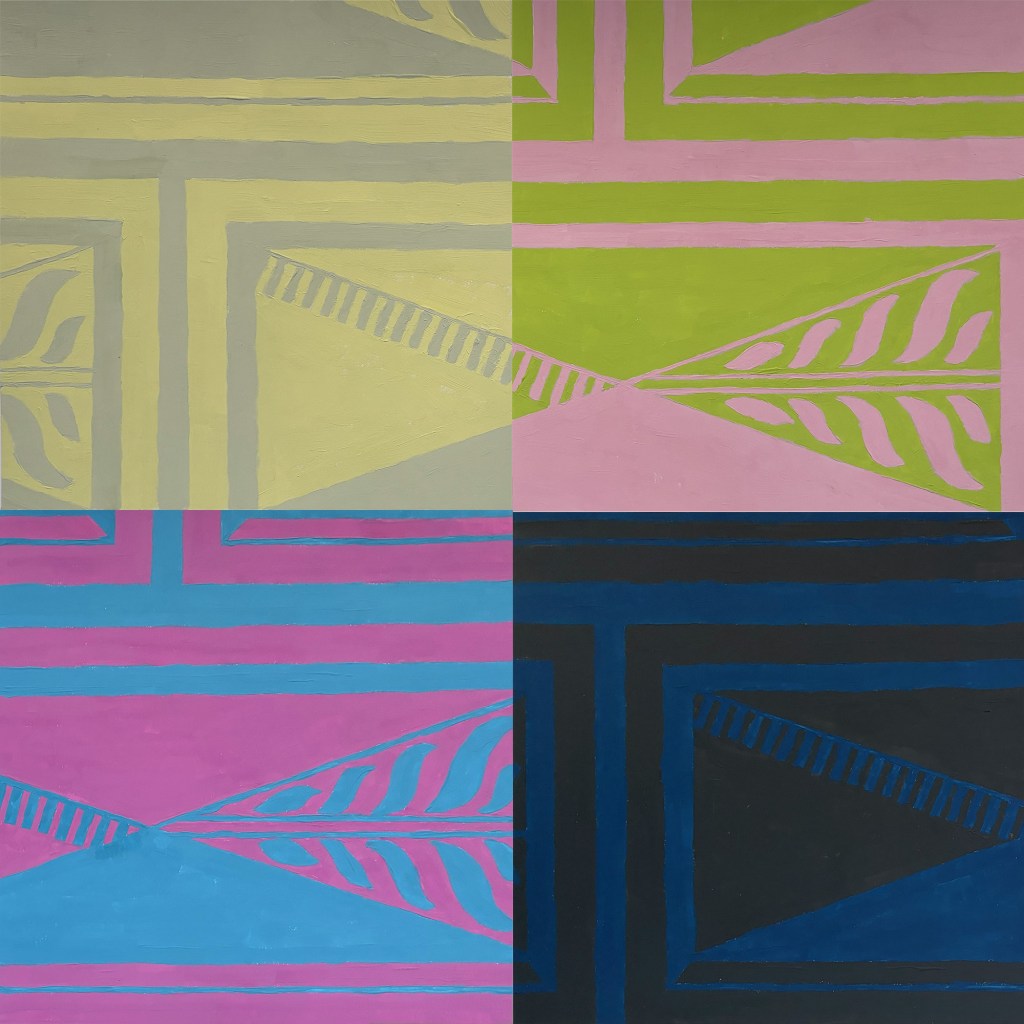
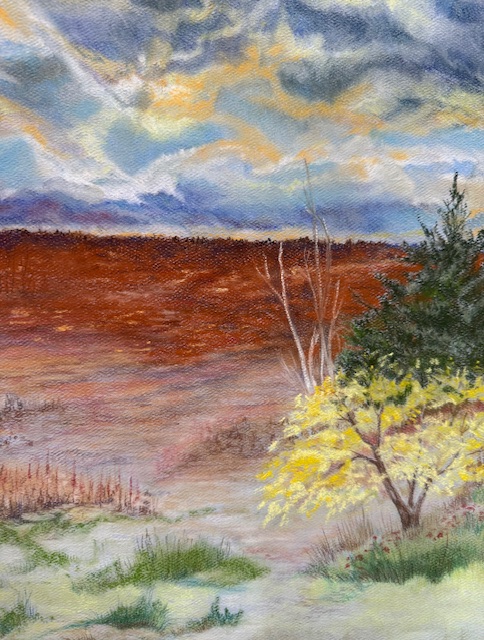
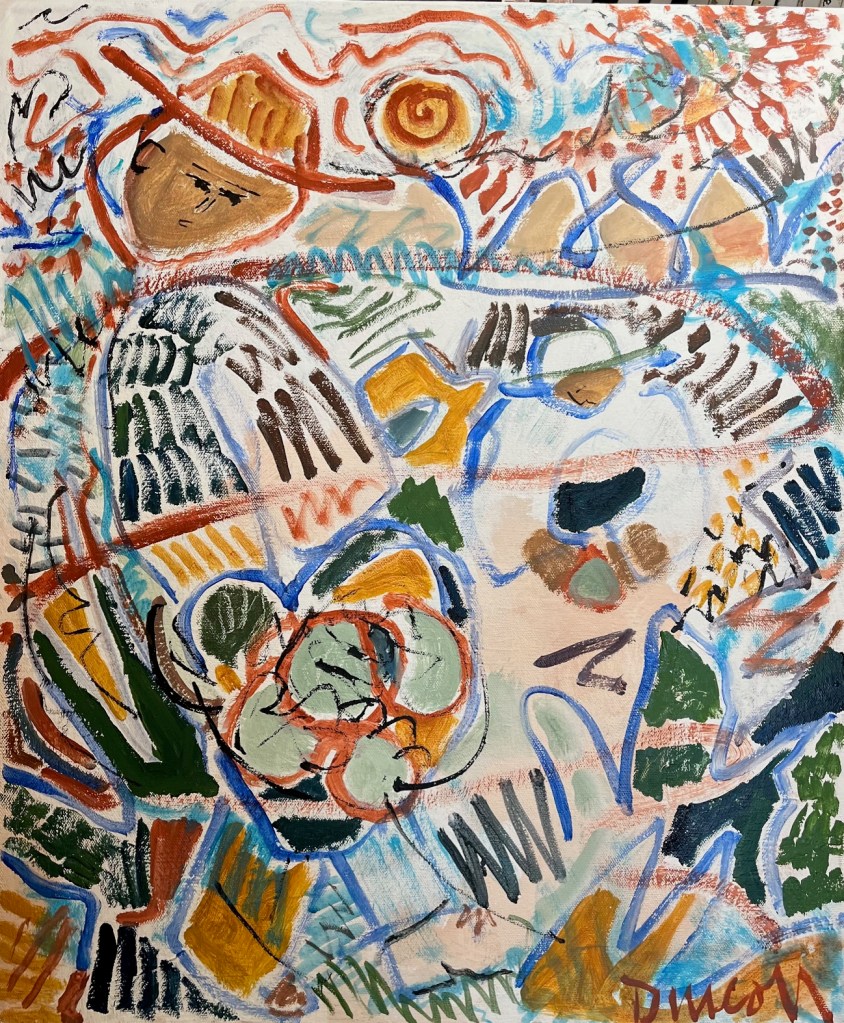
“Colors of the Year,” Sheila McManus’s new solo exhibition, features a group of paintings begun in the summer of 2025 after visiting the Thomas Cole House in Catskill, New York. According to McManus,
“I was surprised by how much the restored interiors affected me—the carpets, wallpaper, and decorative borders were so bright, busy, and colorful. I took some photographs and began making paintings based on a small section of one of the carpet designs.”
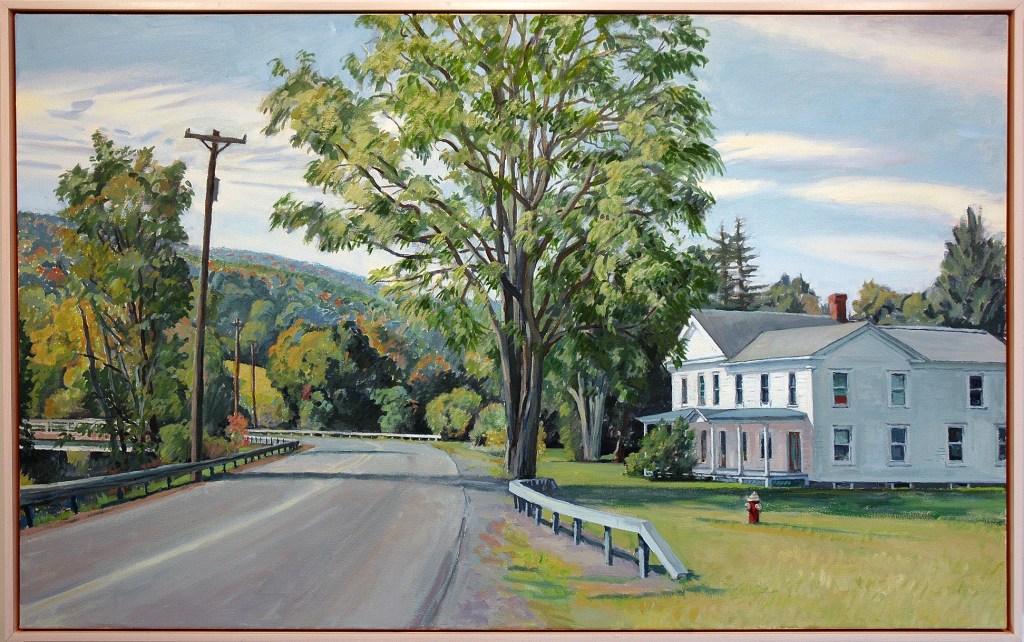
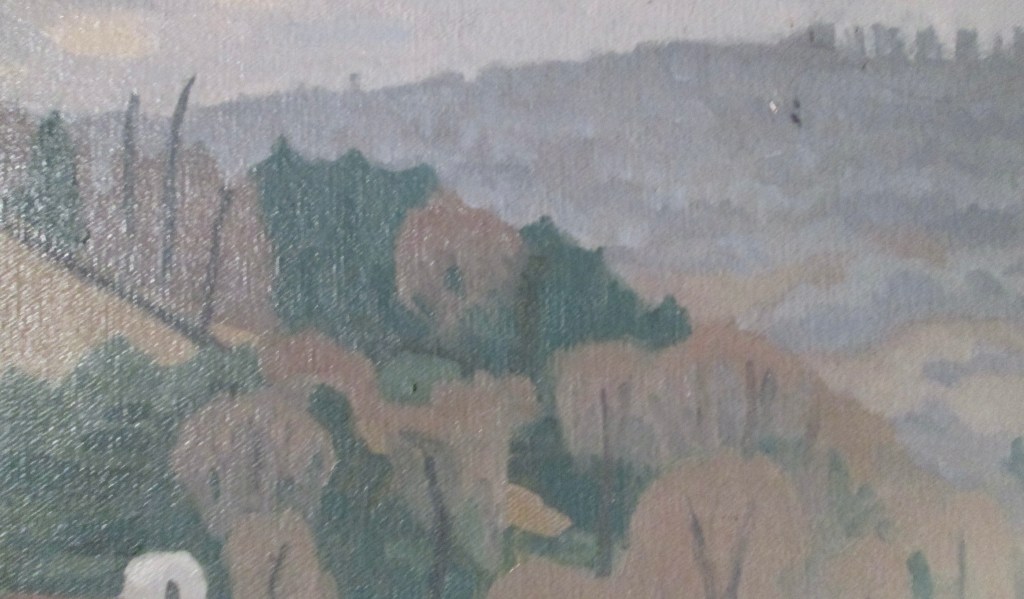
As the artist explains it, after “painting landscapes for several years, trying to achieve some subtlety in the color, inspired by painters like Lois Dodd, Albert York, and Fairfield Porter, it wasn’t going so well, and I became curious about what might happen if I gave up some control over color.” She thus began “choosing colors blindly from a collection of colored pencils that had accumulated over the years,” with the result being “the first group was a grid of sixteen paintings based on the carpet design, each using six randomly selected colors.” McManus then tried to bring the values of those colors close together, occasionally successfully. “The randomness became a way of getting myself to use colors I never would have chosen deliberately,” explains McManus, “and I was also taking some color theory classes focused on Josef Albers. His ideas about color interaction and his square paintings, became an important influence. I’m intrigued by what happens when colors have similar values but different hues or degrees of saturation—how colors advance and recede and sometimes seem to disappear into their neighbor colors—the point where the differences become almost imperceptible. These works bring together the colors of the past year with patterns and graphics I came across over those twelve months—a visual record of the year, translated through my color process.”
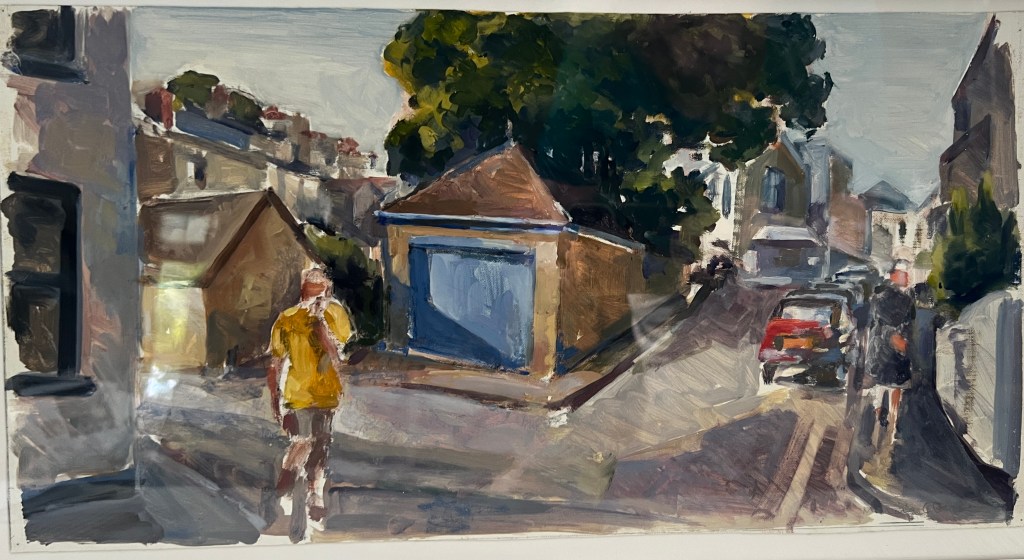
Sheila McManus worked as a graphic artist and web designer in New York City when she took a watercolor class with former Longyear member Alix Travis in Halcottsville. After becoming really absorbed with watercolor, after a while she returned to oil painting, which had been her area of focus in college and favorite medium. Back in New York City, she also studied with Nicholas Evans-Cato, painting plein air on the city streets. Along with studying painting at the University of Connecticut, McManus has taken classes with Elizabeth O’Reilly and Henry Finkelstein at the Art Students League. Her current paintings are a mix of Catskills plein air, New York City street paintings, flowers, still lives and, recently, abstractions.
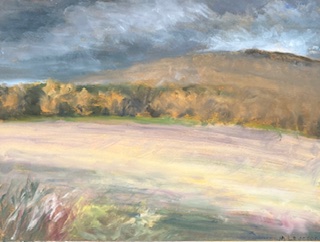
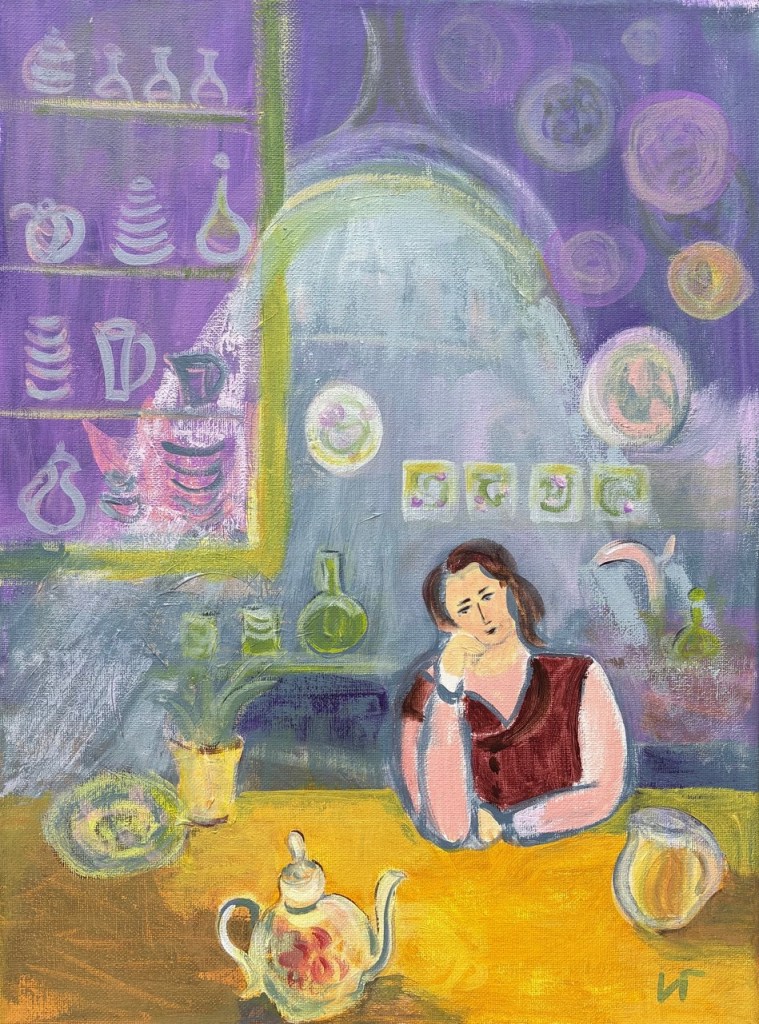
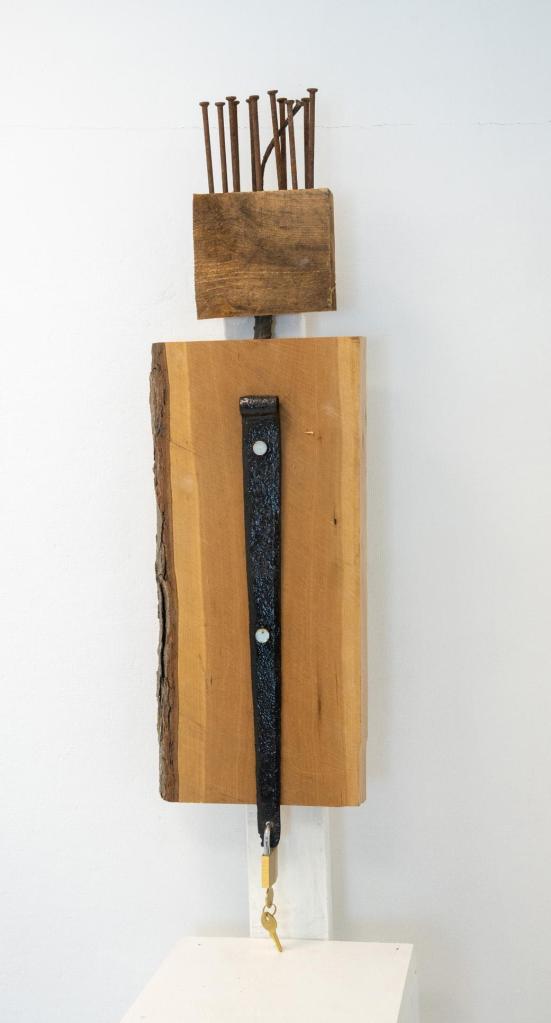
Marcia ClarkRichard MIllsWayne MorrisMeg Leveson
Future fall 2026 Longyear Gallery exhibits include Longyear’s Holiday Invitational Exhibition: “Artists Choose Artists,” running from Friday, November 20th through Sunday, January 3rd, 2027, accompanied by a Longyear Gallery Members’ Group Show.
Longyear Gallery is located Downstairs in The Commons, 785 Main Street, Margaretville. The gallery will be open from 11 a.m. – 4 p.m. Fridays, Saturdays, and Sundays. For information, please see Longyear Gallery’s website, email the gallery at info@longyeargallery.org, or call 845.586.3270 during gallery hours.
FRIDAY, SEPTEMBER 11th – SUNDAY, OCTOBER 11th, 2026
***
OPENING RECEPTION: SATURDAY, SEPTEMBER 12th from 3-5 p.m. CLOSING RECEPTION: SATURDAY, OCTOBER 10th from 3-5 p.m.
Longyear Gallery of Margaretville is pleased to announce the opening of three new concurrent exhibitions, Frank Manzo Memorial Exhibition, honoring late Longyear Gallery member Frank Manzo; Cena Pohl Crane New Member Introductory Exhibition; and a Longyear Members’ Group Show. Opening on Friday, September 11th, these exhibitions will run through Sunday, October 11th with the Opening Reception on Saturday, September 12th from 3-5 p.m., hosted by Cena Paul Crane, and a Closing Reception hosted by former Longyear Member Helene Manzo, wife of Frank Manzo, on October 10th from 3-5 p.m.
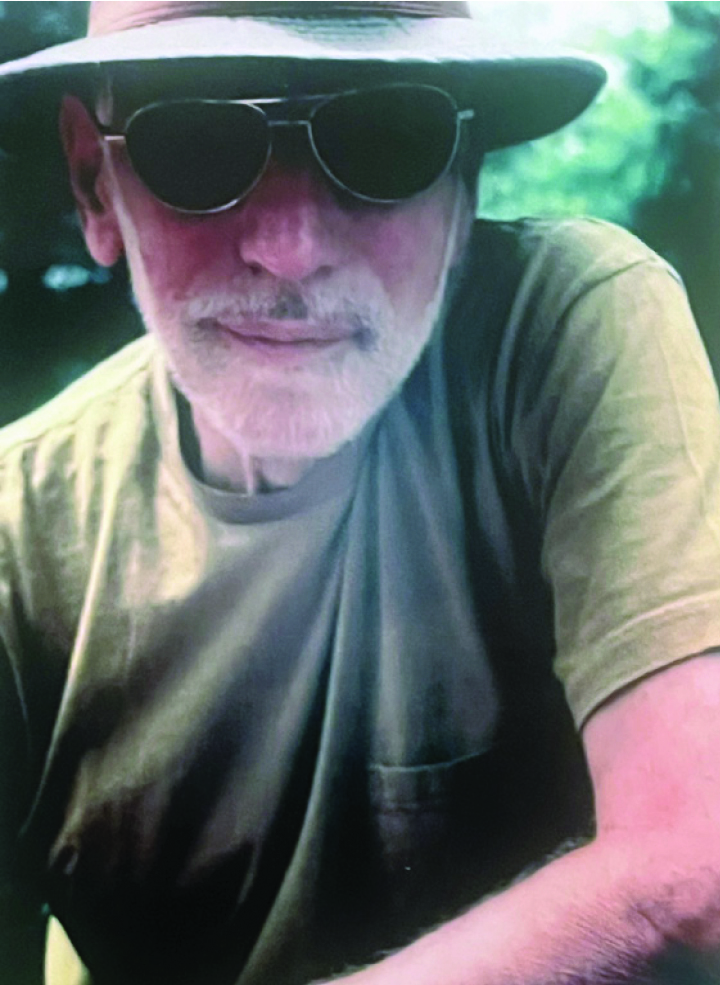
Frank Manzo
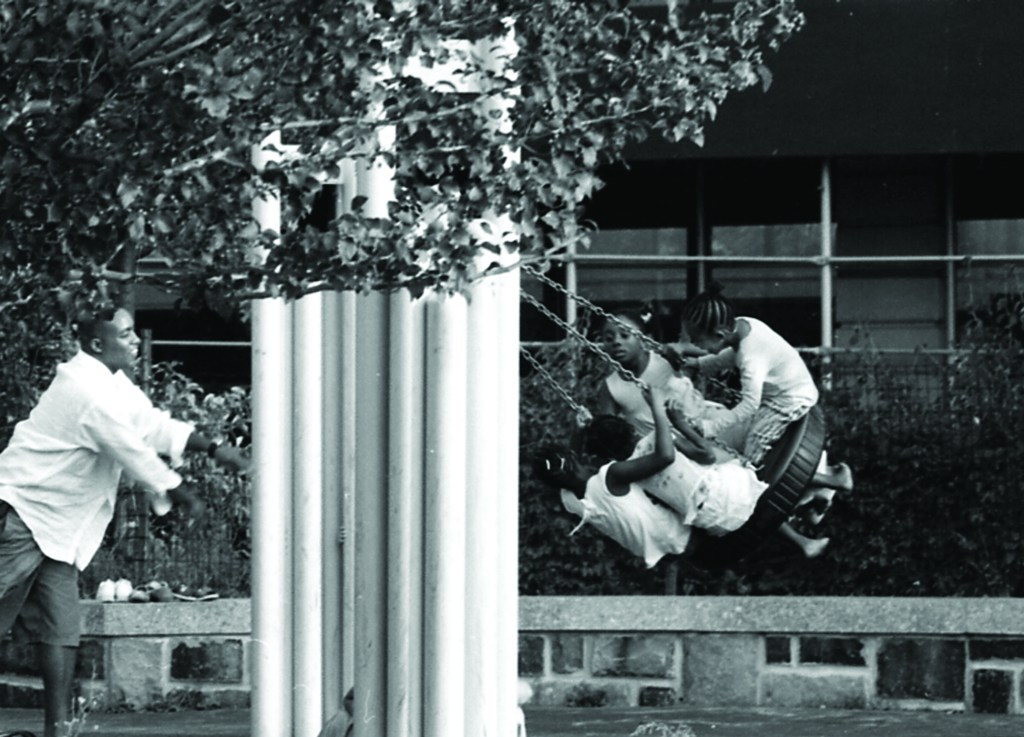
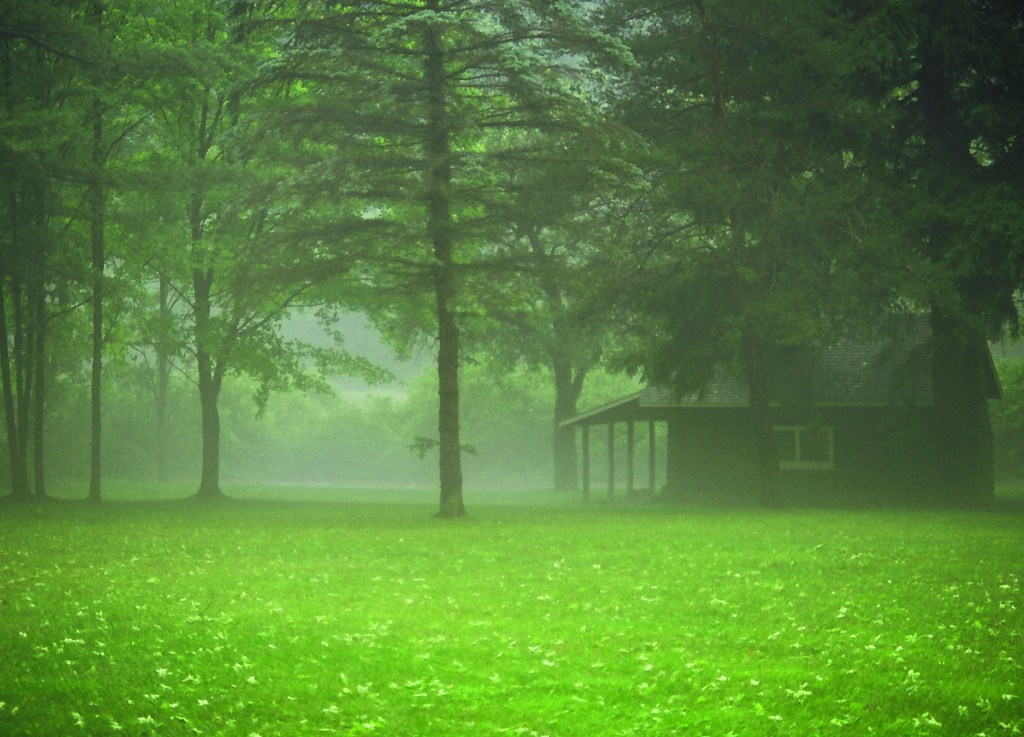
Longyear Gallery founding member Frank Manzo passed away at age 85 on March 31, 2026. He and his wife, Helene Manzo, were instrumental in establishing Longyear Gallery in the fall of 2007 after purchasing the Commons Building. A resident of Brooklyn and Roxbury, NY, Manzo was an active participant in the gallery for many years. This memorial exhibition presents a selection of photographs from his archive spanning more than six decades. From his early work at Pratt Institute to photographs made throughout New York City, upstate New York, and his travels, the exhibition reflects a lifelong practice of careful observation and a deep appreciation for light, architecture, and everyday life.
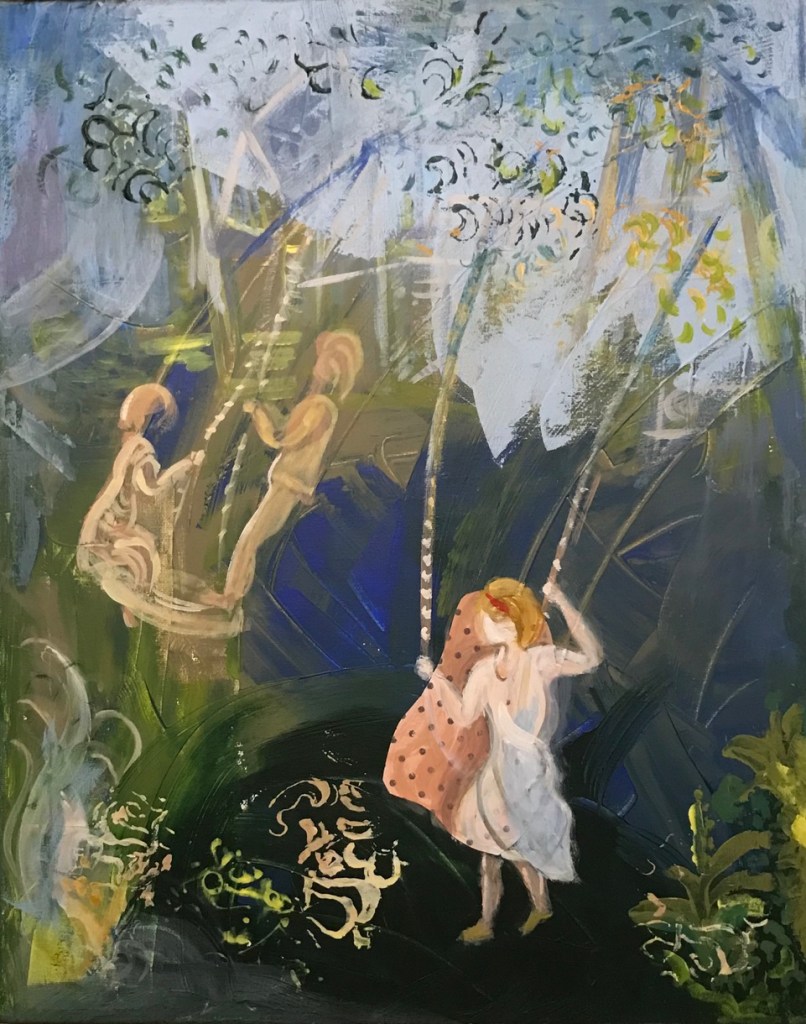
SwingersUntitledTIghtrope Walker
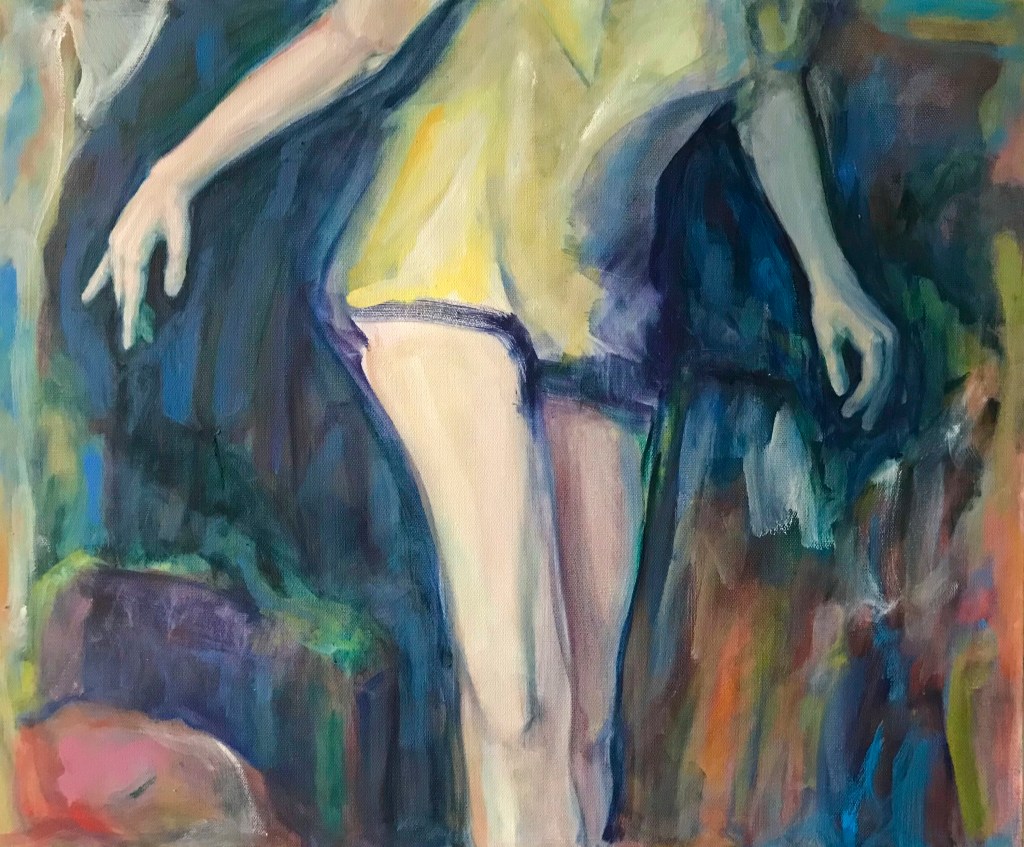
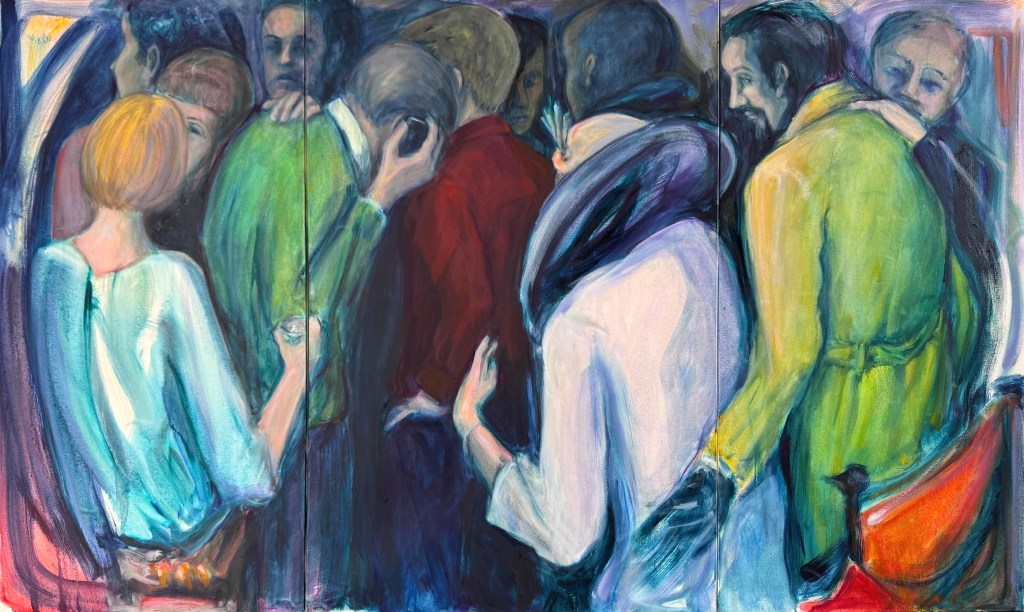
New Longyear Gallery member Cena Pohl Crane is a figurative painter whose work moves beyond the constraints of realism by utilizing a palette of deeply saturated color combined with energetic brushwork that allows her “to prioritize emotional resonance over representational likeness.” As Crane states, “I prefer to work with oil on canvas for its luminous properties, its ability to capture reflective light, and the capacity to contrast thin, layered washes with loose areas of opacity. My process is one of discovery rather than documentation; I do not work from life or photography.” Instead, she begins by making spontaneous marks on the canvas then responding, she explains, “by interpreting this chaos, pulling figures out or pushing landscapes back, responding to the feeling that the emerging shapes elicit, allowing me to give form to recognized and unspoken feelings. In a painting’s early stages, I have no preconception of what it should communicate. Instead, the image discloses subconscious meaning through the act of creation, often revealing themes of melancholy, anxiety, or the uneasy comfort found between figures.” For this artist, “painting is a way of making sense of a fractured world—a process of healing—in the hope that a viewer will pause, look, and find comfort in a shared emotional experience.”
Late to the Party
Cena Pohl Crane is an oil painter based in Margaretville, New York. After a thirty-year career in digital design, she relocated from Brooklyn to the Catskills to rededicate herself to a full-time studio practice. She received her BFA in painting at Washington University in St. Louis, which included a semester studying art history and painting in Florence Italy, cementing her love of figurative art. She is typically found in her studio upstairs from the Longyear Gallery in the historic Commons Building, where visitors are welcome to view her latest work. Her paintings have been exhibited regionally and in Brooklyn.
Future fall 2026 Longyear Gallery exhibits include two solo exhibitions by members Temma Bell and Shiela McManus, running from Friday, October 16th-Sunday, November 15th with the opening reception on Saturday, October 17th from 3-5 p.m., followed by Longyear’s Holiday Invitational Exhibition: Artists Choose Artists, running from Friday, November 20th through Sunday, January 3rd, 2027. All solo exhibitions are accompanied by a Longyear Gallery Members’ Group Show.
Longyear Gallery is located Downstairs in The Commons, 785 Main Street, Margaretville. The gallery will be open from 12 a.m. – 5 p.m. Fridays, Saturdays, and Sundays. For information, please see Longyear Gallery’s website, www.longyeargallery.org, email the gallery at info@longyeargallery.org, or call 845.586.3270 during gallery hours.
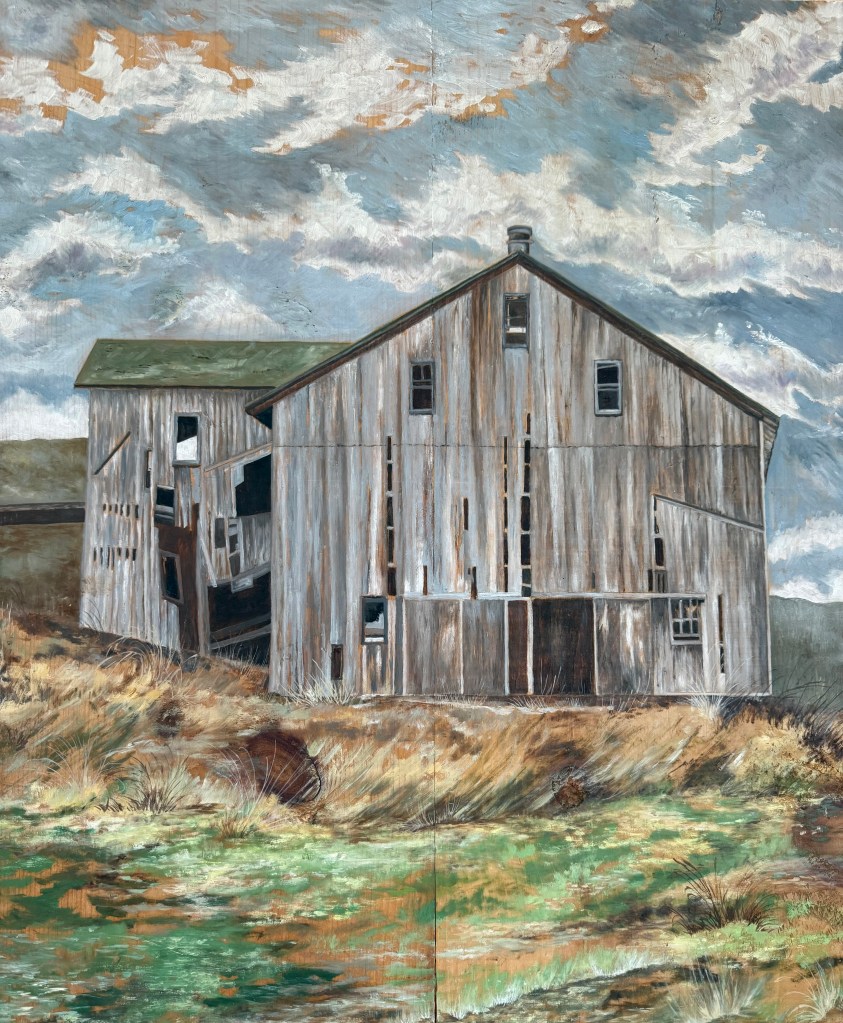
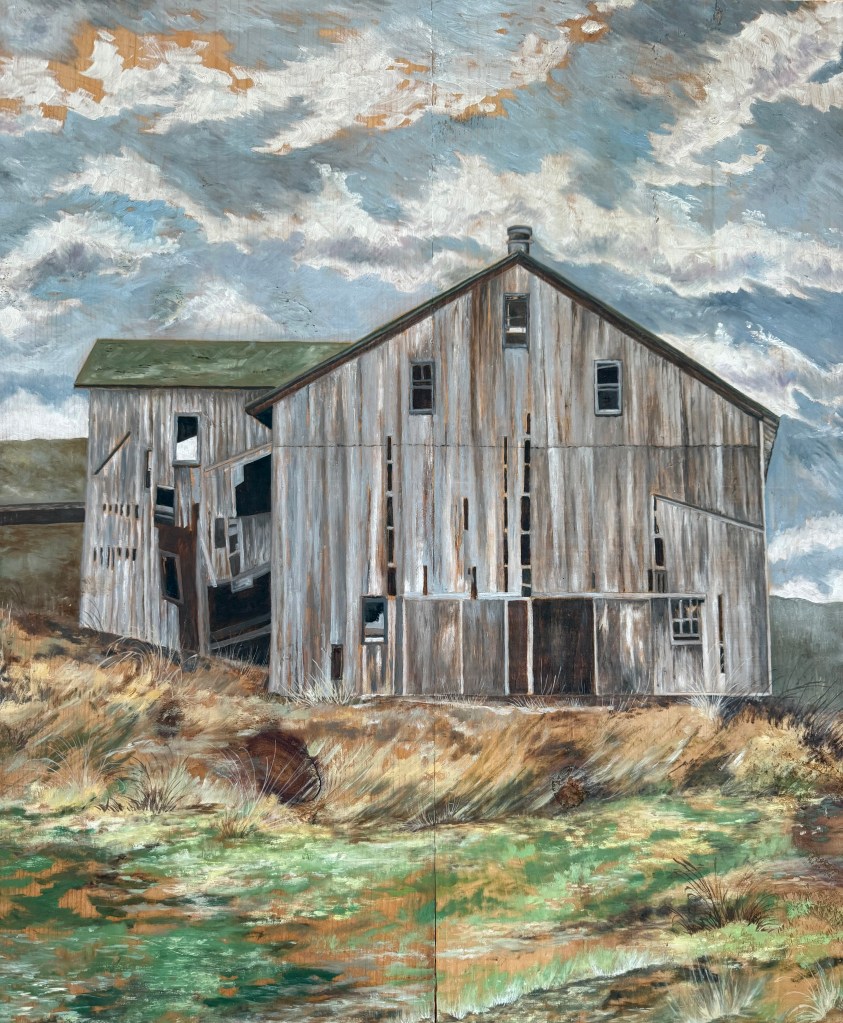
Stepping into Longyear Gallery, the first painting that catches your eye is Deborah Ruggerio’s Sunny Brook Farm Standing Alone, part of her solo show entitled “Time as a Canvas.” Painted in oil on two pieces of barn wood, the work depicts an abandoned barn, gaps showing through its weathered gray vertical planking, perched on a berm of wind-swept, wheat-colored grasses against a sky filled with scintillating clouds. The building faces the viewer directly, its flattened form emphasizing its simple geometry and conveying a certain formality, as it posing for a portrait. Isolated in a vast space alive with the movement of clouds and light on grass, the image speaks powerfully of isolation and loss, of a farming culture long departed. Bits of the wood surface are left unpainted, as if the image was conjured up by the barn’s weathered boards. It’s a tribute to Deborah’s skill and deep feeling for the rural countryside where she lives and paints that the monumental building has such presence.
As the title of her show indicates, her landscapes capture moments of time, re-creating the fleeting spectacle of light and weather in paint, so that all may behold her vision of momentary beauty. “Time runs out but art does not,” she writes in her statement. “Artwork lives forever, to capture ‘life’ on this magnificent planet. Every moment in time is lost forever, unless it is captured to be experienced by others.”
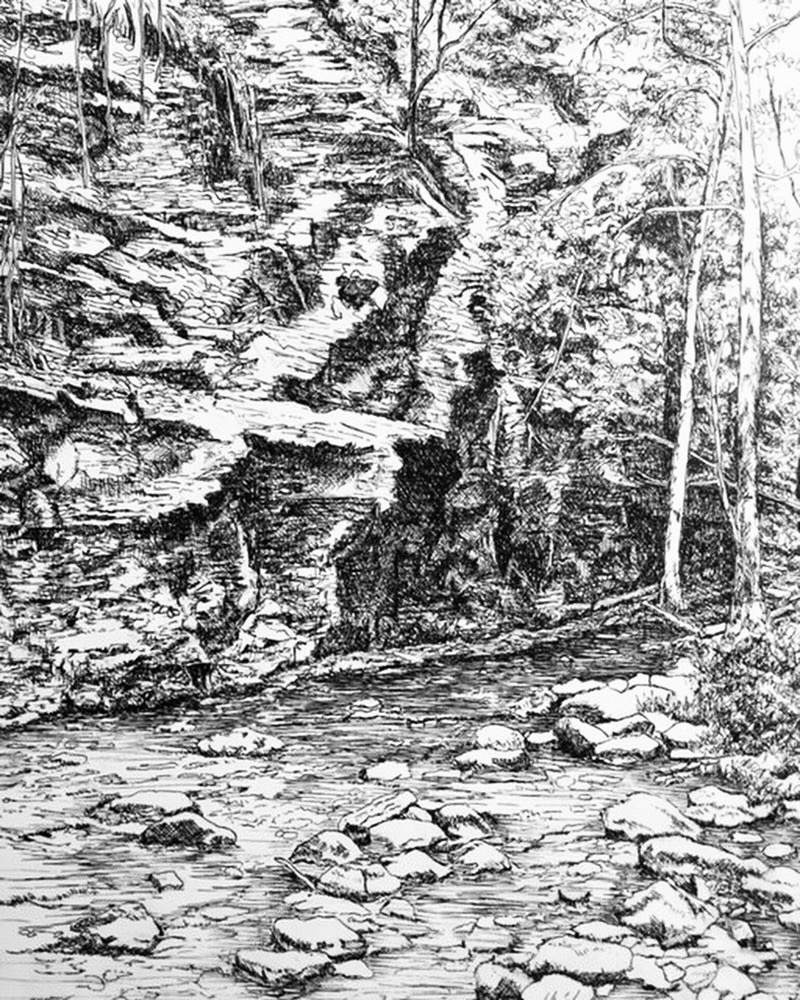
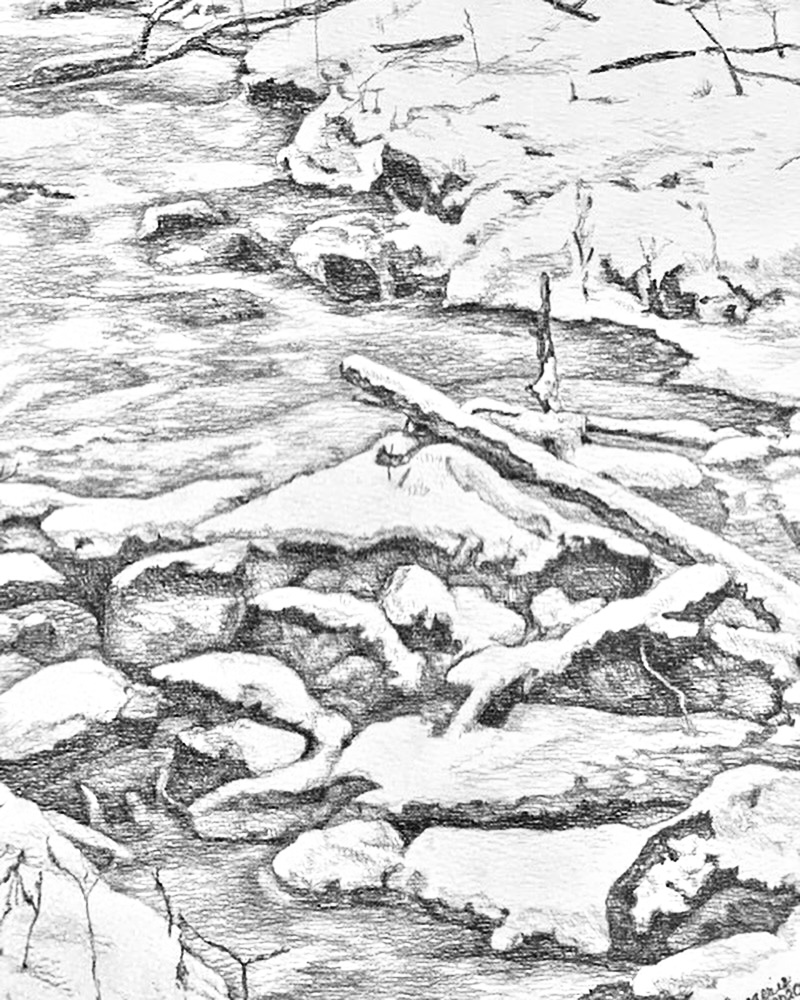
Deborah’s paintings and drawings in graphite and ink collectively comprise a comprehensive portrait of the western Catskills landscape. She knows this land well, from intimate views of waterfalls and wooded hollows, fallen trees and rocks to vistas of fields stretching toward the distant hills and mountains in all seasons. Her attention to detail and nuances of light give these images an almost surreal quality, such is their clarity. Indeed, the ink and pencil drawings, such as Minekill and Winter in the Woods,
MinekillWinter in the Woods
are almost trippy in the precision with which the artist depicts the texture of cliffs, of rocks strewn across a stream, plant growth on a hillside, a woodland of twiggy saplings. “I do get intrigued by the detail,” says Deborah. “Some of the drawings took four months to do”—and for those done in ink, there was little room for error.
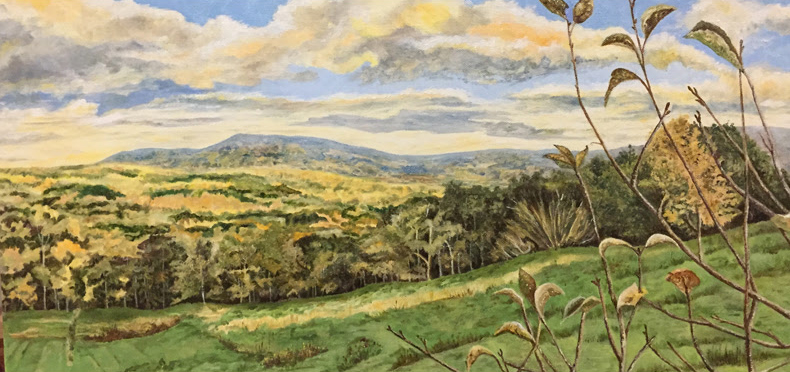
On her hikes and drives near her home in Denver, which she shares with her husband, Vince, she is constantly on the lookout for subjects and often pulls off the road to snap a photo. She works both plein air and from photos. In her vistas, “I like to create atmospheric perspective and direct the eye to the middle and background by including something in the foreground.” In Orange Essence of Schoharie,
Orange Essence of Schoharie
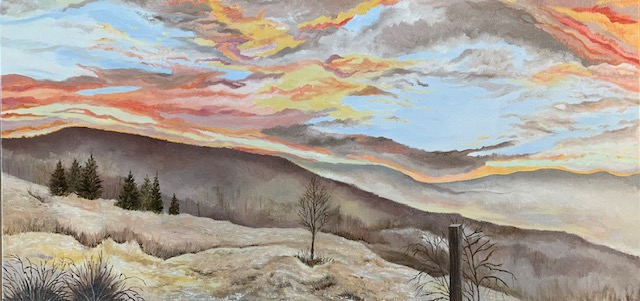
the gracefully curving leaves and pods of a plant in the foreground frame the view at lower right, placing the viewer in the scene; the curving linear forms point to the sliver of light at the far edge of the field and from there the eye moves to the variegated light and dark pattern of the forest cover stretching to the distant blue mass of the mountain. The undulating mass of golden clouds that unspool along the top of the canvas, seemingly more near than the mountain, add drama. Nightfall,
Night Fall
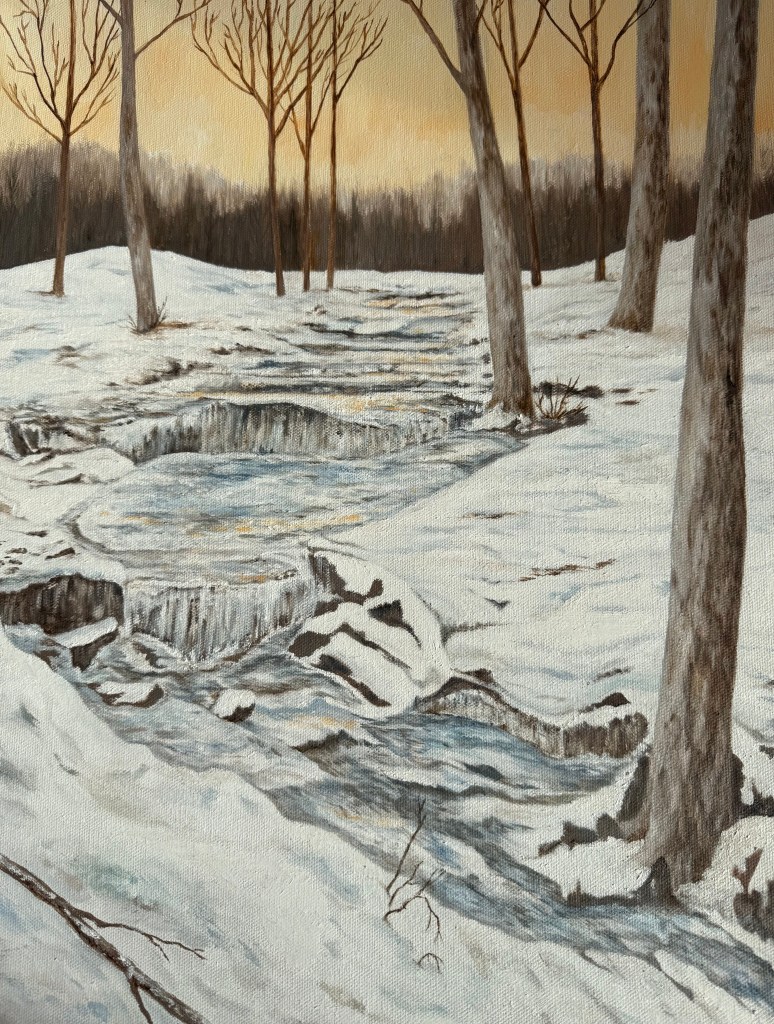
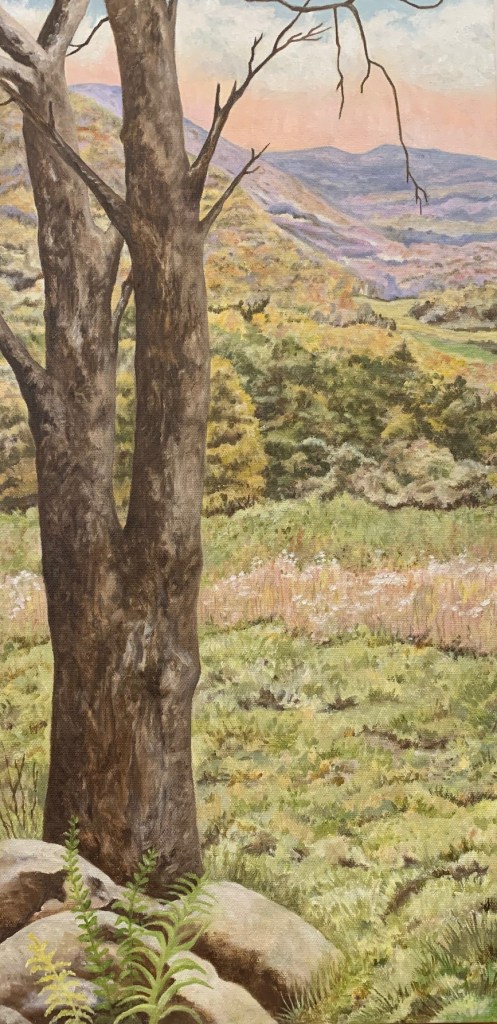
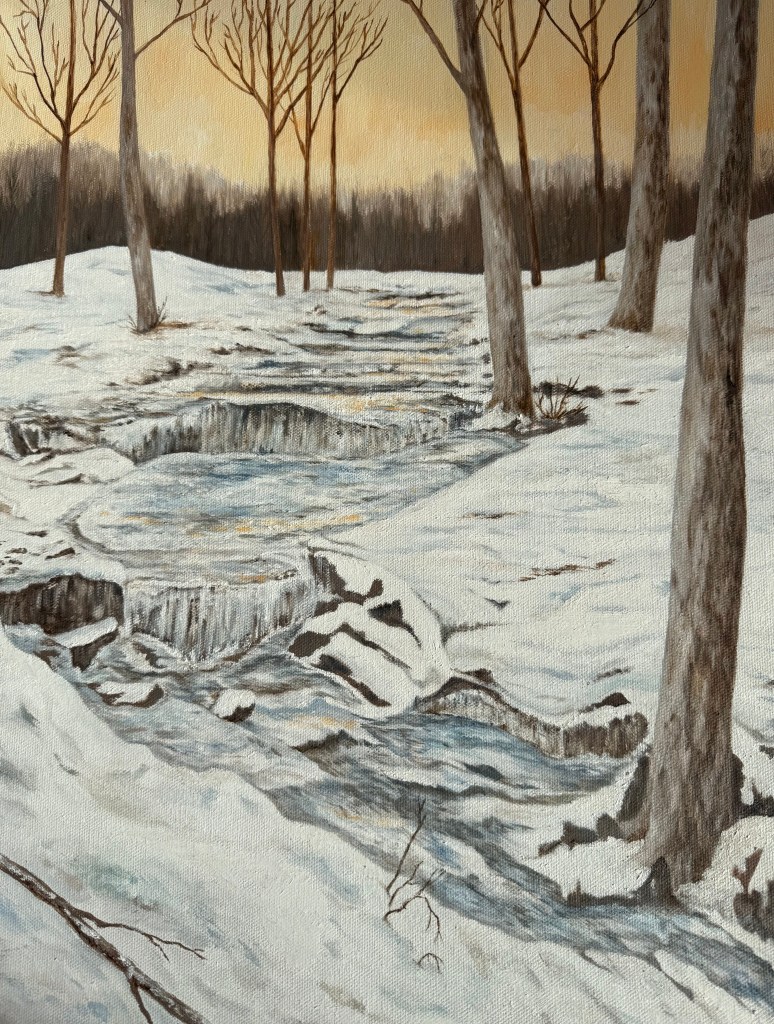
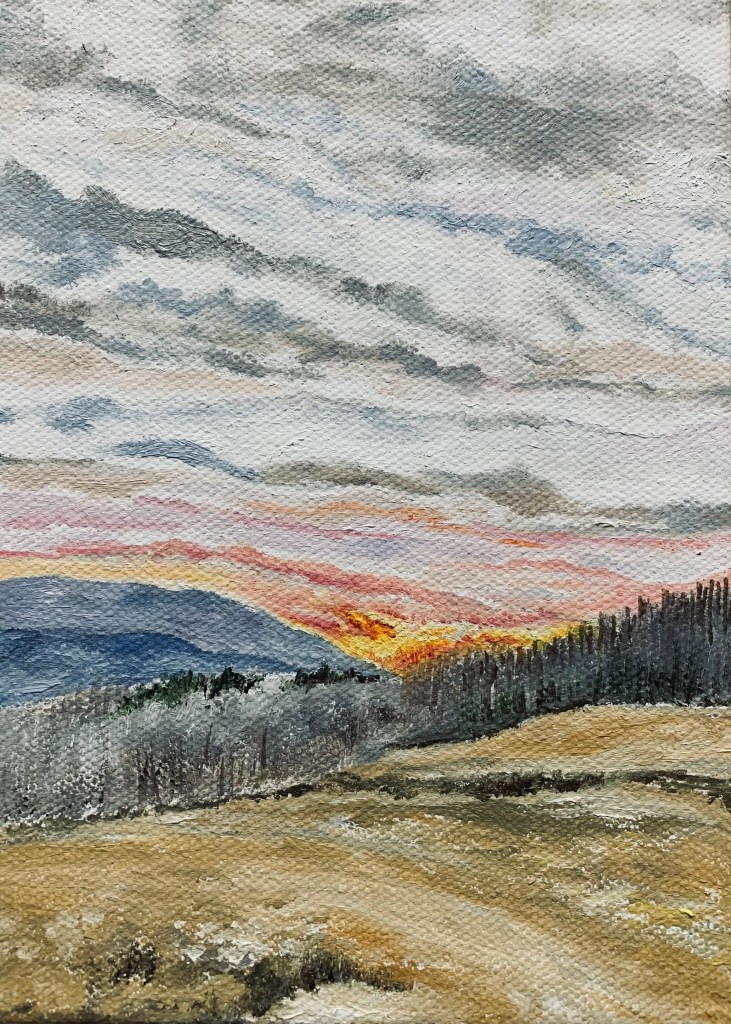
a mountain vista in winter in which the gray, snowbound earth is contrasted with a fiery sunset sky, is similarly dramatic. Lower Meeker in the Snow, in which the icebound creek meanders from the foreground past a spare scattering of bare-branched trees to a distant wood, is striking for the luminous, pale orange of the sky. Another beauty is Valley View, a narrow vertical canvas in which a magnificent view of the curved side of an enormous mountain is framed on the left by a single tree rising above a pile of rocks. The delicate light and faded colors have a vintage quality, reminiscent of early 20th-century hand-colored photographs.
Lower Meeker in the Snow,Valley View
Deborah began drawing as a kid. After majoring in art education in college, she taught middle school and high school art in New Jersey. In 2010 she and Vince bought property in the Catskills and Deborah began painting. In 2016 she retired and the couple moved to the area fulltime. Two years later, she joined Longyear and has been hanging shows ever since.
“Before, I used to do people all the time and worked a lot in black and white, then I got brave enough to use color,” Deborah says. “The color changes around here are magnificent,” she adds, perhaps offering an explanation of why she switched from painting people to landscapes. “Everywhere you look, there’s another canvas to paint.”
She also paints with watercolor and is a member of the East Branch Delaware River Plein Air Painters (EBDRPAP). She’s shown at numerous venues in the Catskills and Hudson Valley as well as at Blue Mountain Gallery, in New York City. Her artwork was published in Catskill Cooks, Treasured Recipes & Original Art, created by the Pine Hill Community Center.
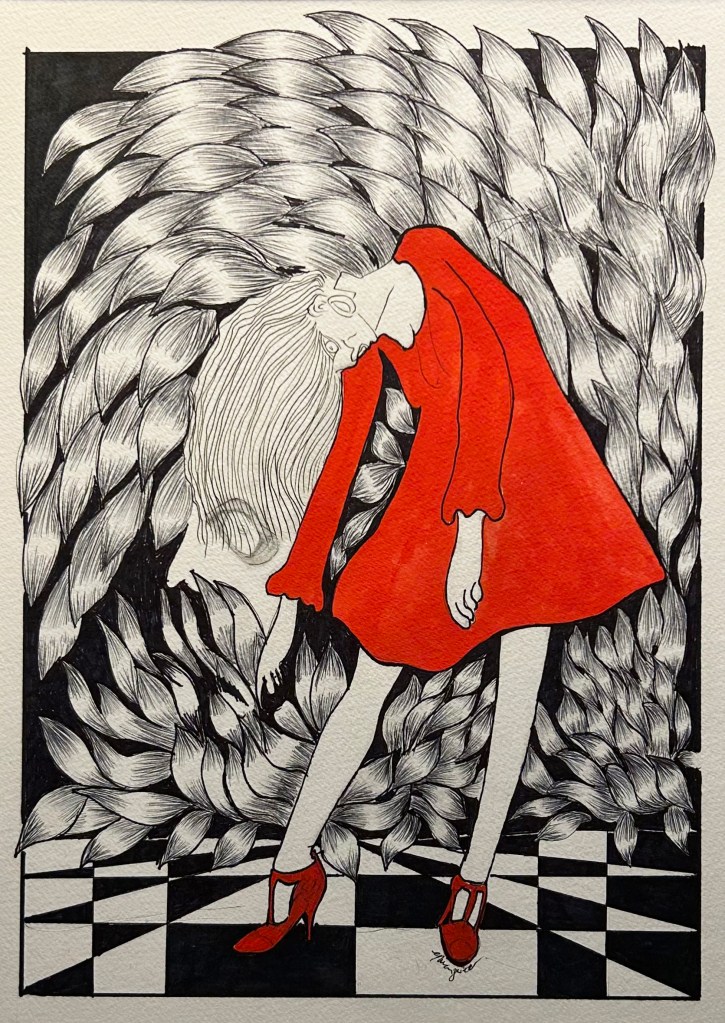
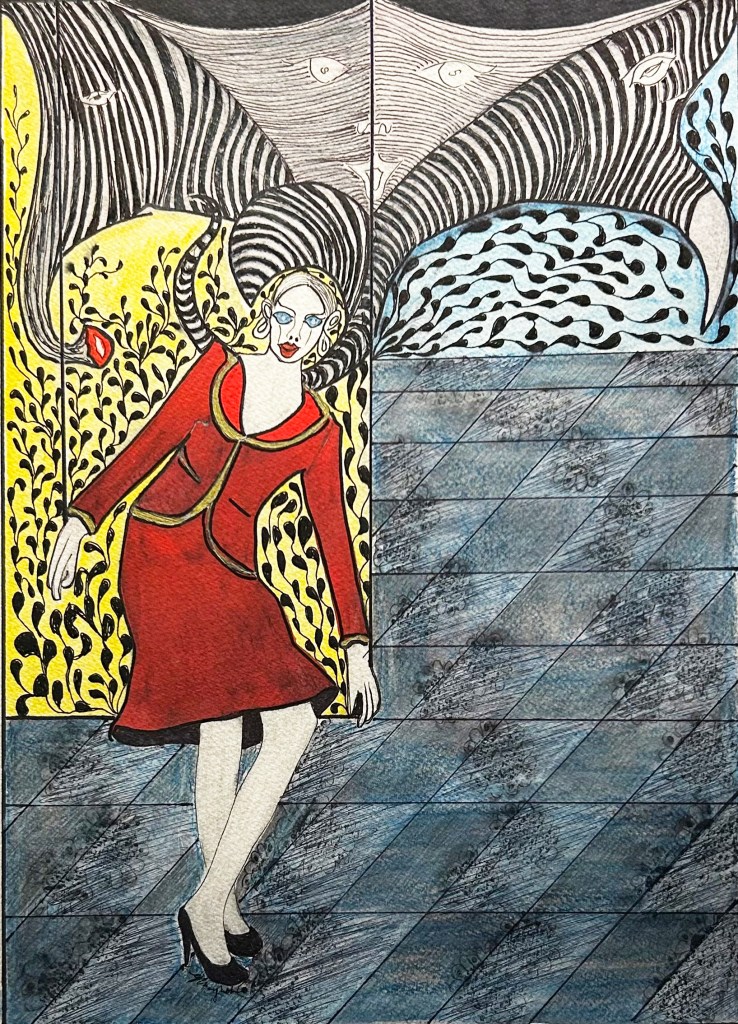
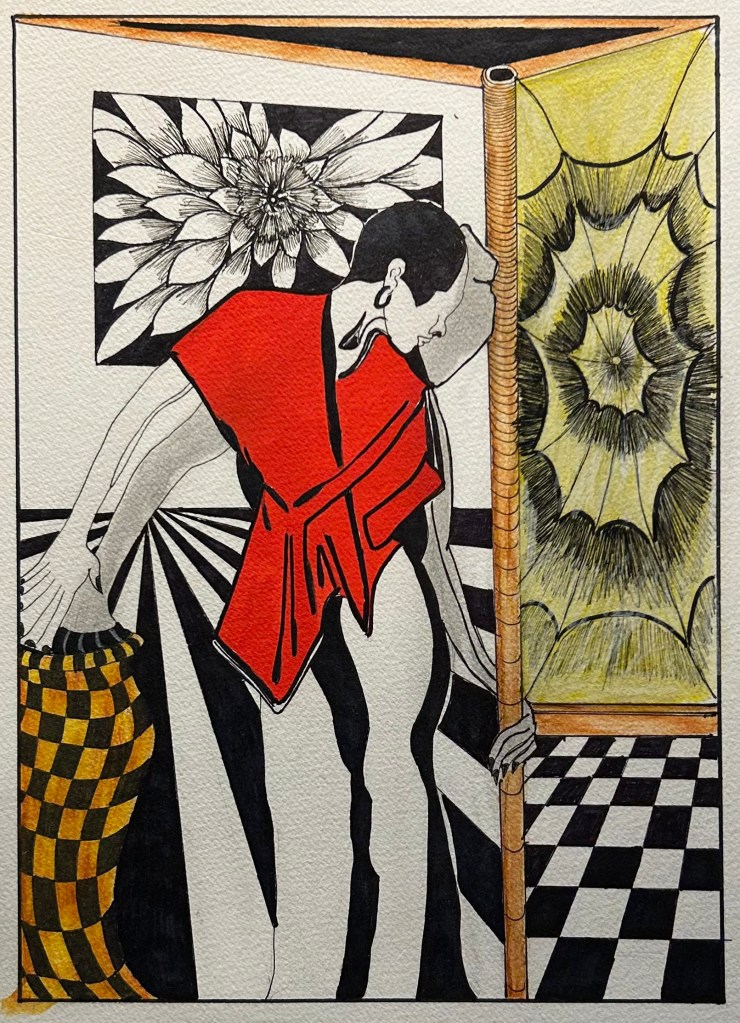
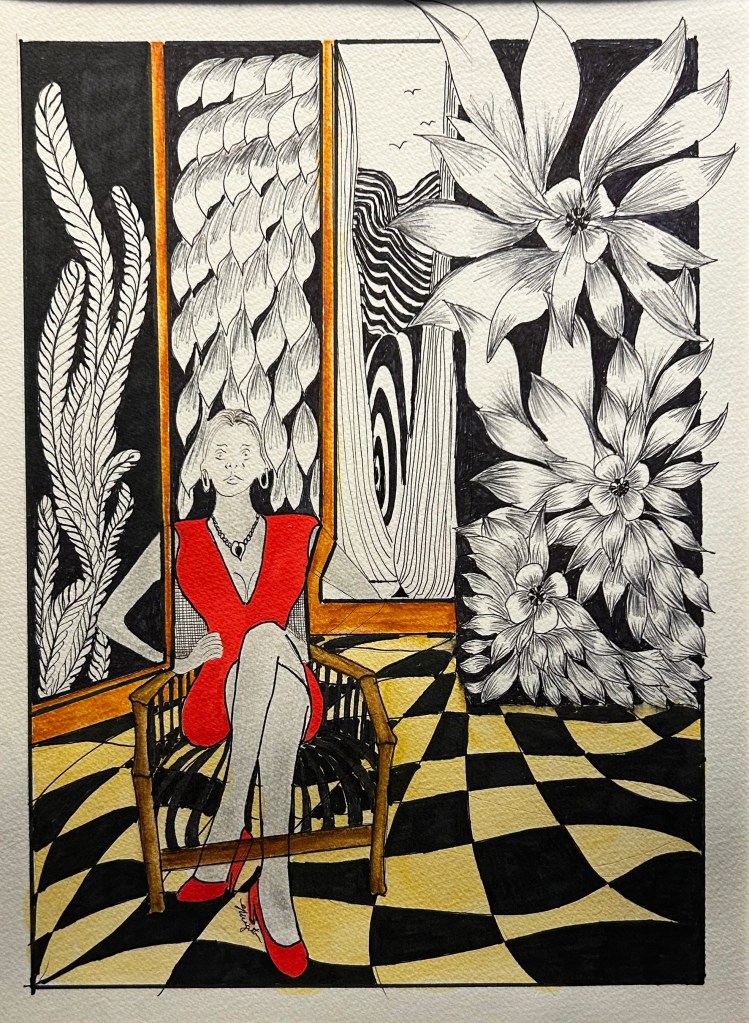
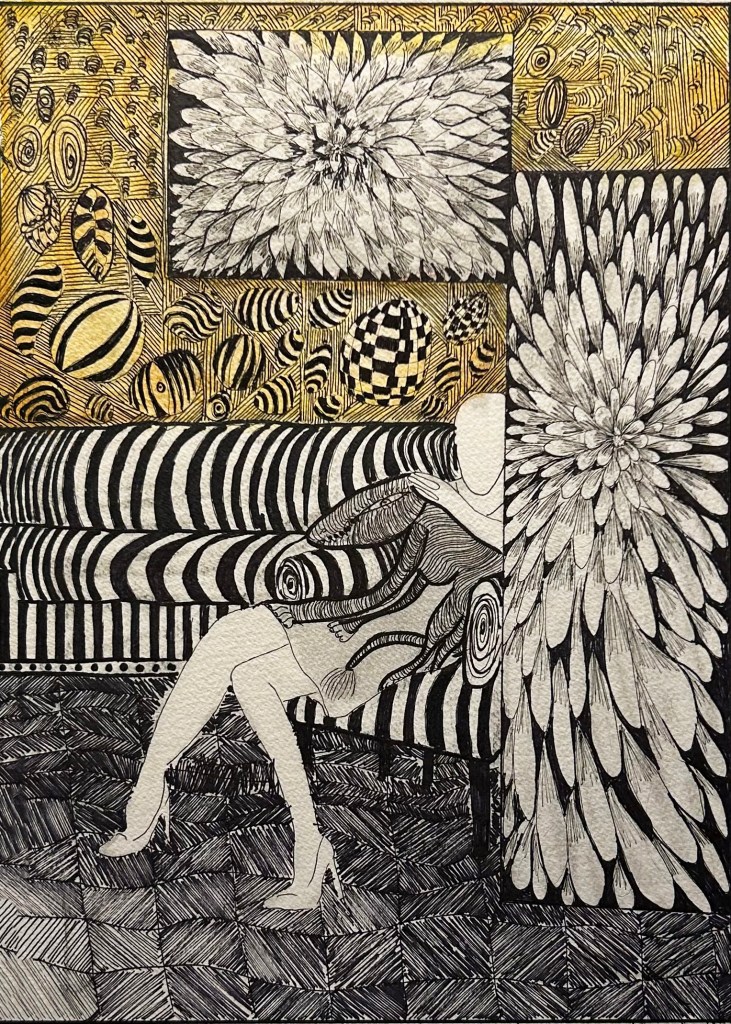
“Time as a Canvas,” along with Anthony Margiotta’s solo show of ink and gouache drawings, entitled “More Controlled Hallucinations,” will be on view through September 6; there will be a closing reception that day from 3 to 5 pm. “I am interested in how humor and the grotesque can coalesce into imagined worlds of visual drama,” writes Anthony of his drawings, in which elegant figures are juxtaposed, or subsumed by, psychedelic patterns. “At the same time, within these imagined worlds is the tension between rich patterns and empty space–between the recognizably real and the distorted.”
Unstrung PuppetTipsyRed Kimono
Twenty-five works in various media by the members of EBDRPAP will be on display at Art Up Gallery, in Margaretteville, from August 28 through September 27. The artists represented are Robert Axelrod, Deborah Brindis, Cena Pohl Crane, Christopher Criswell, Kathleen Green, Irina Grinevitskaya, Oneida Hammond, Ann F. Hoffman, Margaret Leveson, Myra Lobel, Patrice Lorenz, Ronald Macklin, Sheila McManus, Helene Manzo, Pippa Merrick, Michelle Sidrane, Jan Sosnowitz, and Sara Stone. From spring through fall, the group meets every Tuesday at a site in Delaware or Ulster counties and paints until noon, when the work is shared. When the cold weather ensues the group will continue meeting via Zoom.
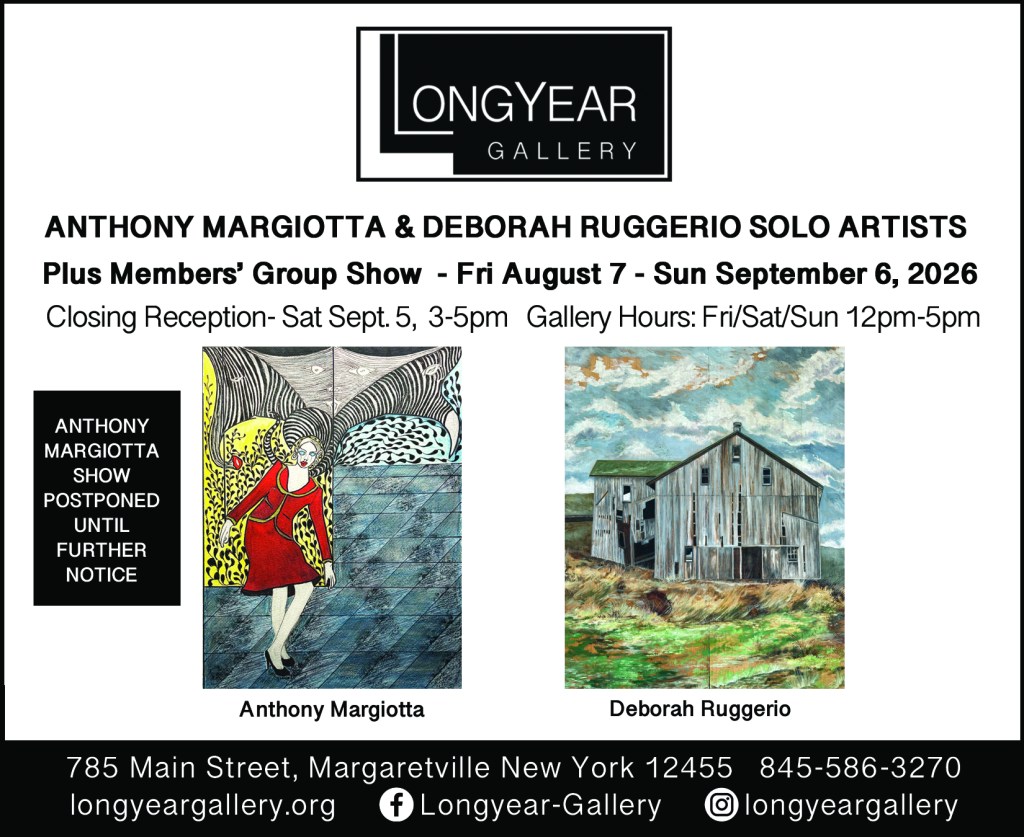
Longyear Gallery of Margaretville is pleased to announce the opening of two new concurrent featured artist solo exhibitions, Anthony Margiotta’s “More Controlled Hallucinations” and Deborah Ruggerio’s “Time as a Canvas,” accompanied by a Longyear Members’ Group Show. Opening on Friday, August 7th, these exhibitions will run through Sunday, September 6th
The ink and gouache pieces in Anthony Margiotta’s new exhibition, “More Controlled Hallucinations,” reveal the artist’s interest in “how humor and the grotesque can coalesce into imagined worlds of visual drama.” According to Margiotta, “The tangential nature of my work is the physical manifestation of how my mind switches from medium to medium. Each switch is an attempt to find a way for the ever-present demons of life to exist within some mesh of prescribed ‘normalcy.’ Within these imagined worlds is the tension between rich patterns and empty space – between the recognizably real and the distorted.”
Anthony Margiotta was born in Saugerties, New York, in 1947. Having no formal training, Margiotta draws inspiration from his surroundings—the dense forests of his home in the Catskill Mountains, the urban landscapes of New York City—and the fantastical formations of his mind. Retiring in 2005, Margiotta and his wife moved to Halcott Center, New York, where he found a flourishing and receptive local arts community. Since moving to the area, Margiotta has displayed his work in a solo show at the Zoom Gallery (July, 2013) and solo and group exhibits at The Arts Upstairs, Phoenicia (2013, 2014, 2015), and in group exhibits at the Woodstock Artist Association and Museum (2013 – Present), where he is a active member. He has been a participant in AMR Open Studio Tours from 2014-2026 and been part of group exhibits in the Commons Gallery, Margaretville (December 2014, April 2015, June 2015); a two-person show at Oreo 9 in Woodstock in May 2015; and a two-person show at New World in Woodstock in November 2015. He has been a member of Longyear Gallery coop since June 2016.
Deborah Ruggerio’s new exhibition “Time as a Canvas” reflects Ruggerio’s belief in “how important it is to take that extra time to take a second look to appreciate the beauty that surrounds us every day. By looking more closely,” says Ruggerio, “you really start to understand how we are all connected to this picturesque planet we call home. I want the viewer to take that extra moment to see how my eyes speak to me.” Ruggerio notes how she is “captivated by the colors and minute details” such as “a decaying barn, still standing so proud with its flaking paint and washed out color or the soft petals of a delicate flower swaying in the wind.”
Deborah Ruggerio enjoys painting in oils and using watercolor to paint plein air weekly with the East Branch Delaware River Plein Air Painters. A member of Longyear Gallery, she has shown her work at the Roxbury Arts Group; Cooperstown Art Association; Gilboa Museum and Jury History Center, Schoharie, NY; Green County Council of the Arts, Catskill, NY; The Green Kill Gallery, Kingston, NY; The Olive Free Library, West Shokan, NY; and Blue Mountain Gallery in New York City. Since 2018 she has participated in the AMR Open Studios Tour, and her artwork was published in the Catskill Cooks: Treasured Recipes and Original Art Book created by the Pine Hill Community Center. Her art is in a variety of private collections in upstate New York, New York City, and in New Jersey.
Future fall 2026 Longyear Gallery exhibits include a Memorial Exhibition highlighting the work of the late fine art photographer Frank Manzo, one of Longyear Gallery’s founding members, running from Friday, September 11th-Sunday, October 11th with the opening reception for the Members’ Group Show on Saturday, September 12th from 3-5 p.m. There will be a closing reception for Frank Manzo’s Memorial Exhibition on Saturday, October 10th, from 3-5 p.m. Longyear’s next show will feature two solo exhibitions by members Temma Bell and Shiela McManus, running from Friday, October 16th-Sunday, November 15th with the opening reception on Saturday, October 17th from 3-5 p.m. All solo exhibitions are accompanied by a Longyear Gallery Members’ Group Show.
Longyear Gallery is located Downstairs in The Commons, 785 Main Street, Margaretville. The gallery will be open from 12 a.m. – 5 p.m. Fridays, Saturdays, and Sundays. For information, please see Longyear Gallery’s website, email the gallery at info@longyeargallery.org, or call 845.586.3270 during gallery hours.
The solo show of Longyear member Alan Powell, which runs this month through August 2, as does the solo exhibition of fellow member Irina Grinevitsky, is unusual in that it is a sculptural installation.
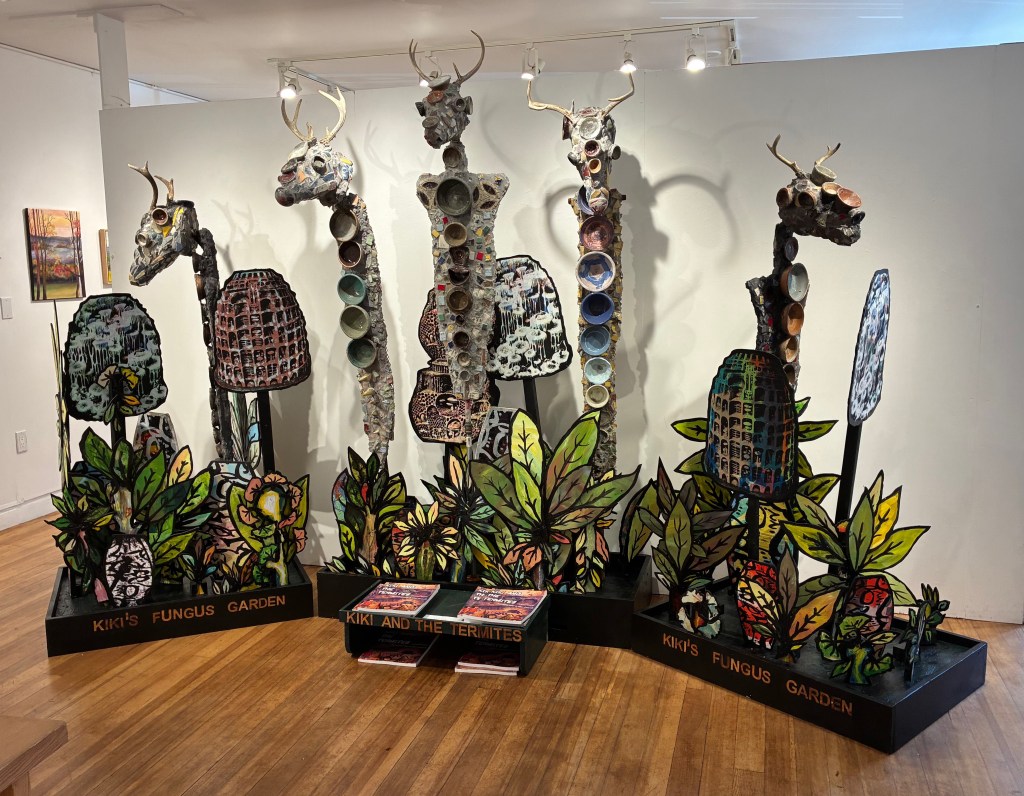
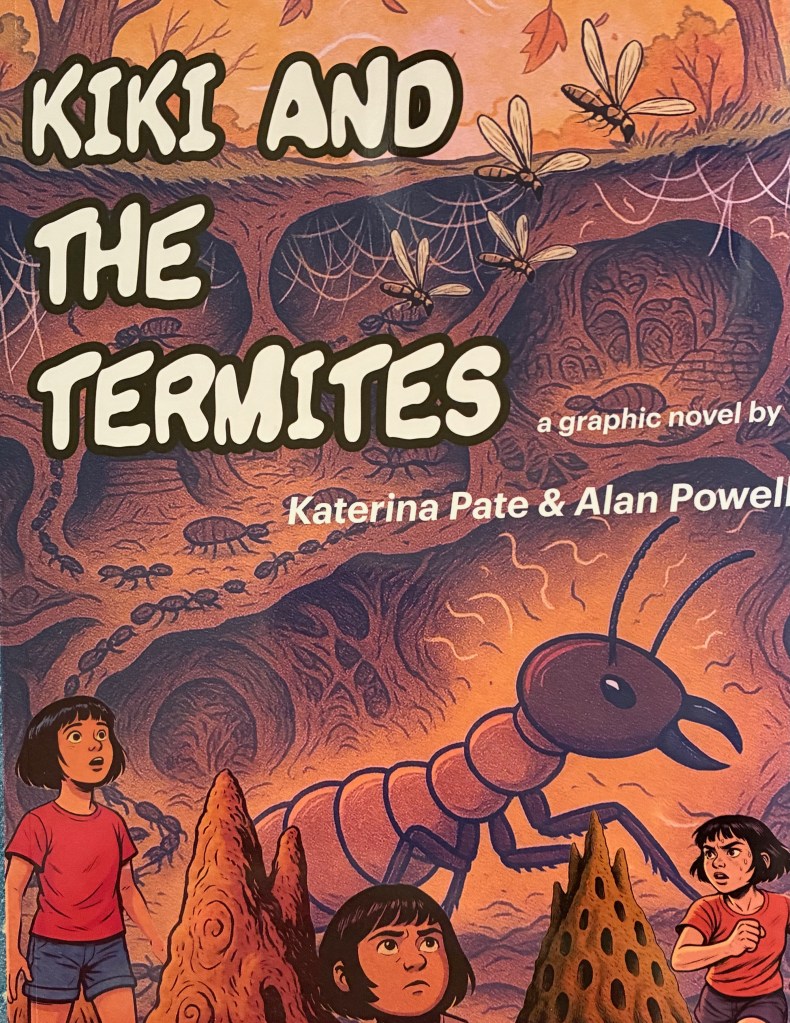
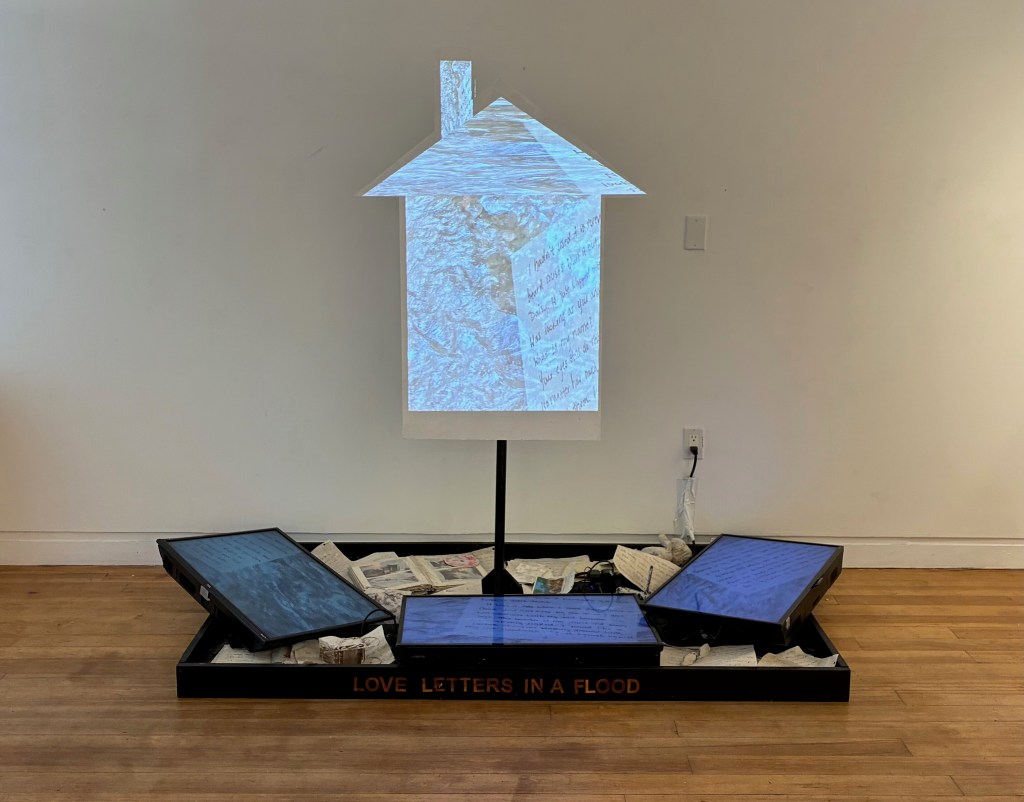
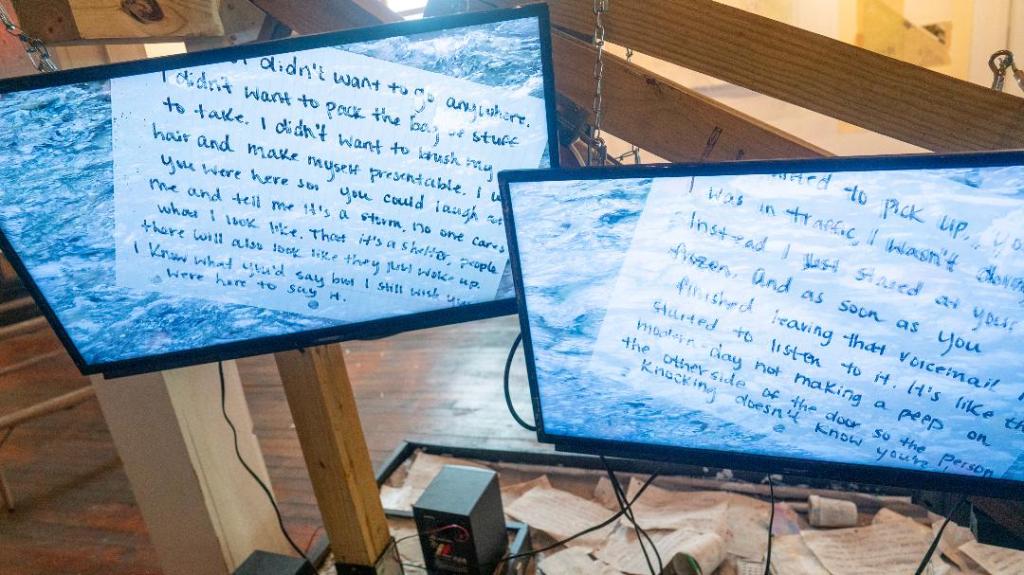
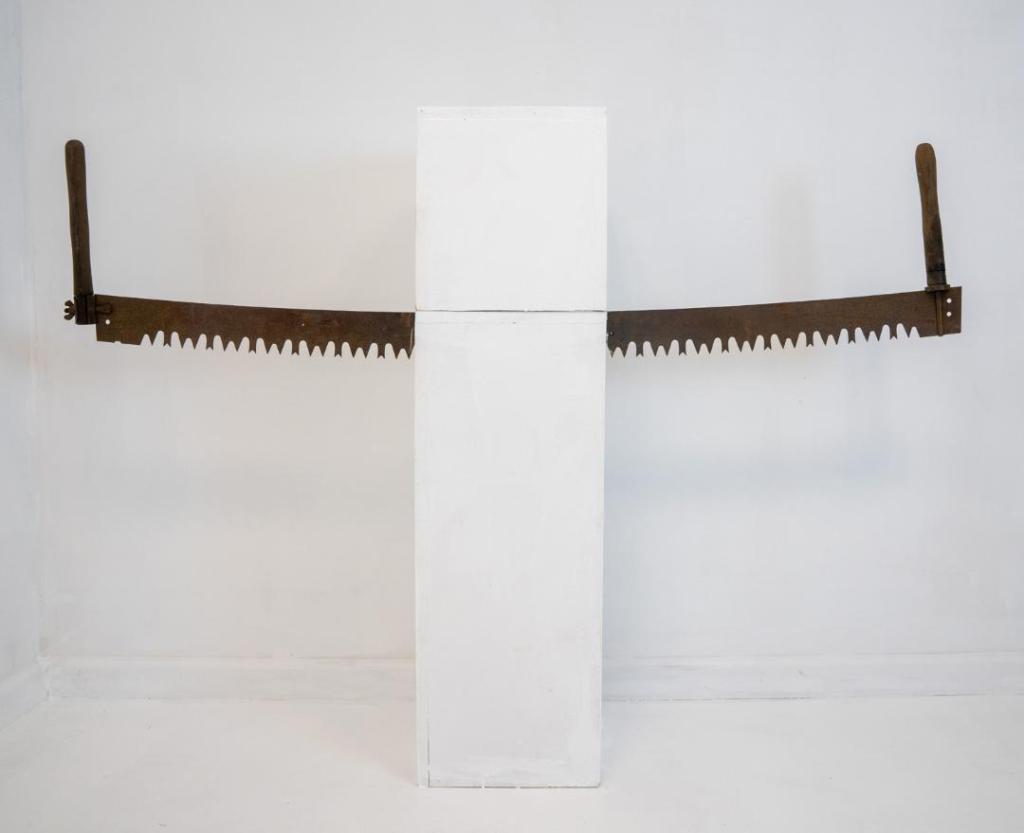
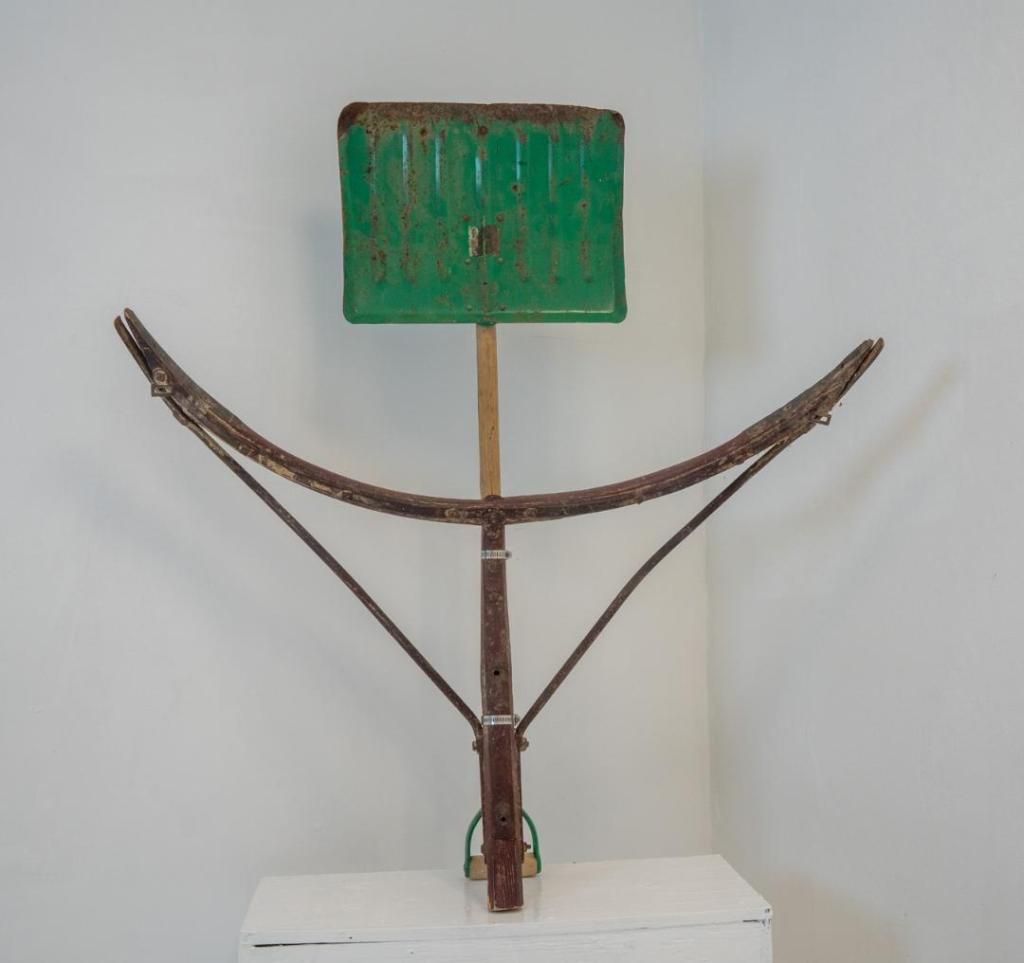
The star of the show is an assemblage of several figurative sculptures crafted of deer skulls, cement, pipes, and ceramics positioned within a conceptual “garden,” entitled “Kiki and the Termites,” derived from a graphic novel Alan wrote with Katerina Pate. On the adjacent wall is a video installation entitled “Love Letters in a Flood” in which multiple screens, one in the shape of a house, pivot up from a base re-creating the floor of a flooded house; the letters appear on the screens, accompanied by a soundtrack of a woman reading them aloud. On the opposite wall are sculptures comprised of old tools, a couple of which humorously resemble parts of human anatomy. Rounding out the exhibition are five abstract monotypes incorporating old records. Recently retired as professor emeritus from Arcadia University, where he taught communications for over 20 years, Alan has devoted his time to making new work, and the show is impressive evidence of his ability to translate imaginative ideas, which often have a socio-political or ecological bent, into artworks incorporating a variety of media.
“Kiki and the Termites” is an amazingly complex work, which Alan has been working on for over a year. The theme of termites relates to Termite TV, a Philadelphia-based multimedia collective of which Alan was a founding member and current board member (he was a pioneer in video art, having earned one of the first BFAs in the film and video at the Rhode Island School of Design). Inside their vast hives, termites compost vegetative material and their poop into chambered gardens, a model of sustainability the cooperative embraced, “eating through the culture to sustain itself” in much the same way, Alan explained.
The installation is accompanied by copies of the graphic novel, which traces a narrative of a girl in a flooded house trying to communicate with termites to save her doomed community from a rapacious developer. But you don’t have to read the novel to appreciate the totemic power of the five sculptural figures. (The skulls were sourced from a place Alan discovered in the forest near his home in Fleischmann’s where “deer go to die,” as he describes it.) They are arranged in three large rectangular planters, inscribed with “Kiki’s Fungus Garden,” in which a thick assortment of leaves and flowers protrude, each leaf fashioned from a silkscreen print glued onto a shaped wood piece.
Their muted green, red, bronze, and yellow tones with delineating black lines have a graphic quality, giving their dimensionality a theatrical quality, as if they were a set piece for a comic book coming to life. Rising above the plants are several depictions of termite hives, whose imagery of porous, labyrinthian structures suggests architectural ruins, an effect the artist achieved through layering. The amount of complex image making that went into the piece is astounding, and that’s not even including the graphic novel, whose hundreds of cartoons were created by the two collaborators by “feeding photos and drawings and descriptions into AI,” which then generated back the images, according to Alan. (The imagery of the hives was achieved in a similar way, while Alan sourced the ceramics from Arcadia’s ceramics department.) The piece was shown last year at the Philadelphia Art Pier in an exhibit entitled “Understory.”
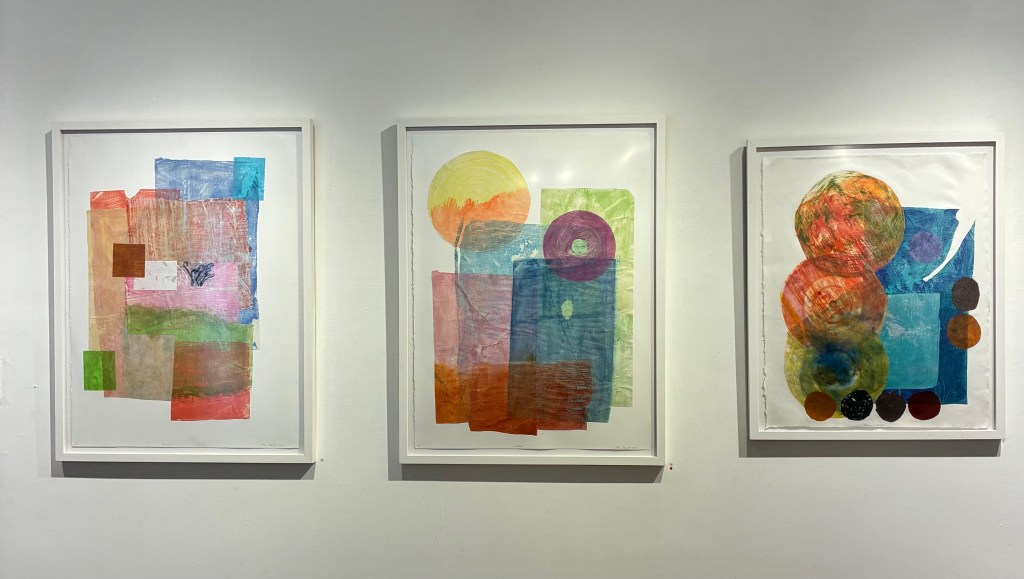
The five abstract monoprints, hung on the opposite wall, are pleasing in their earthy, translucent color harmonies and simple geometric shapes; some of the circles consist of actual 45s affixed to the surface, while the rectangular colored shapes were printed from pieces of discarded wood, revealing the texture of the wood grain. “I try to develop a way of working with nature that’s not a pretty landscape, but rather has a dialog with nature,” he said. “I struggle to make a direct relation with nature into my art.”
“Love Letters in a Flood” tells a narrative that was created for the Prattsville Art Center. Inspired by the account of a young woman who was trapped in her house for six hours in the 2011 flood, he instructed Katerina to lock herself in a room for six hours and hand-write a love letter to her boyfriend, imagining herself as that young woman from Prattsville. He then recorded her reading it, accompanied by sounds of rushing water, and photographed the pages of the letter, animating them (through some video technology wizardry) to create the illusion they are floating downstream in a seven-minute loop shown on the four video screens. The final step was creating a base simulating the flooded floor of a house, with actual objects, such as a Christmas tree ornament and photo albums, scattered on a mud base. Contemplating the piece, we are voyeurs, listening in and glimpsing written phrases in a private communication, even as the women’s mundane musings unfold within the context of a disaster—a situation becoming increasingly the norm in a country battered by floods, ferocious storms, wildfires, and extreme heat.
Alan’s readymades, in which he transformed discarded tools from his barn into sculptures, was originally part of a pop-up show held in an abandoned hardware store in Roxbury. Four of the five pieces are supported on white wooden bases resembling tombstones with their chiseled inscriptions, alternatively commemorating an eco-crisis or lampooning the manosphere (i.e. “Daddy’s Chastity Belt,” “Green Hockey Stick with Green Balls”). As in much of Alan’s work, the formal elegance and handsome aesthetics of his art seduces us into an experience tinged with irony as he reveals and explores the underlying anxieties that inform these troubled times.
My Kitchen in BrooklynSwings in the Park
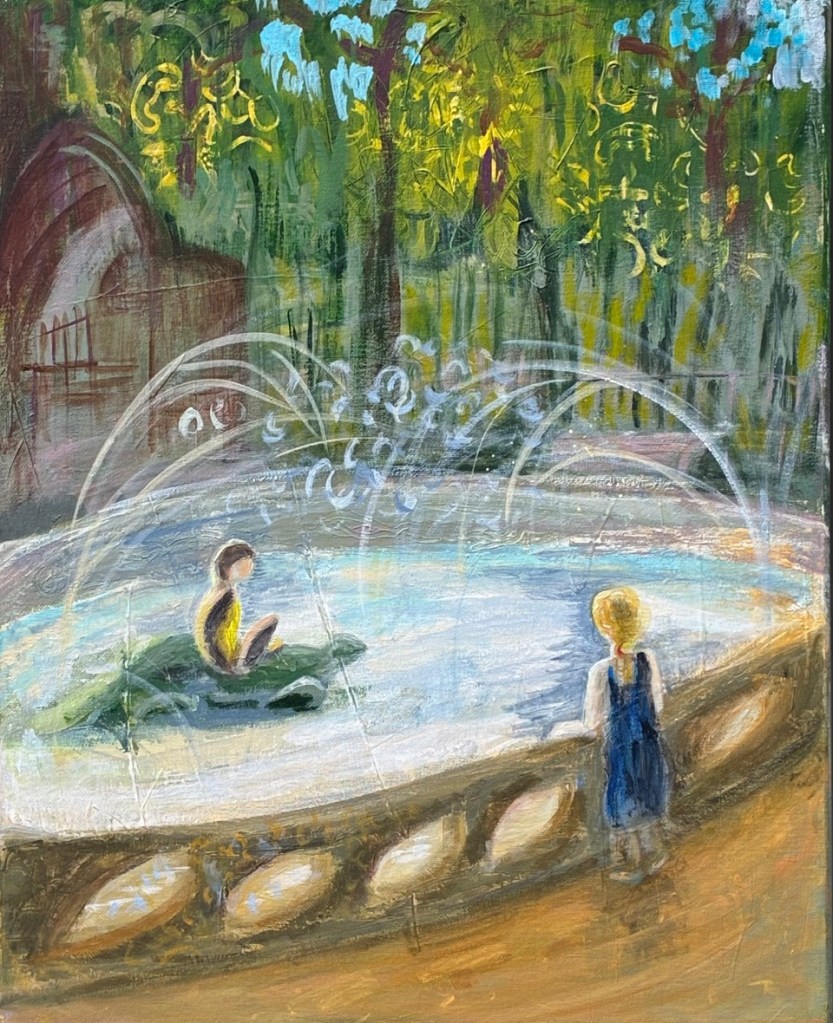
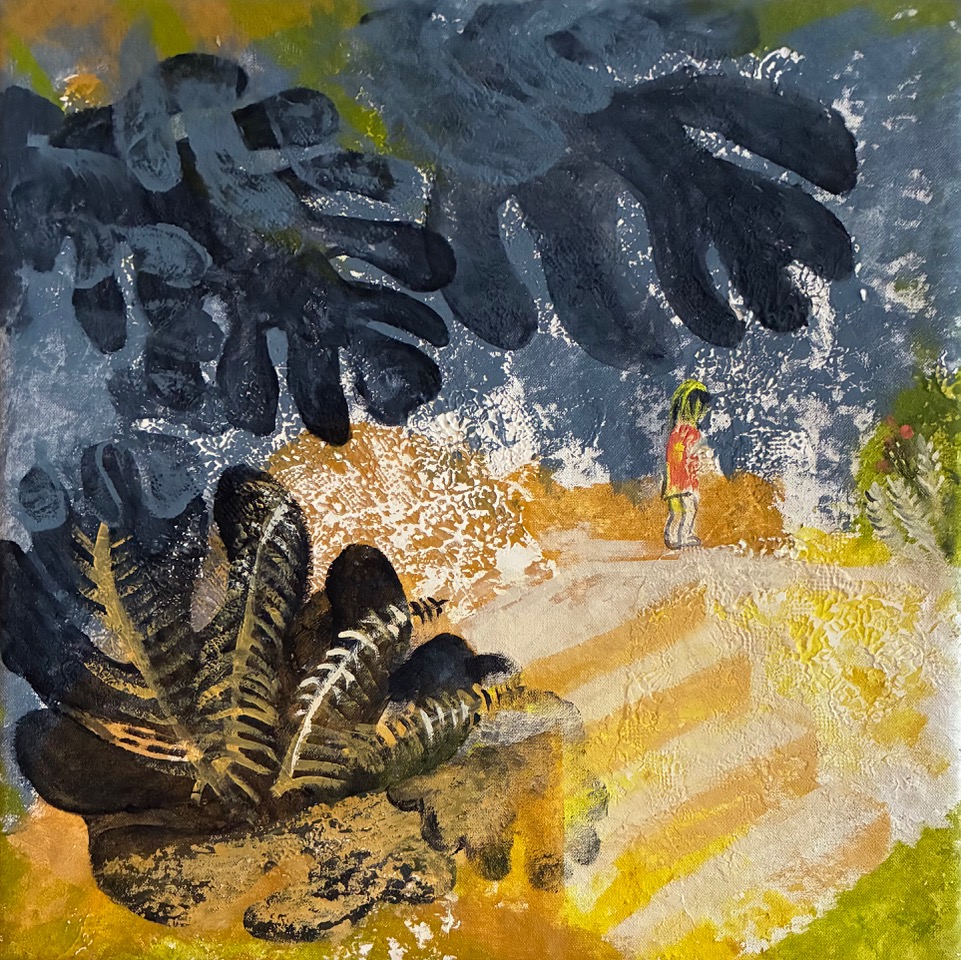
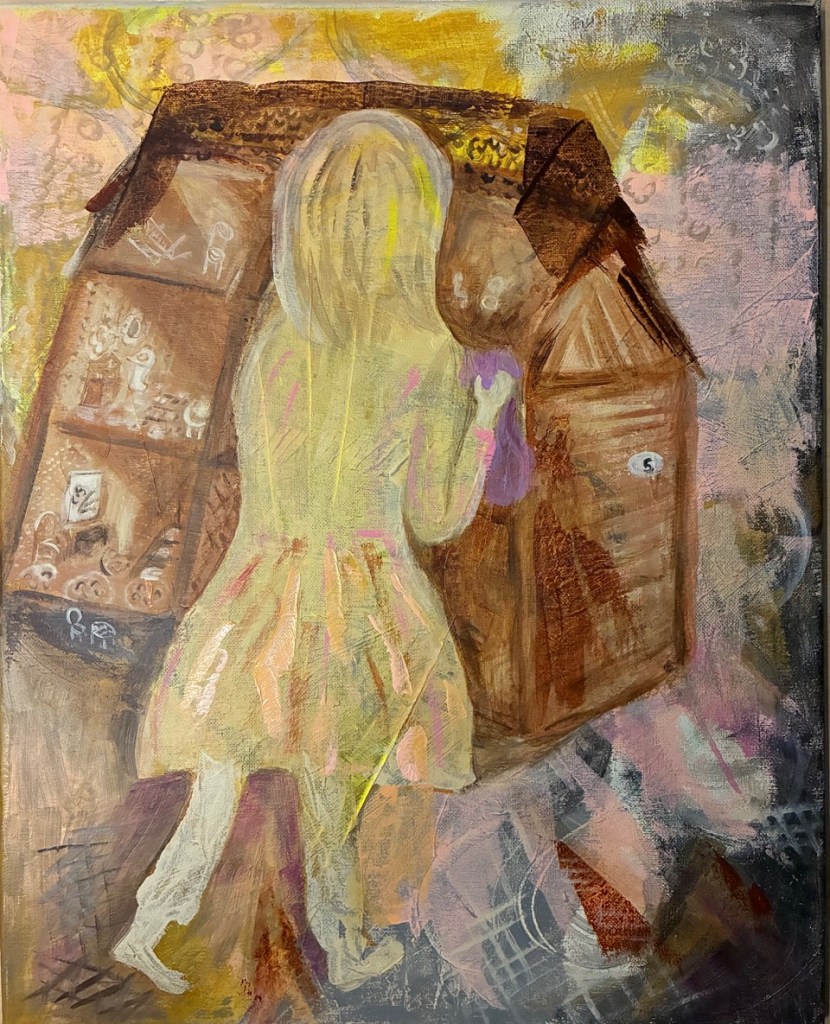
Irina Grinevitsky’s second solo show at Longyear, entitled “Playground,” consists of 35 acrylic paintings and mixed-media works depicting New York City’s parks, backyards, and gardens– not as green spaces hemmed in by concrete but as magical domains where fountains splash, children play and dream, and hammocks sway. “My idea is to see New York through its playgrounds, how children and people communicate in these spaces,” she said. “Besides skyscrapers, the city has a lot of green spaces, which inspired me to watch my granddaughter playing”—the subject of many of her works. One is reminded of the fetes of Watteau, although instead of elaborately costumed courtiers, the main protagonist is a young girl, often shown alone, in a contemplative pose, in the house as well as playground. “I wanted to show a mood, of a girl sitting by herself … she is a little bit lonely.”
The parks painted by Irina include McCarren, Josepha C. Sauer, Fort Greene, and Herbert Von King. Besides leafy playgrounds, in this body of work she has depicted a blooming magnolia and the parks in winter, in which trees cast long shadows and a hill is covered in snow. Even her industrial scenes are imbued with lyricism: inspired by old photographs of water towers, the mixed-media works were created by a special technique, derived from ceramics, in which the artist pressed lace, fabric, and other objects covered in paint onto gesso, forming a kind of relief. The patterned textures dematerialize her depiction of brick and concrete walls. They appear to have been painted on old tin ceilings, lending an antique quality.
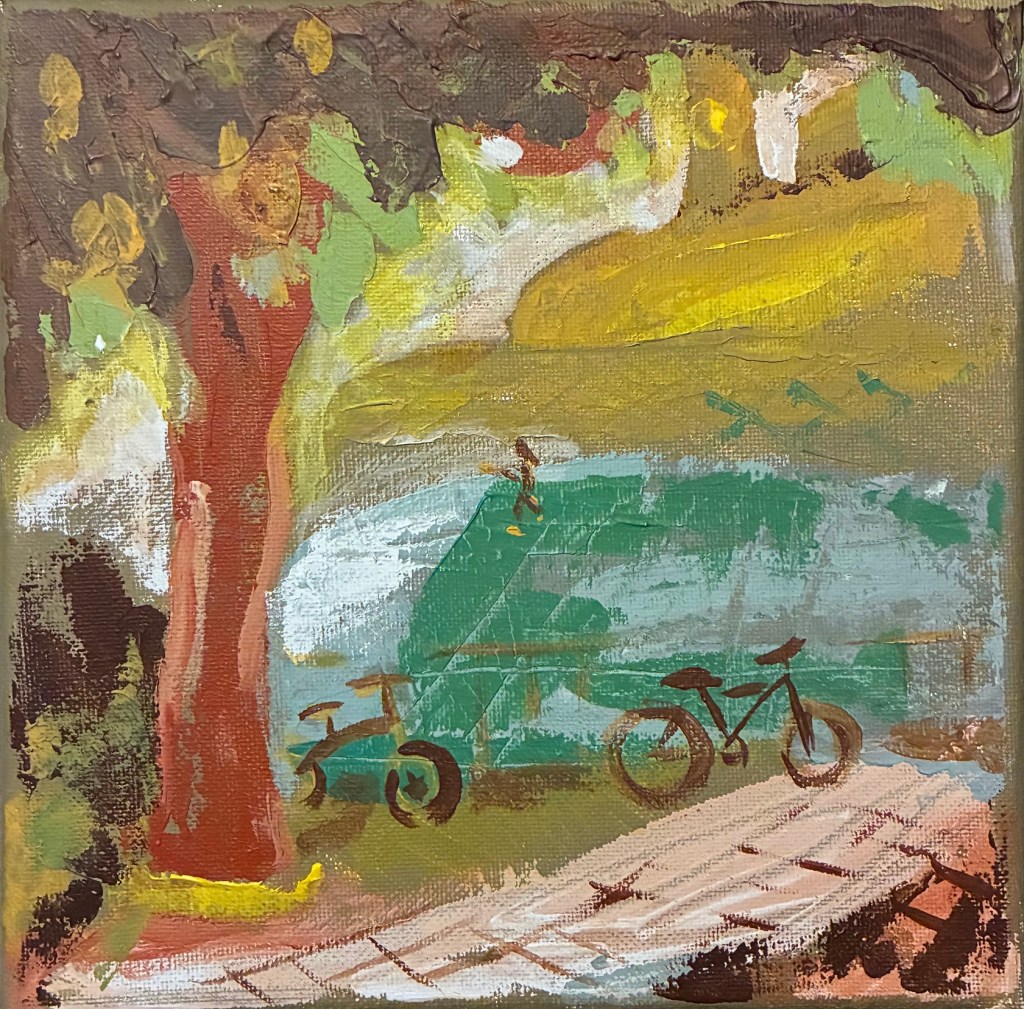
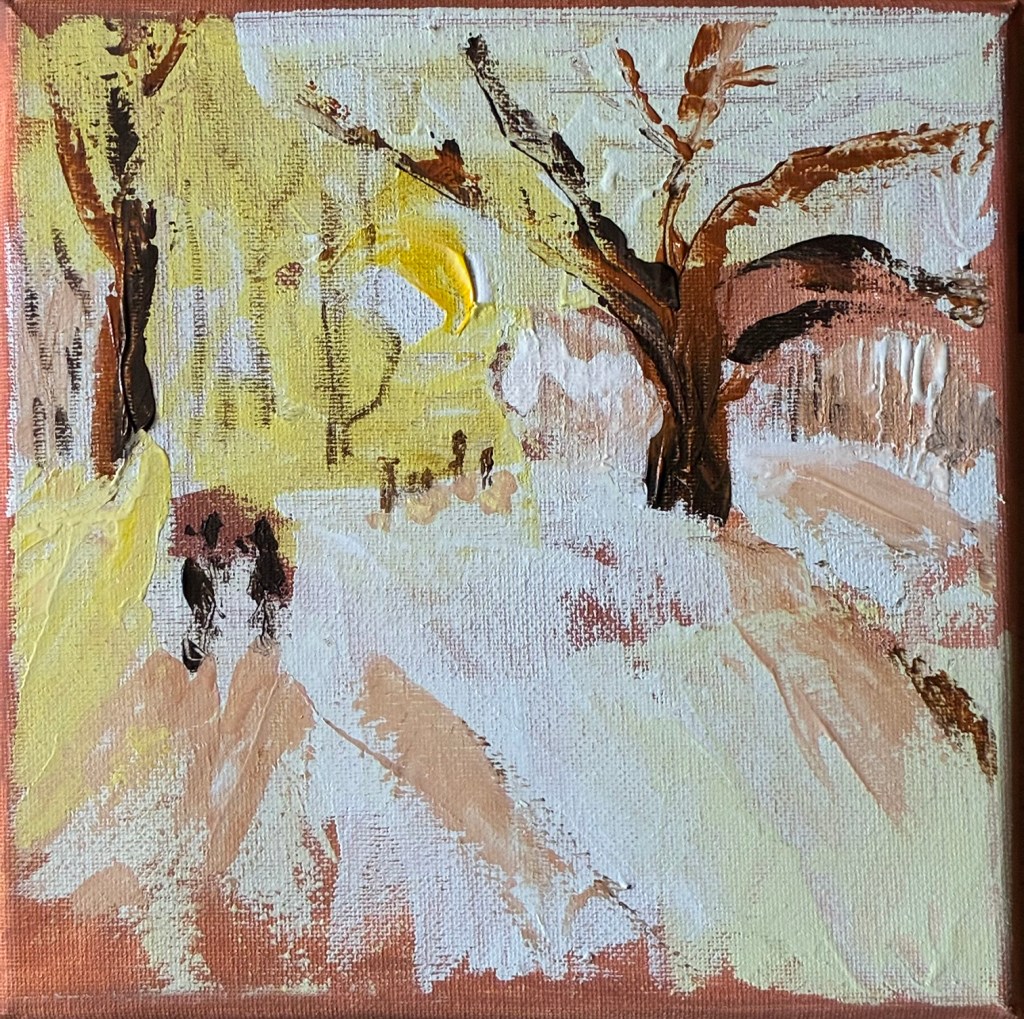
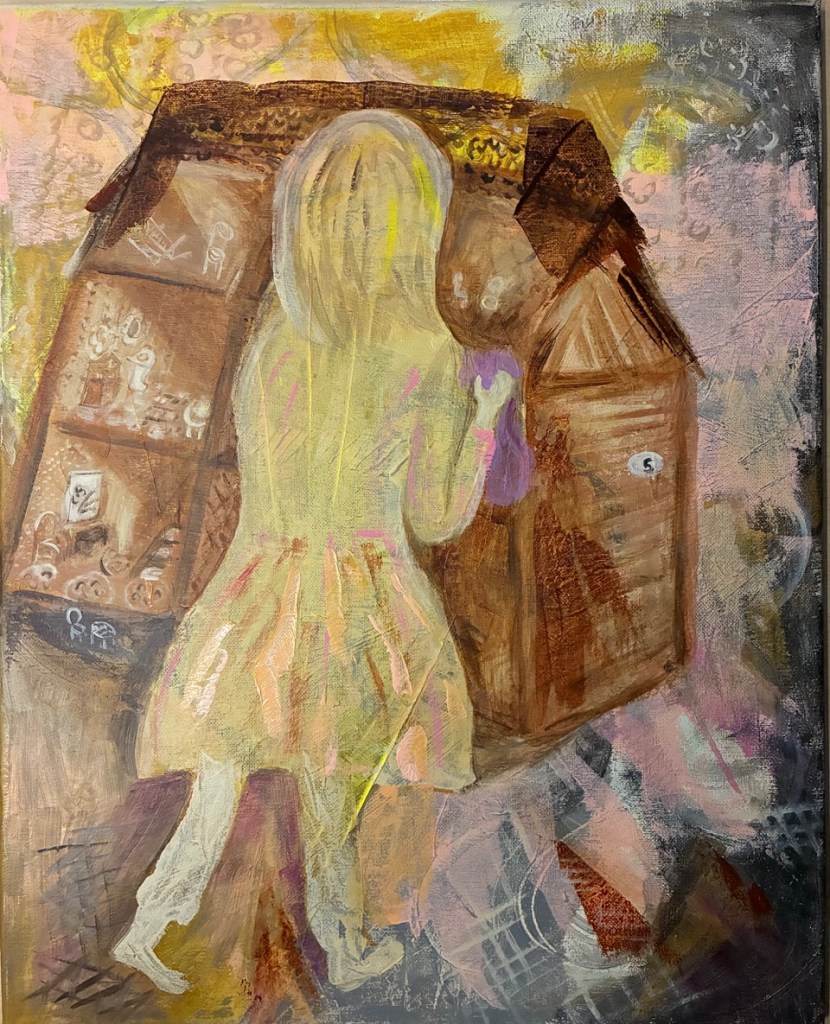
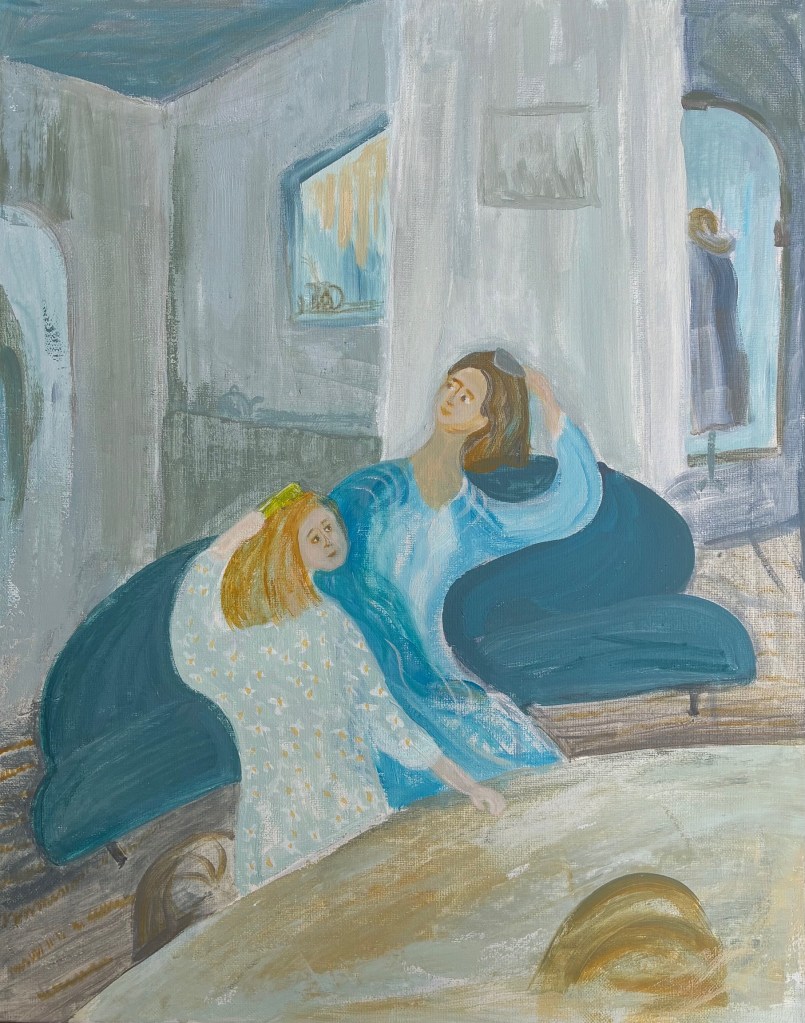
In other works, such as “Doll House” and “Blue Evening,” she first made a collage, using different papers and colors, before making the final painting. Inspired by Matisse’s cutouts, she traced the shape of the two figures in “Blue Evening” from cut paper onto the canvas and then painted them. The figures form two graceful arabesques, a musical counterpoint to the geometric structure of walls and windows in the background. The image was based on a photograph of herself and her granddaughter brushing their hair, a mundane activity she transforms into a kind of dance. In yet another series of smaller, 8×8” paintings, Irina portrays trees and lawns in bold, gesturing brushstrokes. The colorful compositions verge on abstraction.
Born and raised in Moscow, Irina graduated from Moscow State University with degrees in science and math. Although she worked as a computer programmer, she inherited an interest in crafts from her father and sold her wooden and leather jewelry during the holidays. She also was a ceramist and after moving to Chicago in the 1990s, participated in annual shows. In 2004 she and her family moved to New York City and later bought a house in Halcottsville. Since 2015, Irina has published an annual calendar featuring her artwork and has also published her illustrations in numerous regional publications. Besides painting, community gardening, which she does in her neighborhood of Bed-Stuy, is also a passion. “I try to work every day on watercolors”—a selection of which are included in her show.
OPENING RECEPTION: SATURDAY, JULY 4th from 3-5 p.m.
Longyear Gallery of Margaretville is pleased to announce the opening of two new concurrent featured artist solo exhibitions, Irina Grinevitsky’s “Playground” and Alan Powell’s “Kiki and the Termites,” accompanied by a Longyear Members’ Group Show. Opening on Friday, July 3rd, these exhibitions will run through Sunday, August 2nd with the Opening Reception on Saturday, July 4th from 3-5 p.m.
Irina Grinevitsky’s McCarren Park
Irina Grinevitsky’s new solo show “Playgrounds” reflects the artist’s search “to capture the beauty found in everyday objects and places.” As Grinevitsky explains, “Inspiration hides around every corner of the city – a vast playground filled with unexpected joy in color and shape, movement and stillness. My work is figurative, and through it I hope to tell stories from the real world.” A visual artist based in New York City, with her summer studio in the Catskills, Irina Grinevitsky works in mixed media on canvas and hardboards in a variety of sizes. Although her background is in science, art and crafts have always been central to her life. She has explored ceramics and gardening, drawing and textile design, painting and collage as both creative practice and meditation.
While living in Illinois, Irina Grinevitsky studied with distinguished ceramics artists at the Evanston, Highland Park, and Lake Forest Art Centers, where she participated in annual exhibitions. She has also designed jewelry and functional objects using wood, ceramics, and leather. Irina continues her art education online through the Moscow Tarutina Art School. Recently, Grinevitsky has painted with the plein air group EBDRPAP, showed her work as a Longyear Gallery member, and participated in annual AMR Open Studio Tours since 2019. Her illustrations have appeared in printed publications including The Catskiller, Kovcheg, and Almanach. Grinevitsky’s works are held in private collections in Boston, Chicago, New York City, Juneau, and internationally. This is her second solo show at Longyear Gallery in Margaretville, NY.
Swings in the ParkMonsteraDoll HouseMy Kitchen in BrooklynAlan Powell’s Kiki and the Termites Installation
Alan Powell’s new solo exhibition “Kiki and the Termites” explores the artist’s profound connection with the forest and nature that he rediscovered after moving to the Catskills in 2013, According to Powell, his work “regularly incorporates material from the surrounding terrains, from lithographs of dried leaves or mushrooms and installations caked in mud and residue to provide a faithfully tactile component.” It is his belief that, “It’s important that as an artist, I develop work about nature that goes beyond its physical beauty and shows a deep attentiveness to the balance between human presence and the natural world. I have also started to use the technologies of 3-D imaging and modeling as a way of documenting the forest or a wetland. Electronic technology has allowed me ways of defining a natural space using time, sound, and motion. My videotapes no longer function as experimental narratives but electronic paintings that change over time. Today my work is mostly retrospective, simply looking, using image and sound processing to enhance and personalize a documented experience, and the camera lens as a window to the world around us.”
Love Letters in a Flood_InstallationThe Saw That Boke the CatskillsBad Storm ComingDaddy’s Chastity Belt
Alan Powell is a visual and electronic media artist based in Fleischmanns, New York. His fifty-year career encompasses sculpture, painting, and experimental videography as well as multichannel installations and audio compositions. He received a master’s degree from the Mason Gross School of Art after completing his undergraduate work at the Rhode Island School of Design. Now a professor emeritus at Arcadia University, Alan has also taught at the Rhode Island School of Design and Temple University as well as instructed computer animation and video at the Hunterdon Museum of Art. His thirty-year collaboration in video work with Connie Coleman has been exhibited at The Kitchen, NYC; The Museum of the Moving Image, NYC; The Philadelphia Museum of Art, PA; The Long Beach Museum, CA; and the Musée d’Arte Moderne, Paris and is archived at Cornell University Library. He is currently a board member at TermiteTV, a Philadelphia based collective, and Signal Culture in Loveland, Colorado.
Future summer and early fall 2026 Longyear Gallery exhibits include two concurrent featured artists solo exhibitions by members Anthony Margiotta and Deborah Ruggerio, opening on Friday, August 7th and running through Sunday, September 6th, with the opening reception on Saturday, August 8th from 3-5 p.m. followed by a Memorial Exhibit highlighting the work of the late fine art photographer Frank Manzo, one of Longyear Gallery’s founding members, running from Friday, September 11th-Sunday, October 11th with the opening reception on Saturday, September 12th from 3-5 p.m. All solo exhibitions are accompanied by a Longyear Gallery Members’ Group Show.
Longyear Gallery is located Downstairs in The Commons, 785 Main Street, Margaretville. The gallery will be open from 12 a.m. – 5 p.m. Fridays, Saturdays, and Sundays. For information, please see Longyear Gallery’s website, email the gallery at info@longyeargallery.org, or call 845.586.3270 during gallery hours.
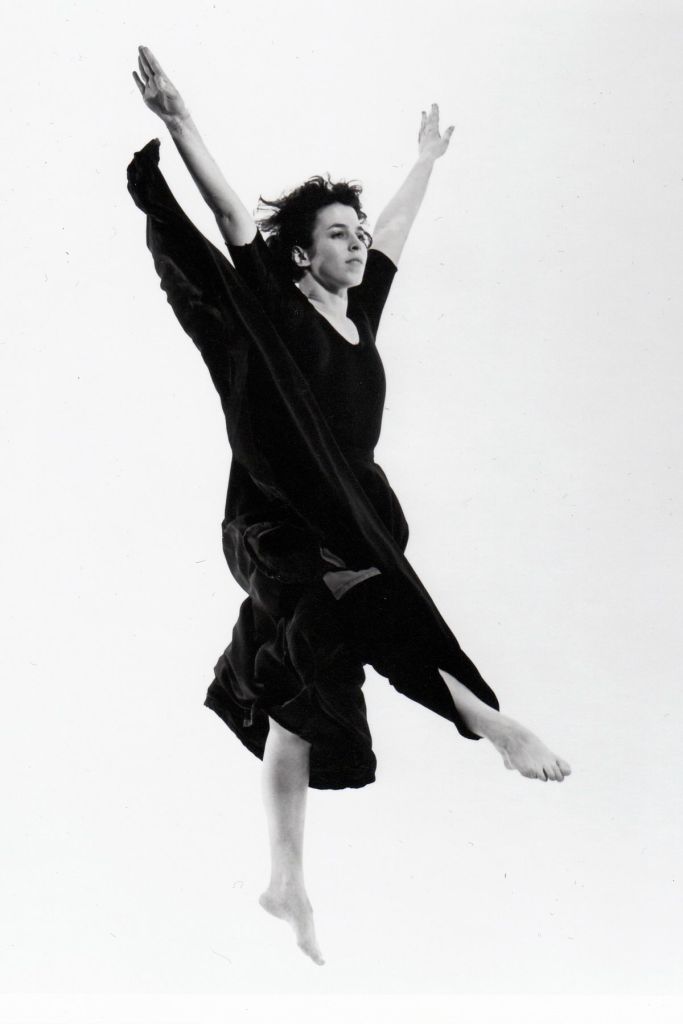
As a New York City-based Pilates teacher and former dancer and choreographer, Lesley A. Powell has a deep connection with the movement of the body. In 2016, after establishing a large studio in the attic of the Victorian house in Fleischmanns she shares with her brother and fellow Longyear Gallery member, Alan Powell, she began painting in earnest, and not surprisingly one of her favorite subjects has been bodies in motion.
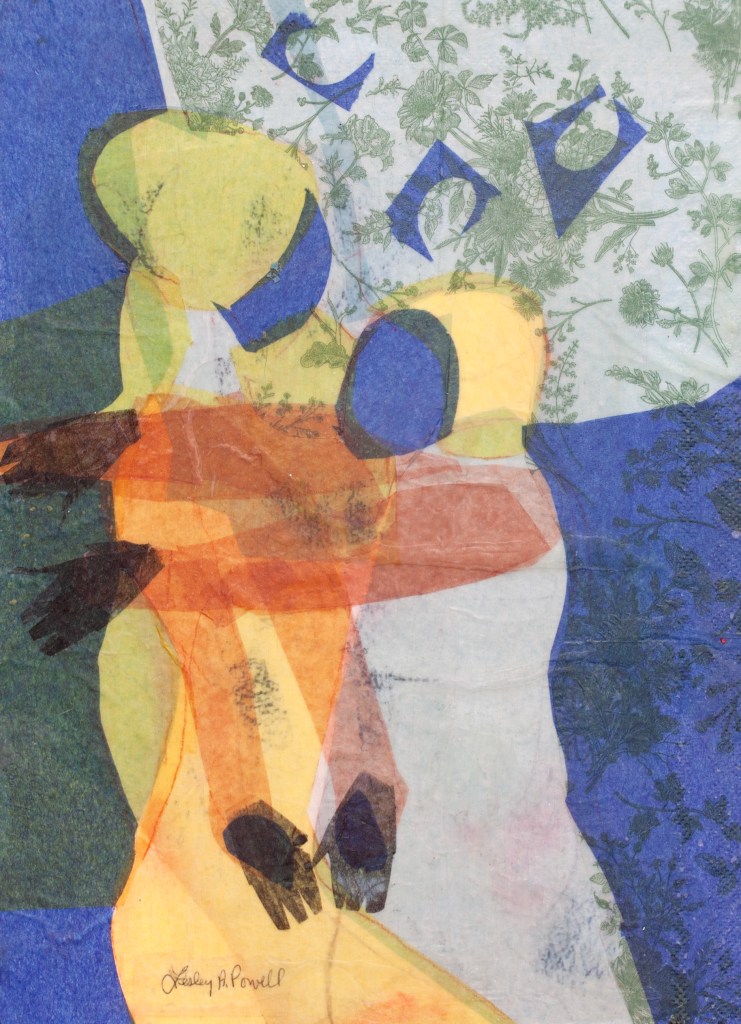
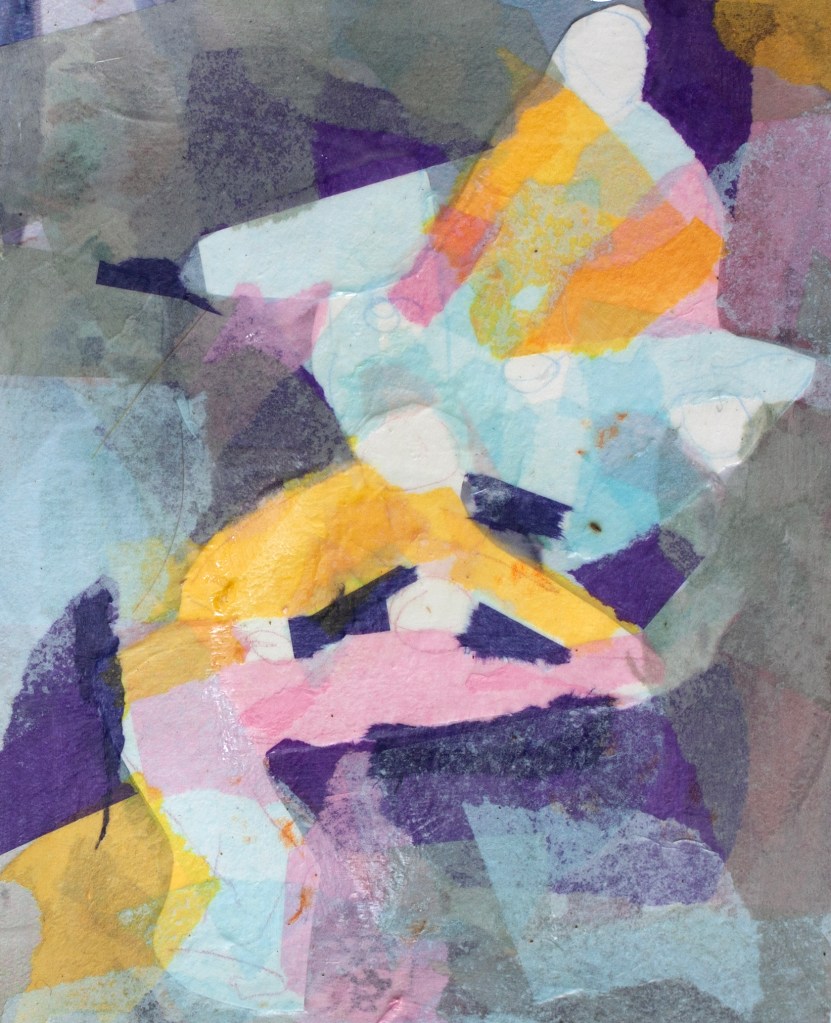
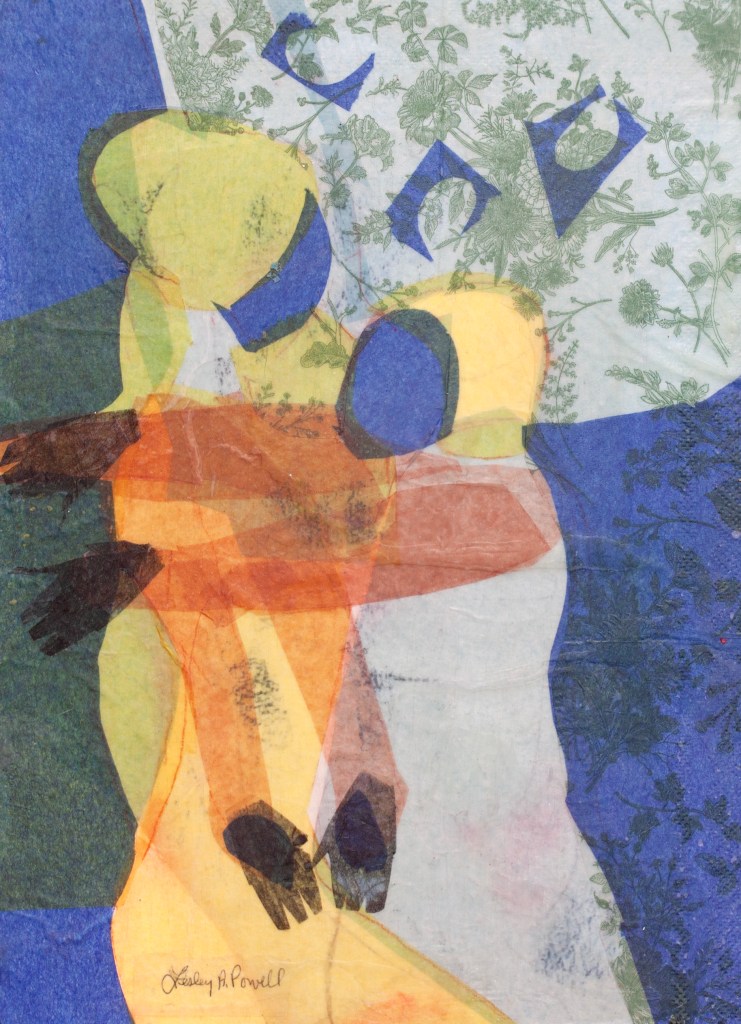
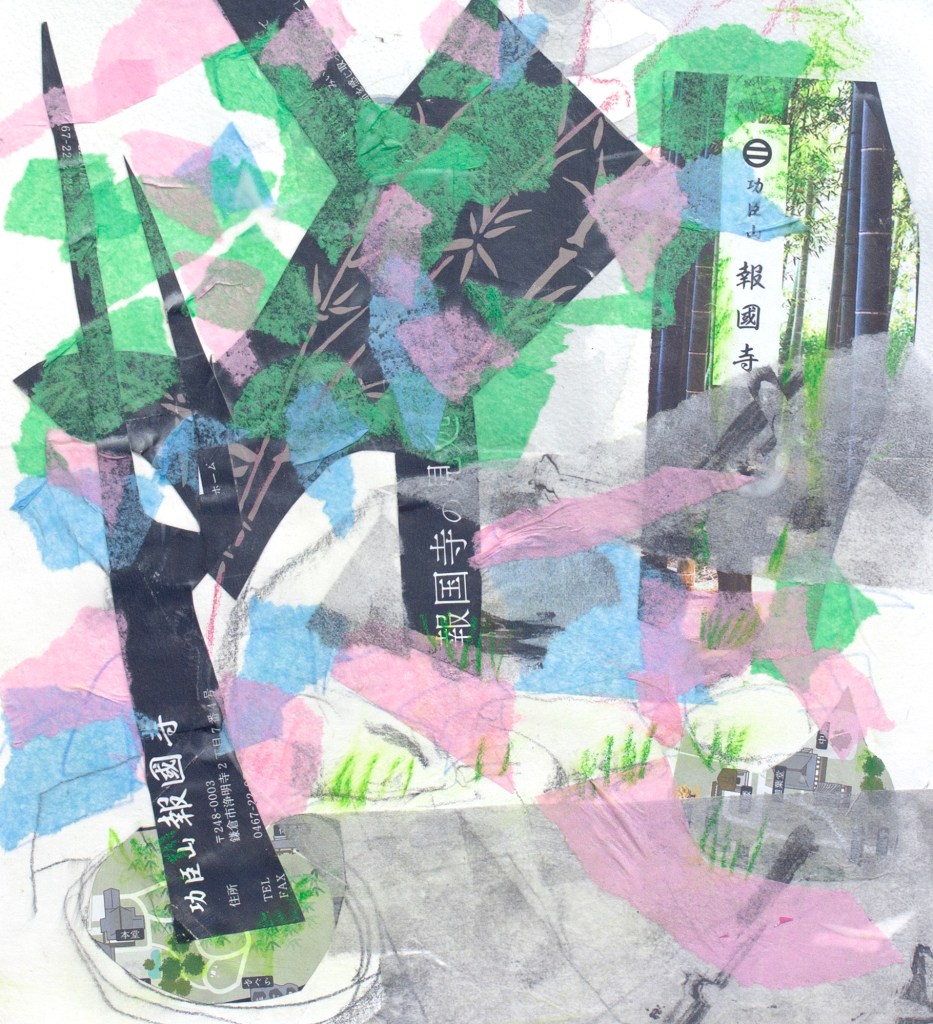
Her current solo show at Longyear Gallery, entitled “Jux Ta Position,” further explores the theme, albeit mainly in the medium of collage. “Sometimes I’m too even with paint, and doing the collages freed me,” she says. Lesley experimented by layering her paintings in watercolor and acrylic with tissue paper; in other pieces, she printed photographs of her figure drawings on rice paper and built up the image with oil pastel, tissue, ribbons and acrylic paint or encaustic.
Unwanted Embrace
The resulting beautiful transparencies of her fragmented color shapes suggest a space that is rich with subtle tonalities, like prismatic ocean depths. Some of her compositions, with their angled or curved gravity-defying figures, suggest the frenetic energies of German Expressionism; I was also reminded of the early 20th-century watercolors of circus performers and Berlin nightlife by American artist Charles Demuth. It’s as if she had channeled the spirit of dance into her very process.
Two Pilates Sessions
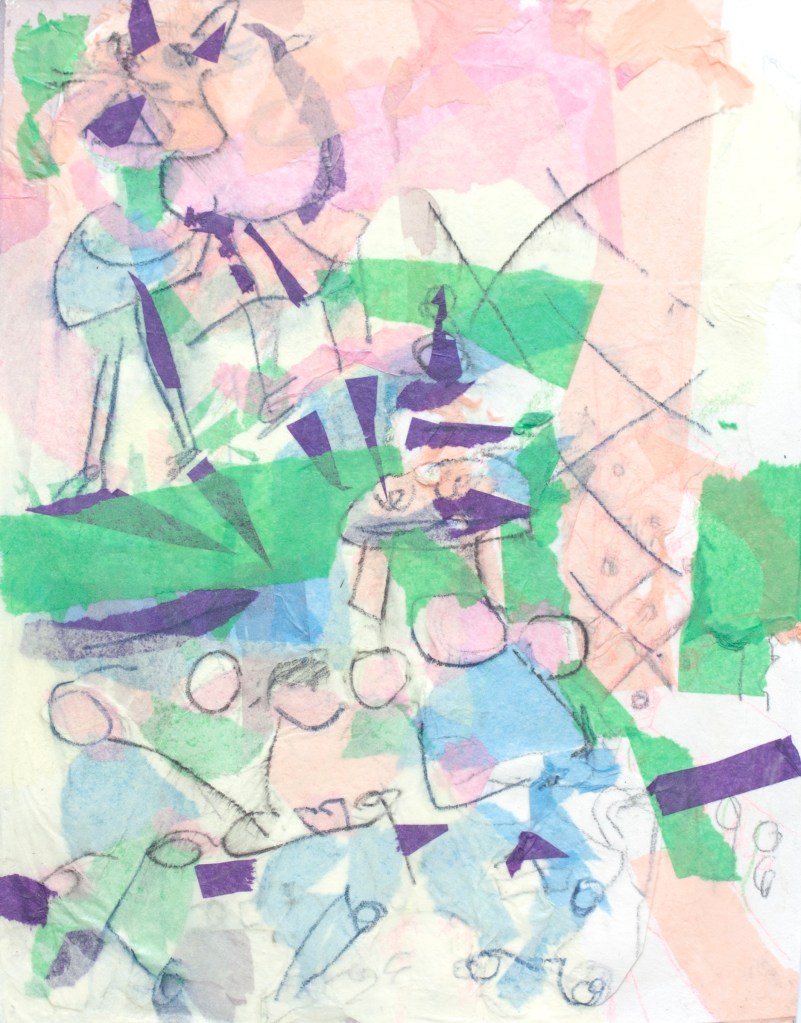
Some of her figures are derived from drawings made at her Pilates studio, others from quick life-drawing sessions, in which she drew two models at once. Yet another inspiration was cowboys riding a mechanical bull: these two pieces are infused with violence, the thrown bodies perhaps alluding to one’s sense of political despair and rage, a shift from the otherwise lyrical tone of her work. There are also scenes of gardens and temples observed on her recent travels to Japan and Nepal as well as in Central Park. An oil painting of a large striped cat meowing at a group of people seated on a bench in the foreground is cartoony, almost comical—it was inspired by a temple Lesley visited in Katmandu– while the image of a floating figure in a pool derived from her forced stay at her hotel in Katmandu due to the riots.
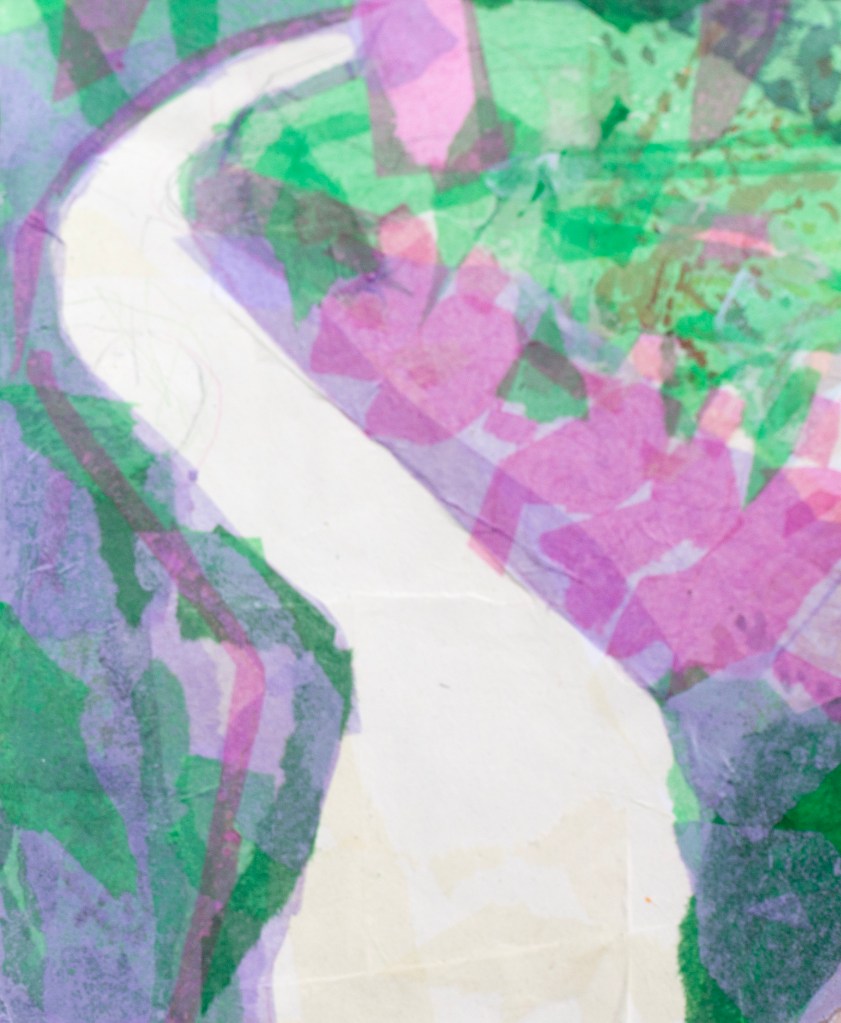
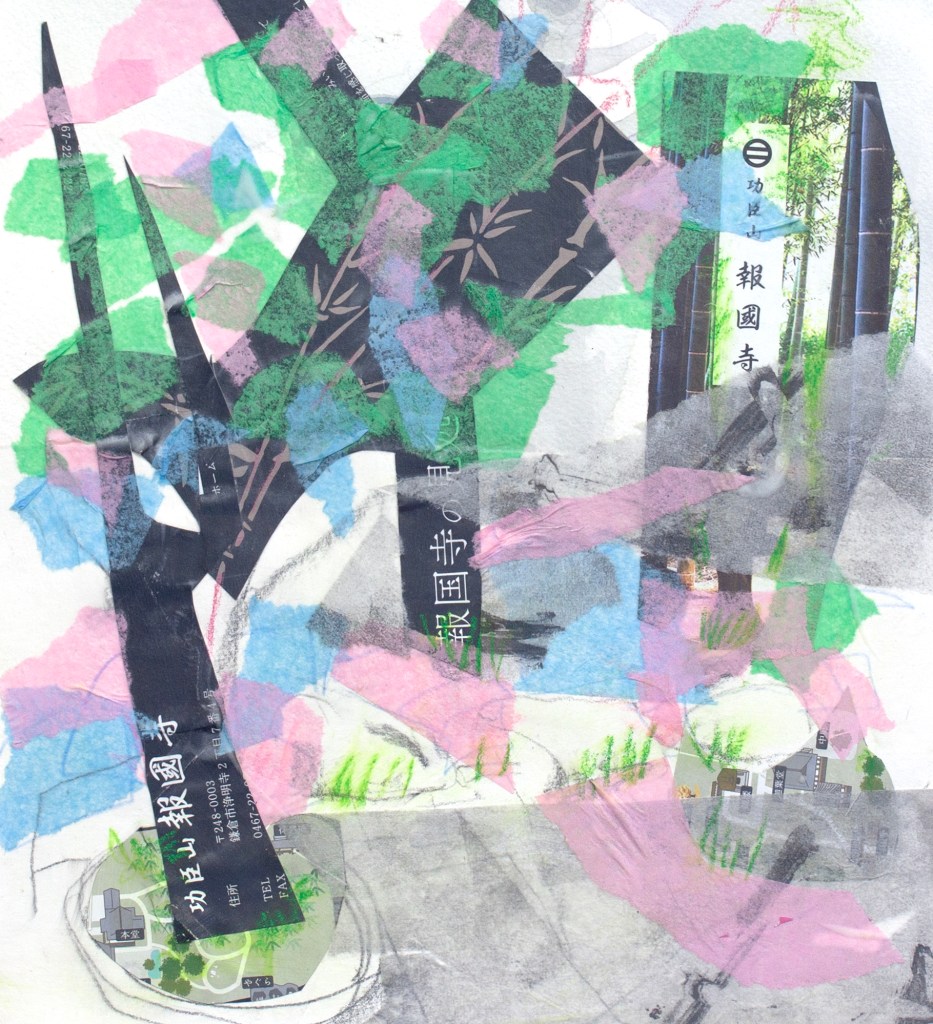
There are Hindu goddesses; purple figures seated on a bench along a winding white path, merging into the delicious green shade of Central Park; a delicate depiction of a Japanese bamboo garden; flags strung over the head of two yellow deities; and twin girls kicking soccer balls in a field described as a patchwork of subtle greens, blues, and dull pinks, the line of dark evergreens in the background indicating this is home, the Catskills. Lesley says she usually limits her palette to three colors, delicately mixing them to achieve her Klee-like gorgeous harmonies.
Walkway in Central ParkBamboo JapanKathmandu
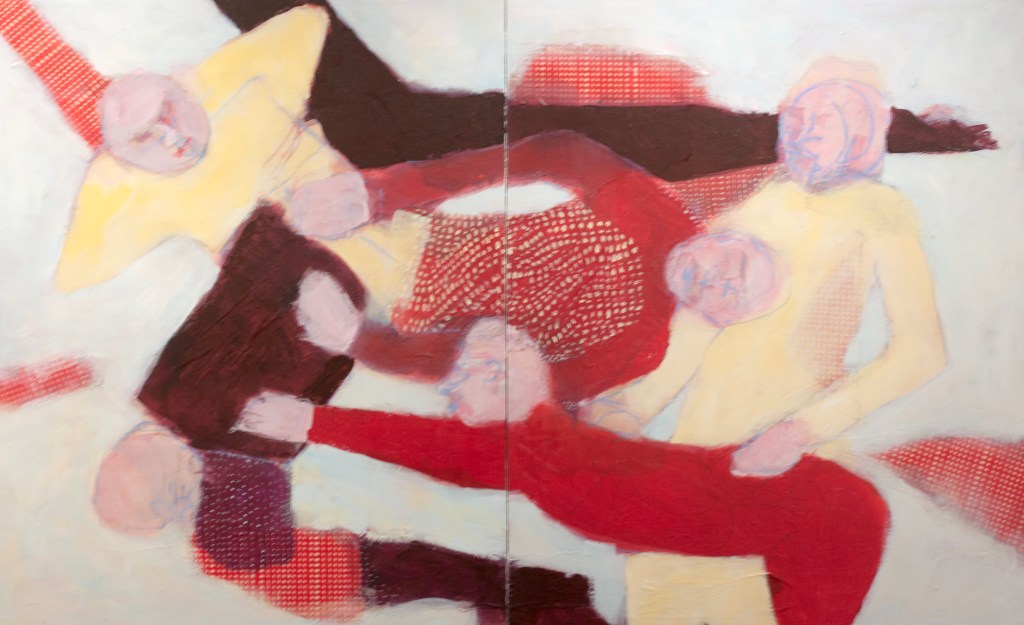
Two anomalies in the show are the large oil diptych of groping figures, entitled “Hands On/Off?”
Hands On/Off?
and
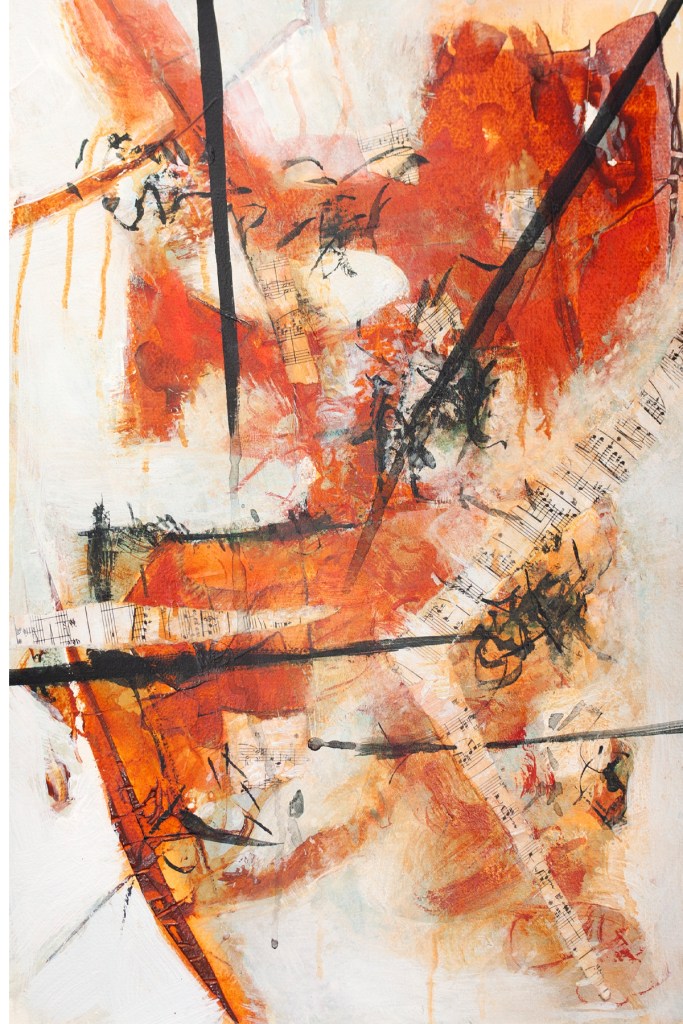
Notes within a Space
“Notes within a Space,” an abstract composition of acrylic paint layered with scraps of a musical score and accented with a few emphatic black lines. It’s both stark and ethereal, comprised of a figure that both stands out from and merges into the ground, which was conceived in part by turning the paper around, a technique Lesley learned at a workshop in New Orleans with Joan Fullerton.
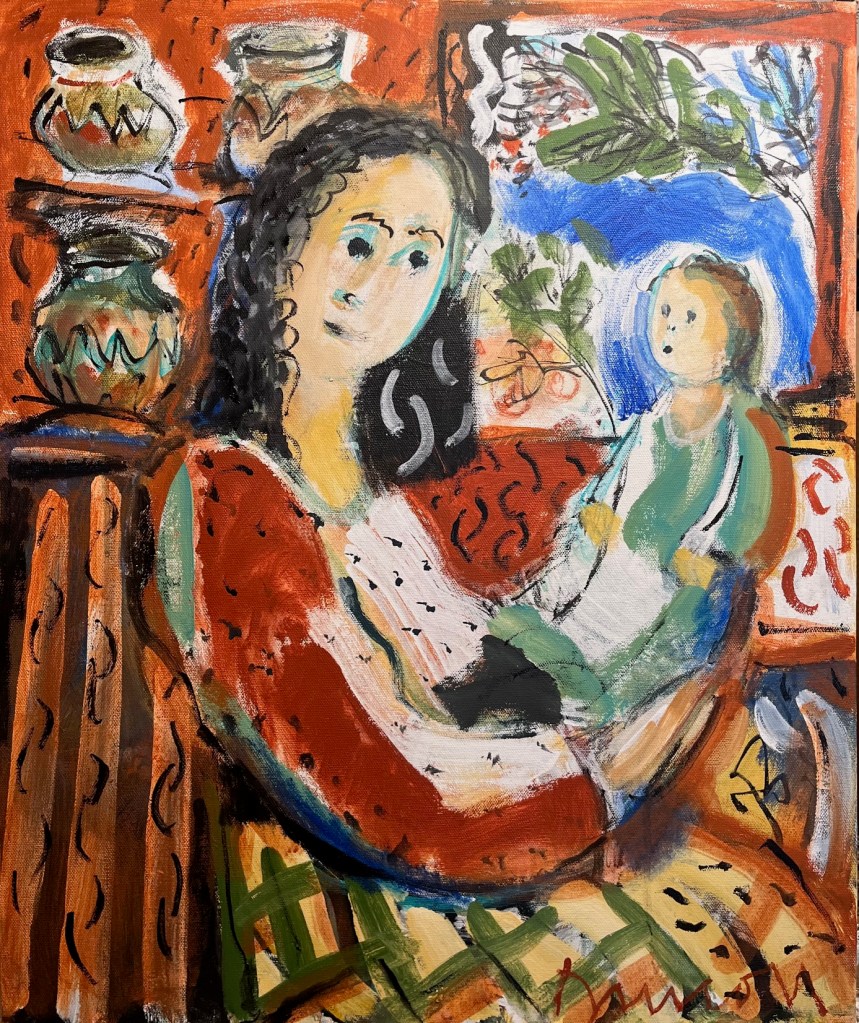
Mother and Infant
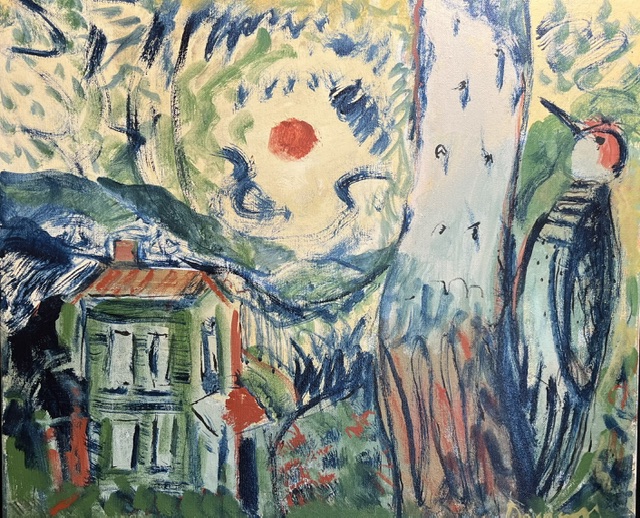
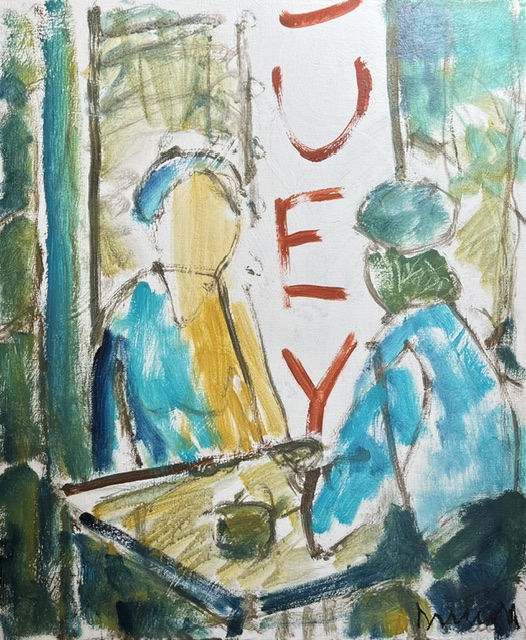
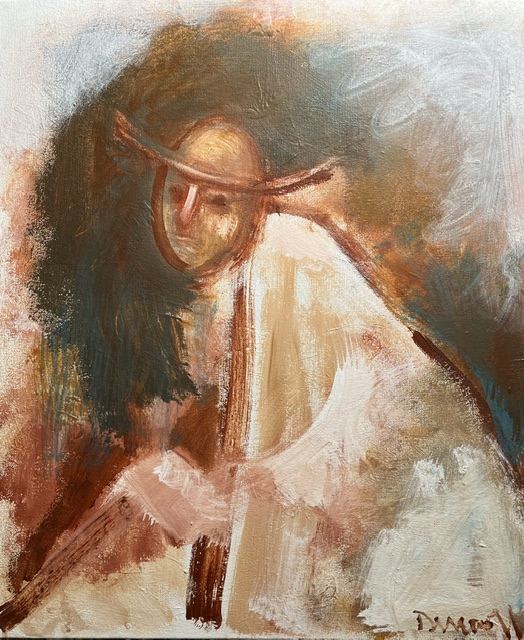
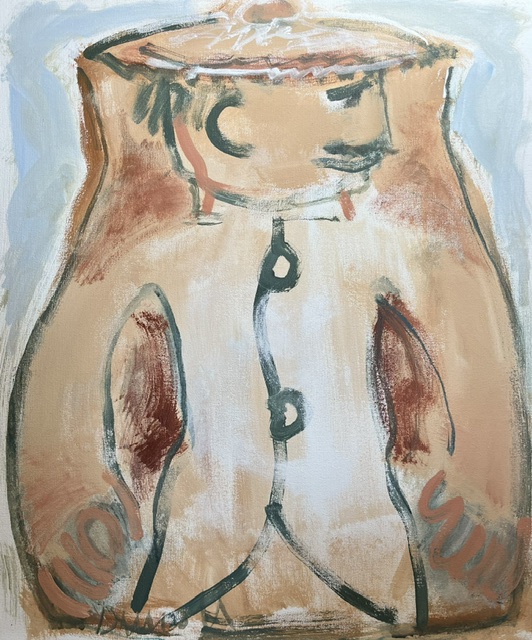
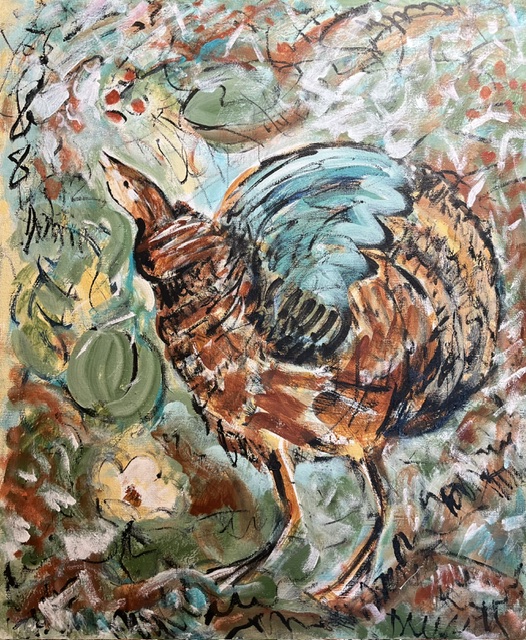
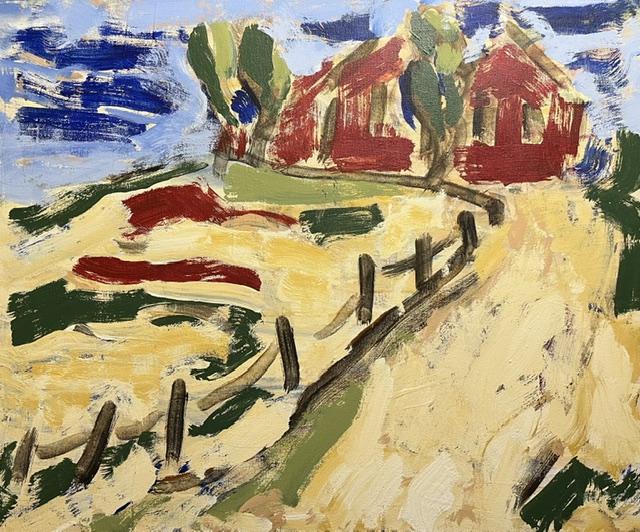
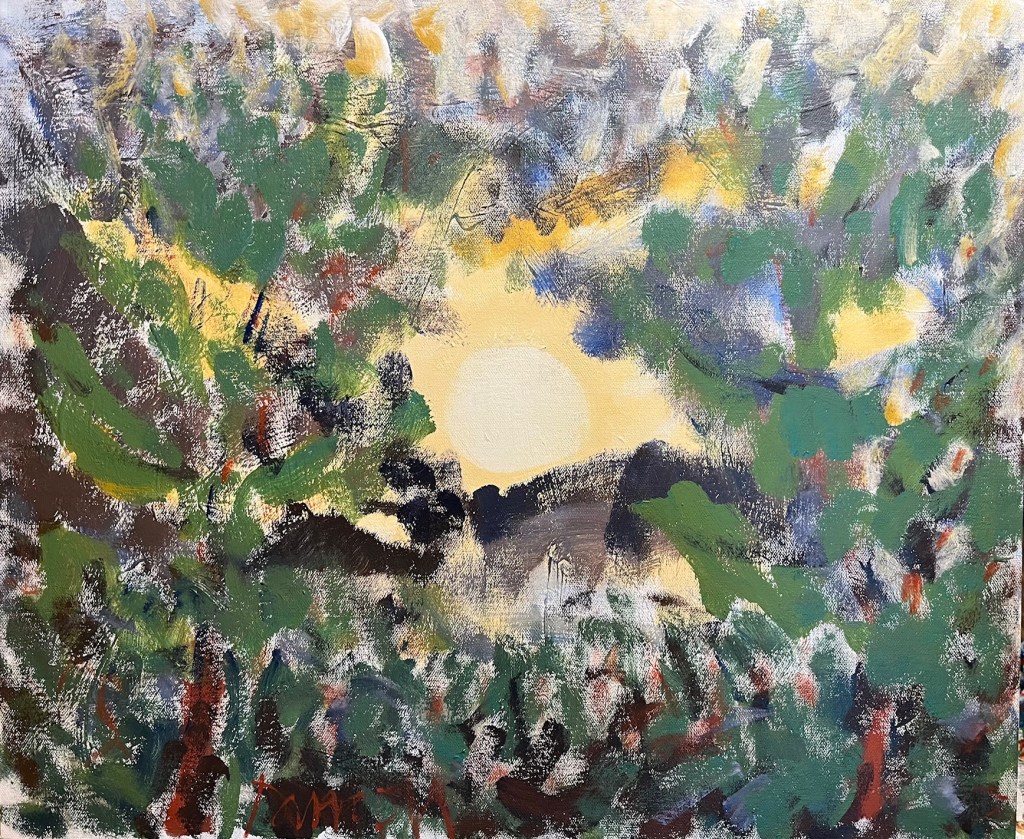
Neil Driscoll’s solo exhibition, “57 New Paintings,” consists of mostly 24 x 20” acrylic paintings hung salon-style in the back gallery. Produced over the past eight months, each work started with a thumbnail sketch, which the artist would loosely transfer onto the canvas as he decided the color scheme and what size brush to use. He painted them quickly, some within an hour, others within two to three hours, and if not satisfied with the result, would paint over an area and rework it. “I look at art history books a lot,” he says. “I also might be outside and see the sun going down and then paint it from memory.” There are echoes of Chagall, Picasso, German Expressionism, and Paul Klee in the pieces. A landscape in which a fence cuts a diagonal leading the eye to a house on a hill suggests vast space, a space the viewer can mentally enter, with the utmost economy. “I like the German painters from the 1920s and 30s for the reason that they reduced the landscape to a simple house on a hill and blue sky,” he says.
Woodpecker TreeSuey
A portrait of Winslow Homer he saw on the cover of a book inspired a more playful work, in which the mustached figure with cap and buttoned-up jacket appears on the surface of a large jar; the painting rhymes with a Picasso-influenced painting in which a face is inscribed on a vase. Neil says one inspiration was folk 19th-century wine jugs that have a face.
After examining some sketches of trees by Cezanne and noticing how the branches crisscrossed, Neil employed the motif himself, making a painting with a pair of crisscrossing branches on which a bird perches; the spare image, consisting mostly of white space, suggests Japanese Zen painting.
One of the more unusual images amid the paintings of landscapes and figures is an enormous apple core, laid on its side. An apple core was lying by his easel, and Neil says the idea to paint it was partly inspired by the pop art of Claes Oldenburg, from the 1960s, in which mundane objects such as toothpaste tubes and erasers were translated into monumental sculptures.
Time PassingPainted JarGrouseRed House on the Hill
For 43 years Neil and his wife have run a gardening business from their home in Schoharie County; his recent retirement has freed up more time for painting. A clue that this is a pressing priority is his painting of a robed figure in white, seated against a dark background. “It was meant to be a figure telling me time is passing and you have 10 more years to live,” says Neil, noting the somberness of the image is partly attributed to the limited the palette of two colors, burnt sienna and blue. He placed it near the entrance to the exhibit, as a reminder. The collective, exuberant energy conveyed in his 57 paintings not only demonstrate he is making the most of that time, but indeed, might outlive and outpaint his own prediction.
NEIL DRISCOLL’S “57 NEW PAINTINGS” and LESLEY A. POWELL’S “JUX TA POSITION” LONGYEAR GALLERY, MAY 29th – JUNE 28th, 2026 OPENING RECEPTION: SATURDAY, MAY 30th from 3-5 p.m.
Longyear Gallery of Margaretville is pleased to announce the opening of two new concurrent featured artist solo exhibitions, Neil Driscoll’s “57 New Paintings” and Lesley A. Powell’s “Jux Ta Position,” accompanied by a Longyear Members’ Group Show. Opening on Friday, May 29th, these exhibitions will run through Sunday, June 28th with the Opening Reception on Saturday, May 30th from 3-5 p.m.
Neil Driscoll -Harvest Acrylic 20×24
Neil Driscoll’s solo show “57 New Paintings” continues with the figurative abstractions that have been a part of his previous work. Roads, bridges, cats and dogs, and various folk serve as the framework for the painting compositions. These paintings stress line, or color, or a combination thereof. According to Driscoll, “The large number of paintings—57–is a result of my having retired a few years ago, allowing more time for painting, exploring new color and, hopefully, being more critical of those finished images.”
Neil Driscoll’s early art studies were at the Memphis Academy of Art and the School of the Chicago Art Institute. His work has been shown at the Roxbury Arts Group, Gilboa Museum, West Fulton Hall, and in Cooperstown.
Lesley A. Powell _ Unwanted Embrace_Encaustic Collage
Lesley A. Powell’s new solo exhibition “Jux Ta Position” explores this artist’s journey from choreography to the canvas, where the spatial drama of figures on stage transforms into composed forms, images, and colors on paper and canvas with her background as a choreographer profoundly influencing her artistic practice. As Powell notes, “Just as the placement of dancers and elements like costumes, lights, and sets create nonverbal narratives in a performance, my artwork articulates its own silent language. Rather than telling a linear story, my compositions, which are grouped in three series, “Juxtapositions in Silence,” ”Juxtapositions of Bull, and “Crisscrossed Juxtapositions,” open a space for layered emotional expression and poetic juxtapositions between figures, nature, and abstract forms.
“Juxtapositions in Silence” reveals the artist’s journey from exploring the human form to canvas with the spatial drama of figures on stage transformed into composed forms, images, and colors on paper and canvas. “Juxtapositions of Bull” combines the images of people falling, reflecting Powell’s travels in Nepal and her visual expression of dealing with our times, springing from Powell’s original drawings of people falling from a mechanical bull, a metaphor rich with tension, uncertainty, and vulnerability. Capturing the raw expressions of those in mid-fall, the artist channels a sense of helplessness that resonates powerfully in today’s world. “Crisscrossed Juxtapositions” reflects Powell’s use of collage as a liberating technique that has expanded her creative horizons. “Through layering images and color in innovative ways,” says Powell, “I have created dynamic compositions that draw the viewer into complex visual relationships. Sometimes complementing these collages are delicate prints on rice paper, an element that introduces a new sense of translucency.” The entire exhibition reveals Powell’s fascination with crisscrossing space and how backgrounds, objects, and figures converse visually within a composition.
Lesley A. Powell’s lifelong interest and involvement in various forms of art and choreography have most recently involved a continuation of her art studies at the National Academy of Art and the Arts Students League with Kamila Talbot for watercolor and with Frank O’Cain.
Future summer 2026 Longyear Gallery exhibits include two concurrent featured artists solo exhibitions by members Irina Grinevitsky and Alan Powell opening on Friday, July 3rd and running through Sunday, August 2nd, with the opening reception on Saturday, July 4th from 3-5 p.m. These exhibitions will be followed by two concurrent featured artists solo exhibitions by members Anthony Margiotta and Deborah Ruggerio, opening on Friday, August 7th and running through Sunday, September 6th, with the opening reception on Saturday, August 8th from 3-5 p.m. All solo exhibitions are accompanied by a Longyear Gallery Members’ Group Show.
Longyear Gallery is located Downstairs in The Commons, 785 Main Street, Margaretville. The gallery will be open from 12 a.m. – 5 p.m. Fridays, Saturdays, and Sundays. For information, please see Longyear Gallery’s website, email the gallery at info@longyeargallery.org, or call 845.586.3270 during gallery hours.
“Travel As Muse,” a group show of paintings and drawings currently on view at High Falls’ Wired Gallery, grew out of the art tours gallery owner Sevan Melikyan has been conducting since 2018. On the last trip he organized to Istanbul three participants who happened to be artists shared their sketches with the group over dinner, which triggered an idea: “They need to show this work to the public,” he recalls thinking. The result is “Travel As Muse,” an exhibition of drawings, watercolors and acrylic and oil paintings by eight local artists who were inspired by the tours. Besides Istanbul, the destinations they sketched and painted are Paris, Venice, Sicily and Malta.
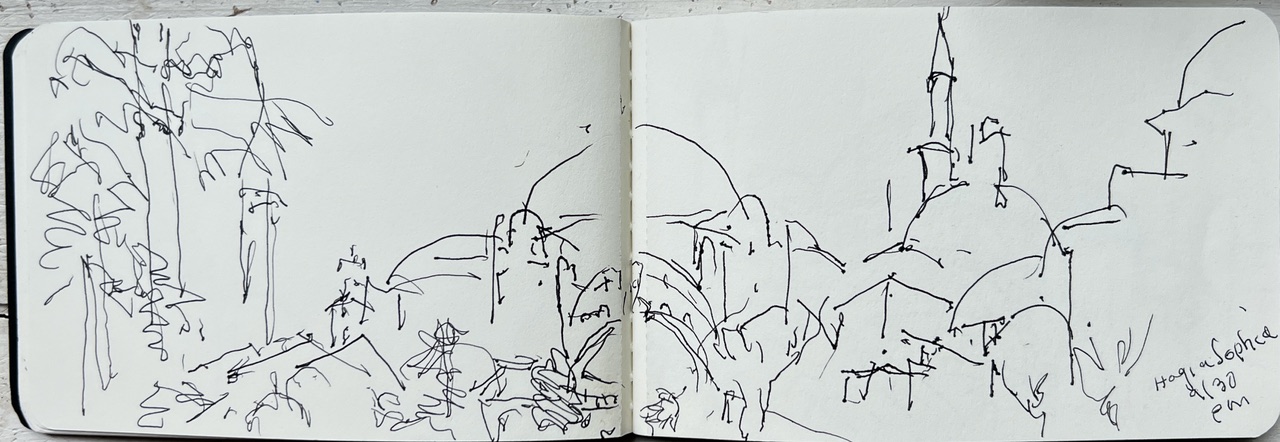
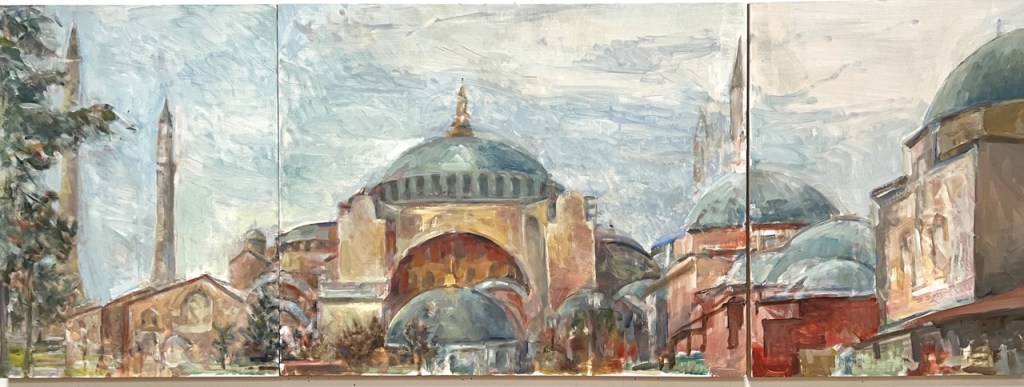
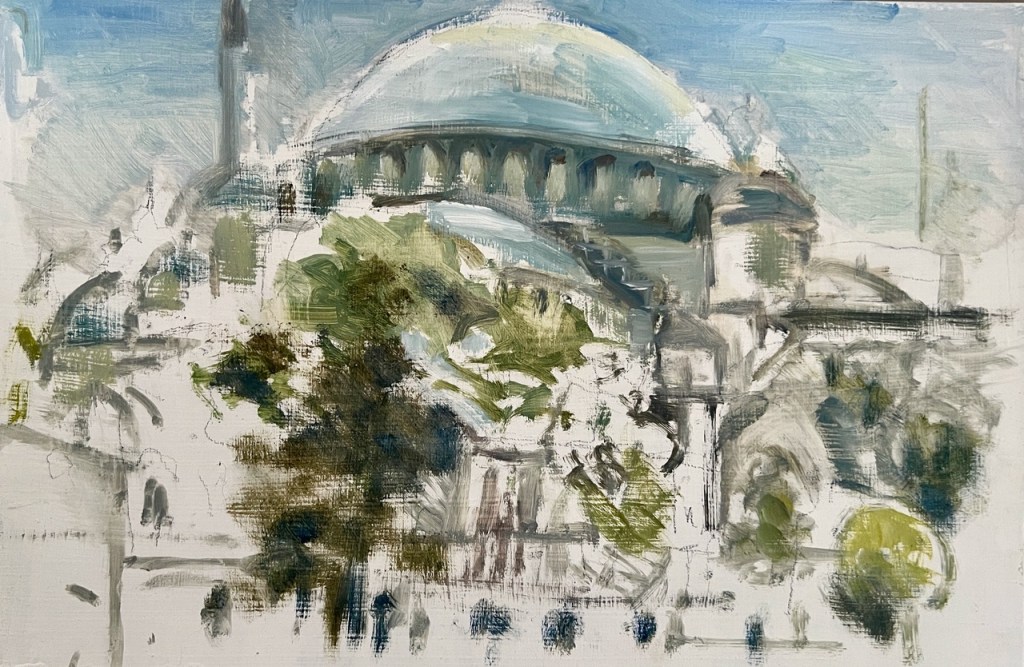
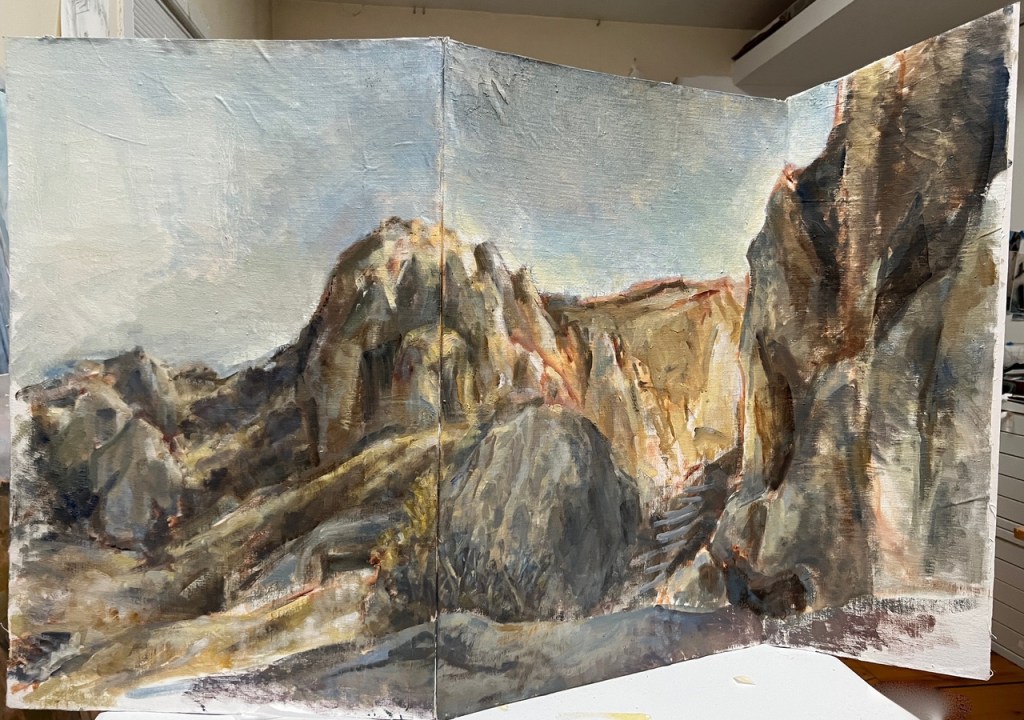
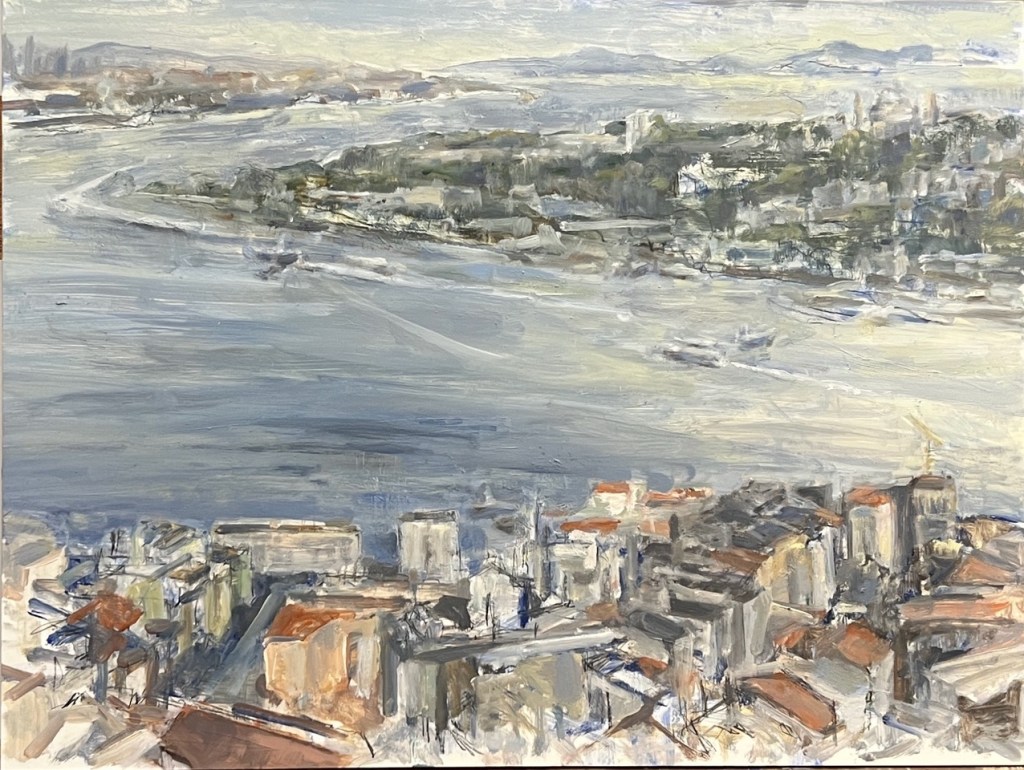
One of the participating artists is Longyear member Marcia Clark, who contributed six paintings, including of Hagia Sophia, the harbor, and the mountainous landscape of Cappadocia (painted in sections of canvas mounted on a freestanding structure of foamcore). “The work all evolved from ink drawings done in a tiny sketchbook,” she says. “I took scads of photos, and the paintings were a balancing act between the facts and my initial strong impression recorded in the drawings.”
Travel to far-flung places has long been integral to her practice as a painter. In 2022, she traveled to the Mediterranean and the Arctic, places she has visited multiple times. In Turkey, Greece and Italy, she painted architectural sites as well as landscapes, while in the Arctic the obvious point of interest were the glaciers and the immense expanse of uninterrupted space. Painting ice also had its appeal: “I was interested in observing the structure of the ice and its quality of light, as well as the simplicity of a color scheme based on blue. I was also attracted to the bright dots of color in the landscape made by communities of little houses mainly belonging to the Inuit population.”
Hagia Sofia from the Hippodrome, 10/3/25, ink drawing, 3 1/2 x 11 inches
A residency in Upernavik in 2007 was her introduction to the region. “I flew to Greenland with a group of scientists who were on their way back to the ice sheet that covers 80% of the country, and their excitement was contagious,” she recalls. “After the residency in Upernavik, I flew to Ilulissat, where there is an ice fiord that you can just about walk to. I’ve returned to Ilulissat many times and have done paintings on site weather permitting. I usually stayed at the Kunstmuseum”—on her first visit she met the director, who offered her a residency the next year—“and had a show there in 2013.”
Since there are no direct flights to Greenland, Marcia usually gets there via Iceland, where she’s had residencies in Reykjavik and in the north in a village that was once the country’s herring capital. “Though I’ve managed to find residencies at many places I’ve been interested in, if I’ve discovered a place where I want to set up I will look for accommodations regardless if there’s a possible residency nearby.”
Her first close encounter with the elemental sublime was In 1971, when she was an artist in residence at the Appalachian Mountain Club’s hut at Lake of the Clouds in the Presidential Range of the White Mountains. She had to hike in with her supplies. “I do gravitate to unencumbered views,” she says. “Above the timberline I could see peak after peak, on a clear day all the way to Portland. There was arctic vegetation, and the weather was extreme. I loved it up there!”
After meeting an observer of the weather station at the summit of Mount Washington, she was invited to help with the planning of a museum about the mountain. She painted the backgrounds for dioramas of the mountain’s historic sites and painted a glacier for the geology exhibition, using an illustrated book about Glacier Bay, in Alaska, as a reference as well as sketches made by Frederic Church, which were in the archives of the Cooper Hewitt Museum.
Marcia had previously developed an appreciation of Thomas Cole after moving part time to New Paltz in the late 1960s and discovering the same landscape he had painted 150 years before. “I saw how beautifully and poetically he studied nature in his sketches and how important it was to the outcome,” she says. “It made me ask myself, are you looking? Well, look deeper!” She retraced the 19th-century artist’s travels in the Catskills and White Mountains and wrote about it in an article published in Smithsonian Magazine.
Hagia Sofia from the Hippodrome, Triptych, 2026, oil on panel 16 x 44 inches
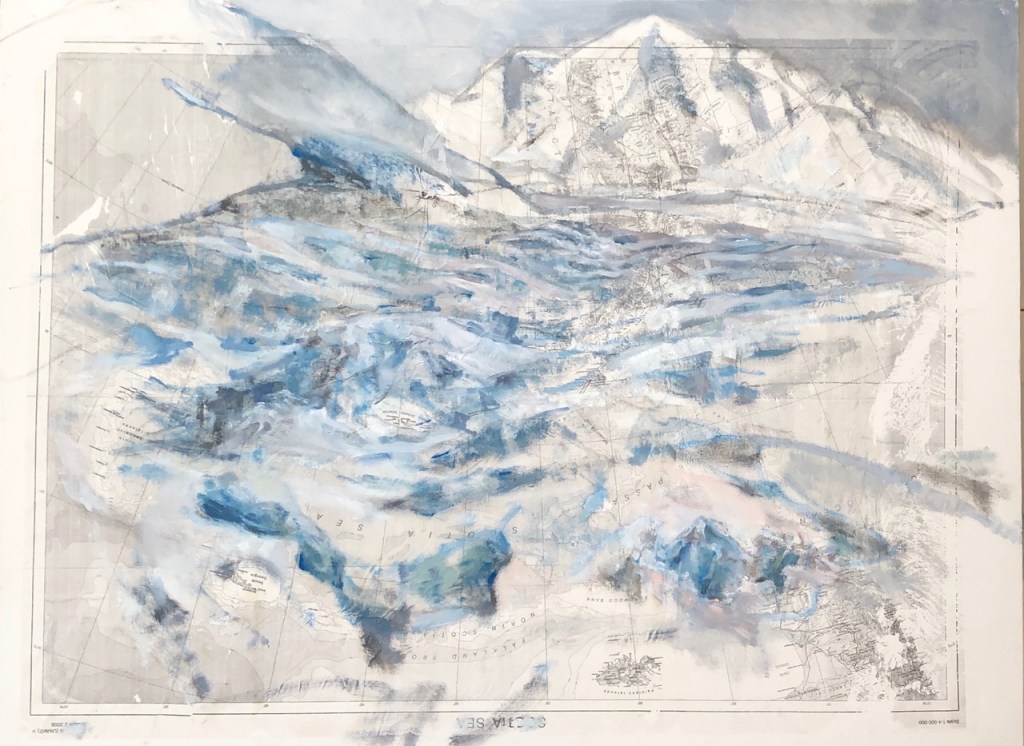
Large paintings of architectural sites in Istanbul (bound for the show at Wired) and Sicily along with panoramic landscapes of immense mountain ranges, rock-ribbed cliffs along the sea, precipitous rocky peaks, and the flanks of glaciers were arranged along the walls and shelves of her skylit studio on the second floor of her house in Rifton during my recent visit. The loose brushstrokes, which precisely describe the convex and concave shapes defining the complex landforms, have the fluidity of watercolor, conveying the effects of light and atmosphere. Rather than take in the scene in one glance, her paintings invite the eye to travel. More paintings fill the downstairs storage room, including ones of the Mendenhall glacier done on topographical maps. To capture the panoramic sweep of her subject, Marcia frequently paints triptychs and diptychs and sometimes extends the painting in sections outside the rectangle, as she did in a work of the Cornish cliffs that hangs in the living room (which she showed at Longyear a few months’ back).
Glacier Surge, April 2021, oil on canvas on map transfer, 30 x 40 inchesBlue Mosque, 2026 oil / aluminum 8 x12 in
There are also paintings of the local woods and scenes from Riverside Park, some of which have the vertigo-inducing viewpoint of her landscapes; an early painting, from the 1980s, depicts a vertical slice of lower Manhattan viewed from the 104th floor of the World Trade Center.
After earning a BFA from Yale, her work “was done almost entirely on site and was mostly small in scale,” she recalls. “It was always based on observation, or should I say, perception, because what you see has to be interpreted. There is the view, but you also have a point of view.” She also holds an MFA from SUNY New Paltz and is a longtime member and director of Blue Mountain Gallery. “Travel as Muse” runs through June 21 and provides an excellent opportunity to view Marcia’s interpretations of Turkey.
Cappadocia, 2026, oil on linen on folded foamcore, approximately 27 x 44 inchesView from the Galata Tower, 2026, oil on panel 12 x 16 inches