
by Lynn Woods
Ray Curran’s ability to capture the qualities of light, atmosphere, and the lay of the land of a particular place through the fluidity and spontaneity of his chosen medium is beautifully on display in “The Waterfront in Watercolor,” which runs through May 24. Six of his 10 watercolors on display depict waterfront scenes along the Hudson River, part of a series that retraced Henry Hudson’s journey from Manhattan to Kingston, while the remaining four paintings are scenes from Monhegan Island, in Maine. Curran’s color harmonies tend to be subdued, consisting of skies in pale blue washes, forested hills in gray greens, and rocky shorelines and cliffs in warm grays. His brushwork has a sprightly spontaneity reminiscent of Maurice Prendergast.
In some works, the neutral palette is enlivened with pops of color, such as the adobe red of the large brick building and the greenish yellows of the willow trees in “The Steelhouse”; the triangular shape of the building and the crisp, rectangular forms of the white and black tugboat in the foreground contrast pleasingly with the rounded forms of the vegetation and squiggly lines in the foreground depicting the reflections on the Rondout Creek.
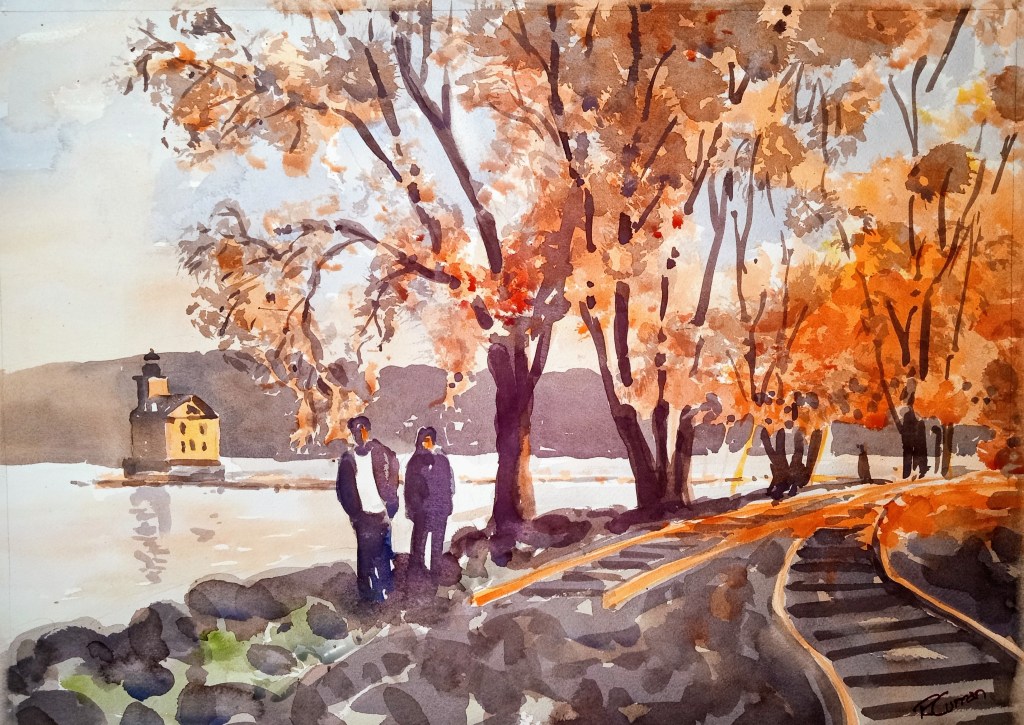
Another standout is “Kingston Point,” in which the curving lines of the railroad tracks, set within the bottom dark triangular shape of the railroad bed extending from lower left to middle right, gains force with the rhythmic row of autumnal trees, which also progress to the right. The composition is anchored by the horizontal form of the ridge in the background, punctuated at left by the compact, geometrical form of the lighthouse. Two figures standing just to the left of center echo the verticals of the trees and help define the space, as well as lend a note of mystery.
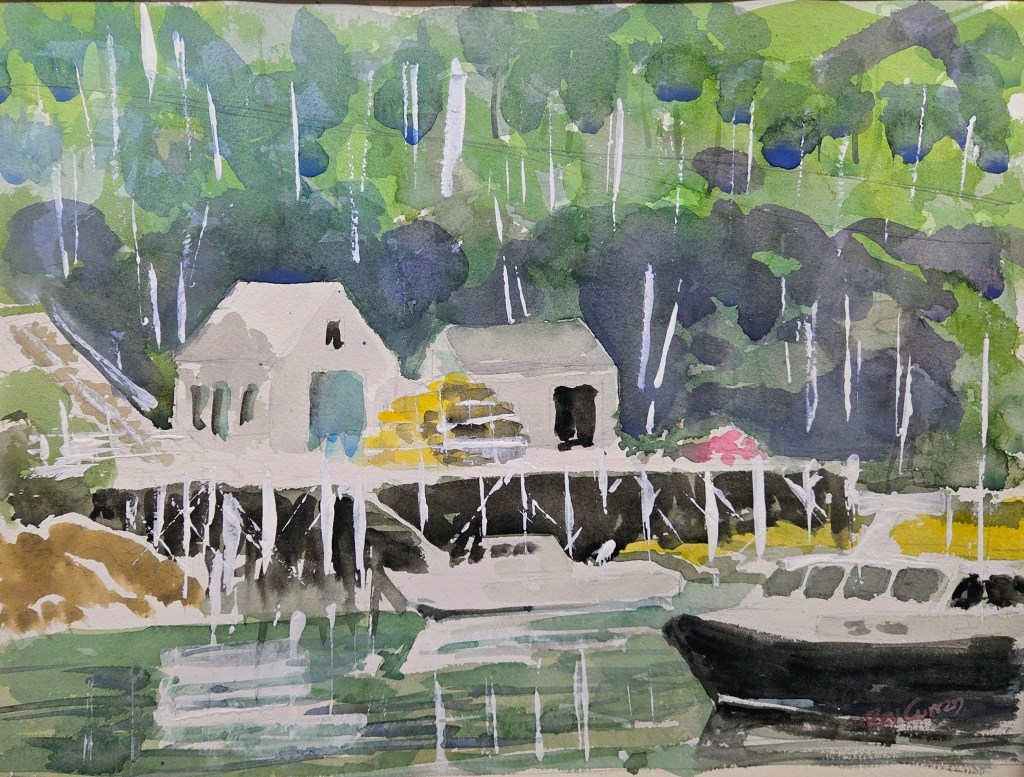
“New Harbor,” one of the Maine paintings, is the most recent work in the show and the most radical, with its simplification of forms: the shapes of the dock, with its piers and row of sheds, and the two boats are defined as negative shapes carved out from the surrounding green and gray areas, exposing the white paper. Streaks of white, also the exposed paper, activate the composition. One has a palpable sense of glimpsing the shore and boats through pelting rain, while the touches of brown, black, blue, yellow, and red adjacent to the dock, alluding to objects and architectural details, add a subtle rhythm.
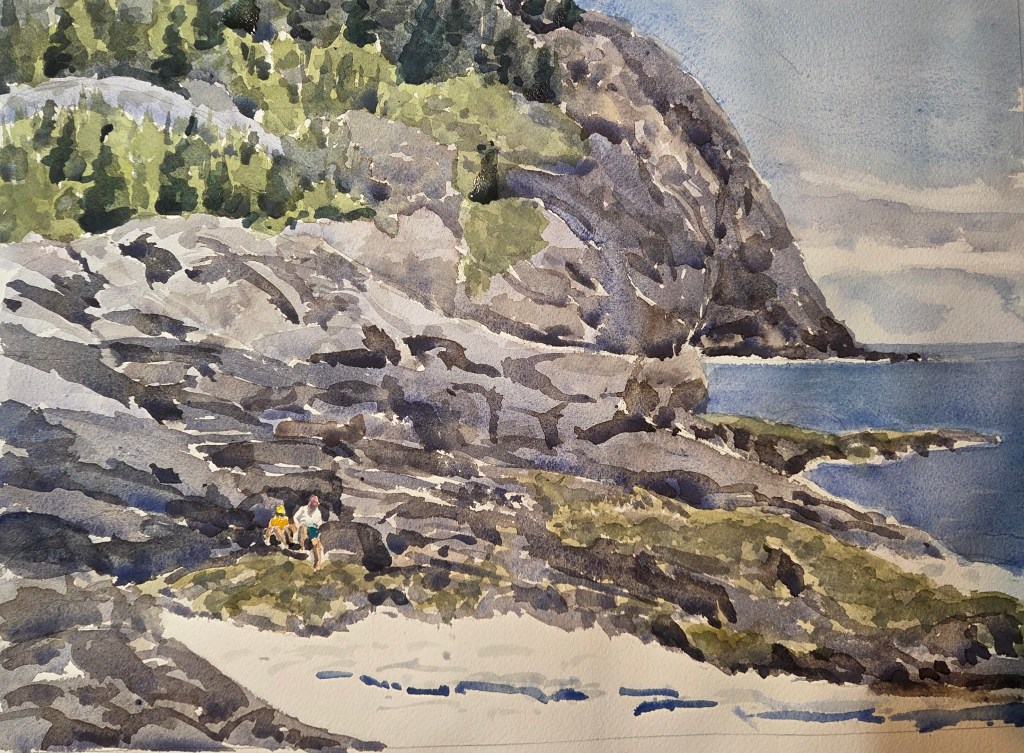
In contrast, “Monhegan Island” is monumental: the cliff extends beyond the top of the paper, which emphasizes its massiveness. Curran skillfully suggests the movement of the stones in space by varying the shapes and contrasts of various shades of gray, conveying the landform as it protrudes into the foreground and extends back into space, connecting the beach at our feet to the cliff’s silhouetted curve descending into the water in the distance. As in “Kingston Point,” the two seated figures at lower left are a human note that by extension enable us to inhabit the scene.
Curran’s connection to the places he paints isn’t just aesthetic; it’s also tied to history and social identity. His paintings along the Hudson were shown previously at the Kingston’s Hudson River Maritime Museum, in a kind of visual diary of the sites visiting by Hudson in his journey up the river in 1609. “People don’t have a chance to see the Hudson River at all, other than from a distance,” Curran said. “They’re horrified that I kayak on the Hudson.” It bears mentioning that the numerous parks established by Scenic Hudson in the last 30 years have helped bring the public closer, an accomplishment in which Curran played a role: In his previous career as senior planner at Scenic Hudson, he proposed adding a large park to the plan for a massive housing development along the river in a former industrial site in Kingston. When the development fell through, Scenic Hudson purchased the 500-acre site, which subsequently was acquired by the state and is now the Sojourner Truth State Park.
After retiring from Scenic Hudson in 2009, Curran had more time to paint in his studio at Kingston’s Shirt Factory and also devoted himself to the local arts community, cofounding the city’s Midtown Arts District. Today he paints from his home in Olivebridge. He says he’s been on a quest to move away from the precision of his earlier paintings, ”to capture the mood and qualities of the assemblage,” as he puts it, rather than do a realistic rendition, though strong drawing underpins his compositions. He uses photographic references, sometimes several for a single piece, but never copies them literally.
While he’s known for his landscapes, he also has painted urban scenes as well as figures, two of which were shown at Longyear last month (the nude figures were painted decades ago at life drawing sessions at Spring Street Studio, in Manhattan). Of late he has been experimenting, resulting in “A Line in Winter,”
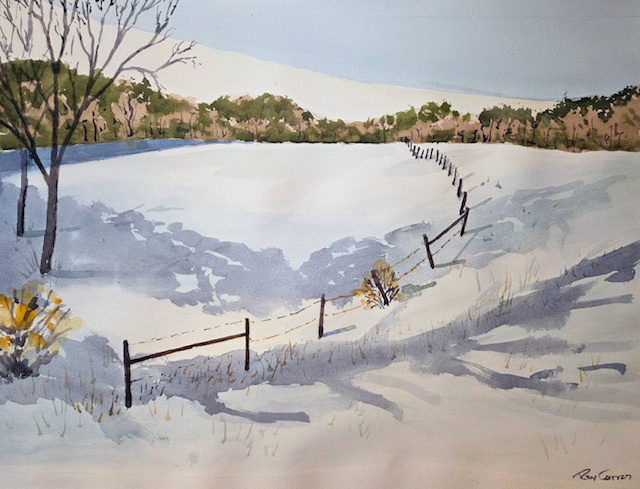
which was also included in last month’s members’ show. It depicts a field in winter; gestural strokes, akin to Zen ink paintings in their economy, describe a receding fence, which directs the eye to a forested ridge in the background. An expansive sense of space and light are conveyed with the most minimal means, a tribute to Curran’s skill and vision.


Leave a Reply