
by Lynn Woods
The solo show of Longyear member Alan Powell, which runs this month through August 2, as does the solo exhibition of fellow member Irina Grinevitsky, is unusual in that it is a sculptural installation.
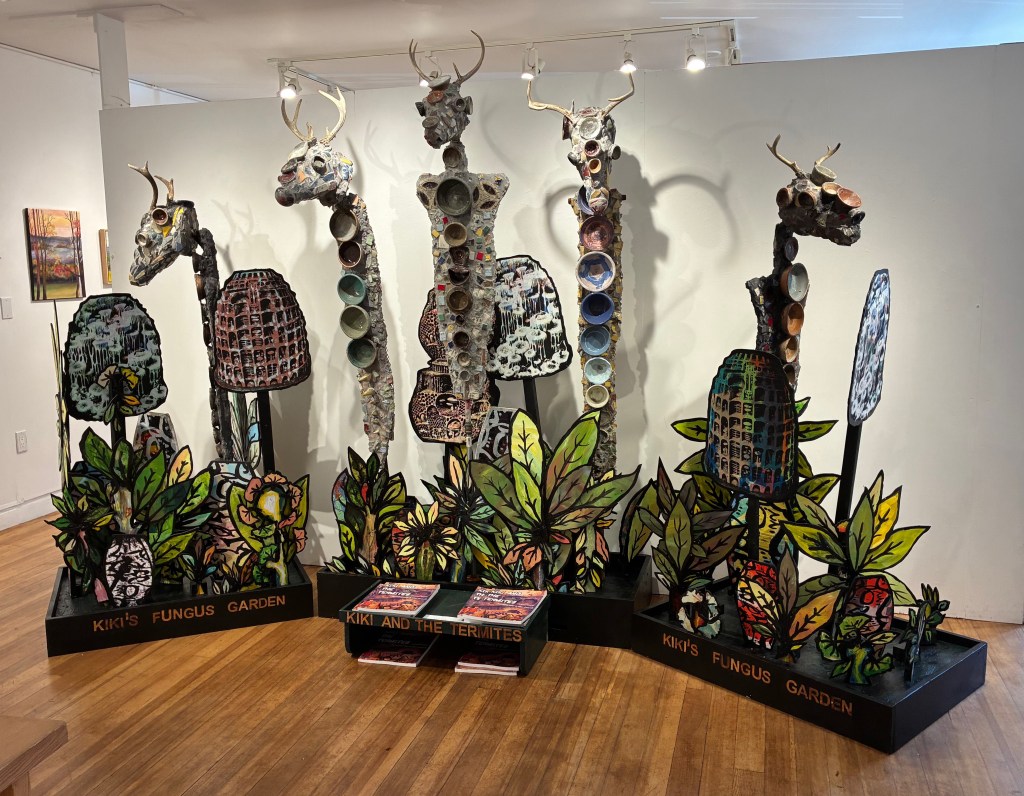
The star of the show is an assemblage of several figurative sculptures crafted of deer skulls, cement, pipes, and ceramics positioned within a conceptual “garden,” entitled “Kiki and the Termites,” derived from a graphic novel Alan wrote with Katerina Pate. On the adjacent wall is a video installation entitled “Love Letters in a Flood” in which multiple screens, one in the shape of a house, pivot up from a base re-creating the floor of a flooded house; the letters appear on the screens, accompanied by a soundtrack of a woman reading them aloud. On the opposite wall are sculptures comprised of old tools, a couple of which humorously resemble parts of human anatomy. Rounding out the exhibition are five abstract monotypes incorporating old records. Recently retired as professor emeritus from Arcadia University, where he taught communications for over 20 years, Alan has devoted his time to making new work, and the show is impressive evidence of his ability to translate imaginative ideas, which often have a socio-political or ecological bent, into artworks incorporating a variety of media.
“Kiki and the Termites” is an amazingly complex work, which Alan has been working on for over a year. The theme of termites relates to Termite TV, a Philadelphia-based multimedia collective of which Alan was a founding member and current board member (he was a pioneer in video art, having earned one of the first BFAs in the film and video at the Rhode Island School of Design). Inside their vast hives, termites compost vegetative material and their poop into chambered gardens, a model of sustainability the cooperative embraced, “eating through the culture to sustain itself” in much the same way, Alan explained.
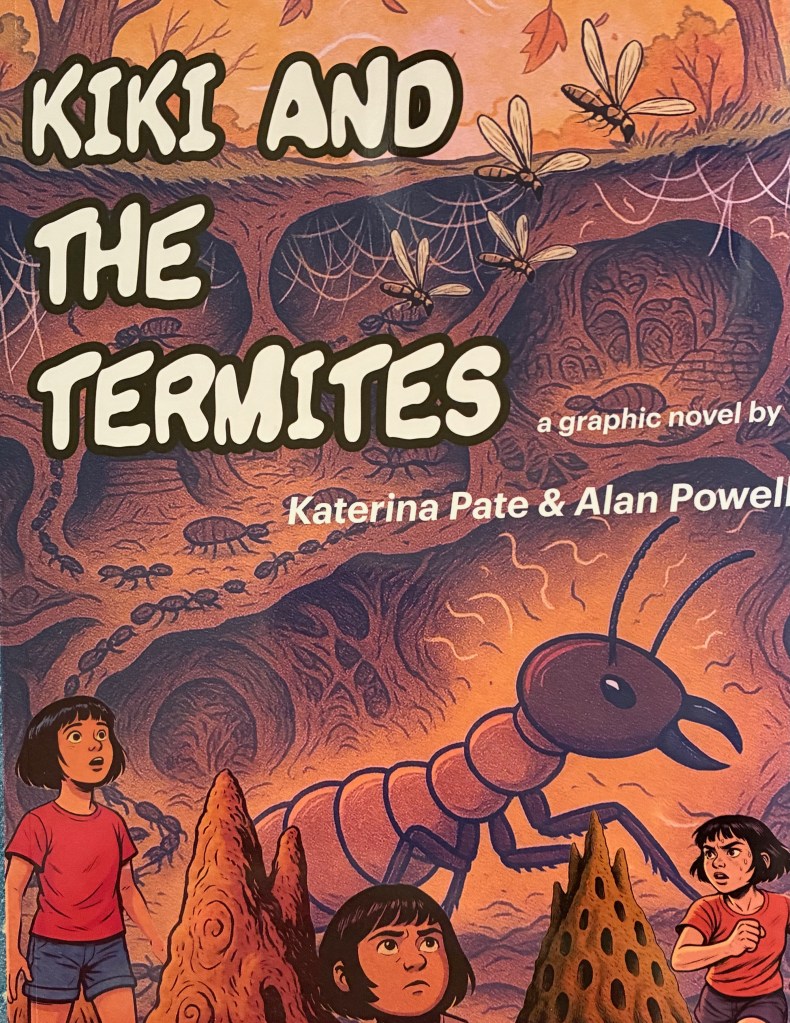
The installation is accompanied by copies of the graphic novel, which traces a narrative of a girl in a flooded house trying to communicate with termites to save her doomed community from a rapacious developer. But you don’t have to read the novel to appreciate the totemic power of the five sculptural figures. (The skulls were sourced from a place Alan discovered in the forest near his home in Fleischmann’s where “deer go to die,” as he describes it.) They are arranged in three large rectangular planters, inscribed with “Kiki’s Fungus Garden,” in which a thick assortment of leaves and flowers protrude, each leaf fashioned from a silkscreen print glued onto a shaped wood piece.
Their muted green, red, bronze, and yellow tones with delineating black lines have a graphic quality, giving their dimensionality a theatrical quality, as if they were a set piece for a comic book coming to life. Rising above the plants are several depictions of termite hives, whose imagery of porous, labyrinthian structures suggests architectural ruins, an effect the artist achieved through layering. The amount of complex image making that went into the piece is astounding, and that’s not even including the graphic novel, whose hundreds of cartoons were created by the two collaborators by “feeding photos and drawings and descriptions into AI,” which then generated back the images, according to Alan. (The imagery of the hives was achieved in a similar way, while Alan sourced the ceramics from Arcadia’s ceramics department.) The piece was shown last year at the Philadelphia Art Pier in an exhibit entitled “Understory.”
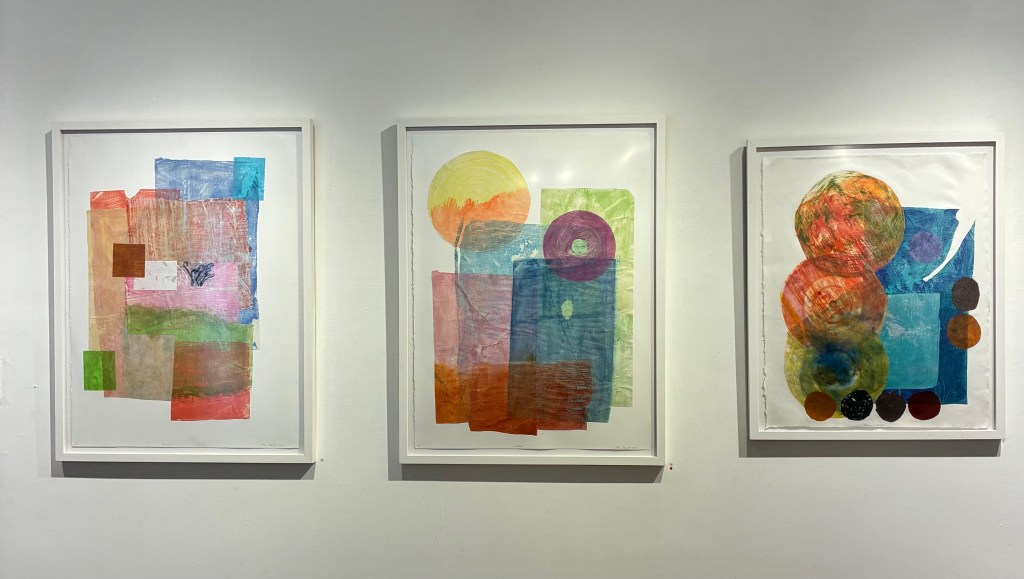
The five abstract monoprints, hung on the opposite wall, are pleasing in their earthy, translucent color harmonies and simple geometric shapes; some of the circles consist of actual 45s affixed to the surface, while the rectangular colored shapes were printed from pieces of discarded wood, revealing the texture of the wood grain. “I try to develop a way of working with nature that’s not a pretty landscape, but rather has a dialog with nature,” he said. “I struggle to make a direct relation with nature into my art.”
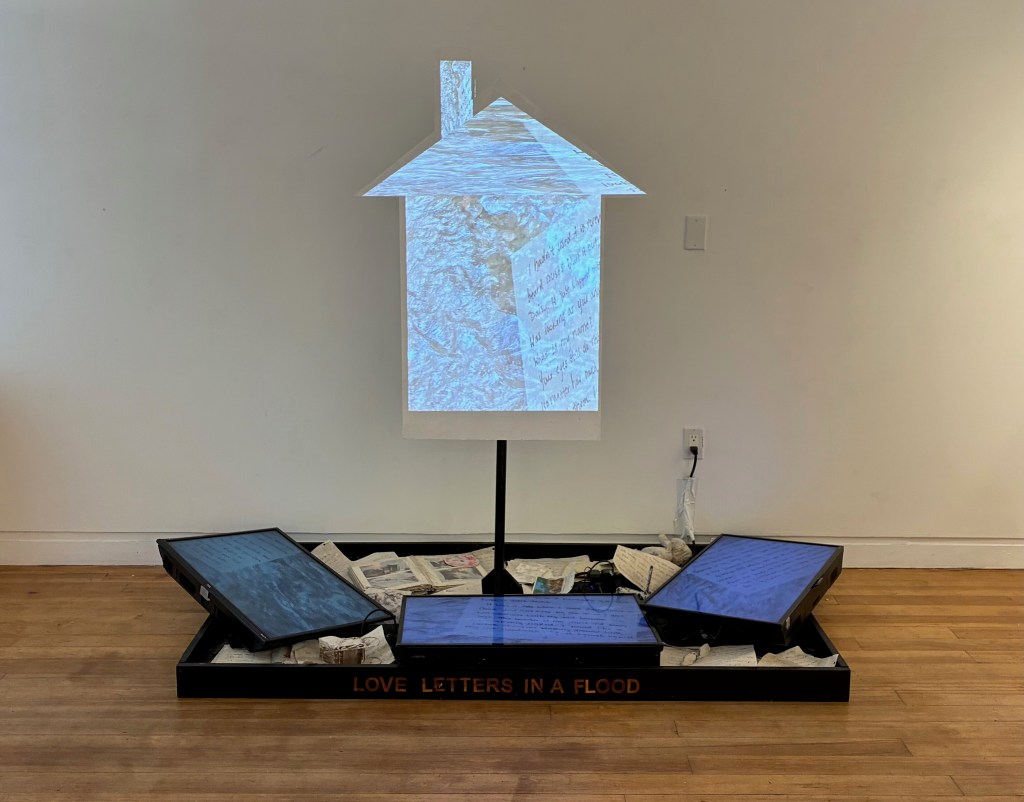
“Love Letters in a Flood” tells a narrative that was created for the Prattsville Art Center. Inspired by the account of a young woman who was trapped in her house for six hours in the 2011 flood, he instructed Katerina to lock herself in a room for six hours and hand-write a love letter to her boyfriend, imagining herself as that young woman from Prattsville. He then recorded her reading it, accompanied by sounds of rushing water, and photographed the pages of the letter, animating them (through some video technology wizardry) to create the illusion they are floating downstream in a seven-minute loop shown on the four video screens. The final step was creating a base simulating the flooded floor of a house, with actual objects, such as a Christmas tree ornament and photo albums, scattered on a mud base. Contemplating the piece, we are voyeurs, listening in and glimpsing written phrases in a private communication, even as the women’s mundane musings unfold within the context of a disaster—a situation becoming increasingly the norm in a country battered by floods, ferocious storms, wildfires, and extreme heat.
Alan’s readymades, in which he transformed discarded tools from his barn into sculptures, was originally part of a pop-up show held in an abandoned hardware store in Roxbury. Four of the five pieces are supported on white wooden bases resembling tombstones with their chiseled inscriptions, alternatively commemorating an eco-crisis or lampooning the manosphere (i.e. “Daddy’s Chastity Belt,” “Green Hockey Stick with Green Balls”). As in much of Alan’s work, the formal elegance and handsome aesthetics of his art seduces us into an experience tinged with irony as he reveals and explores the underlying anxieties that inform these troubled times.
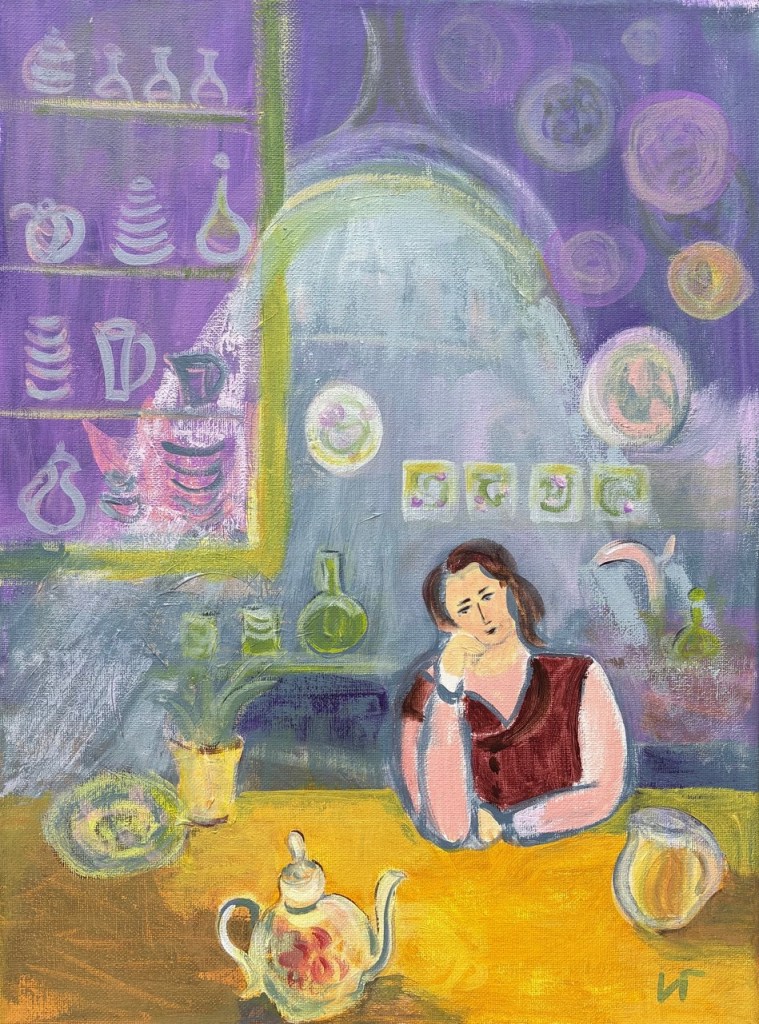
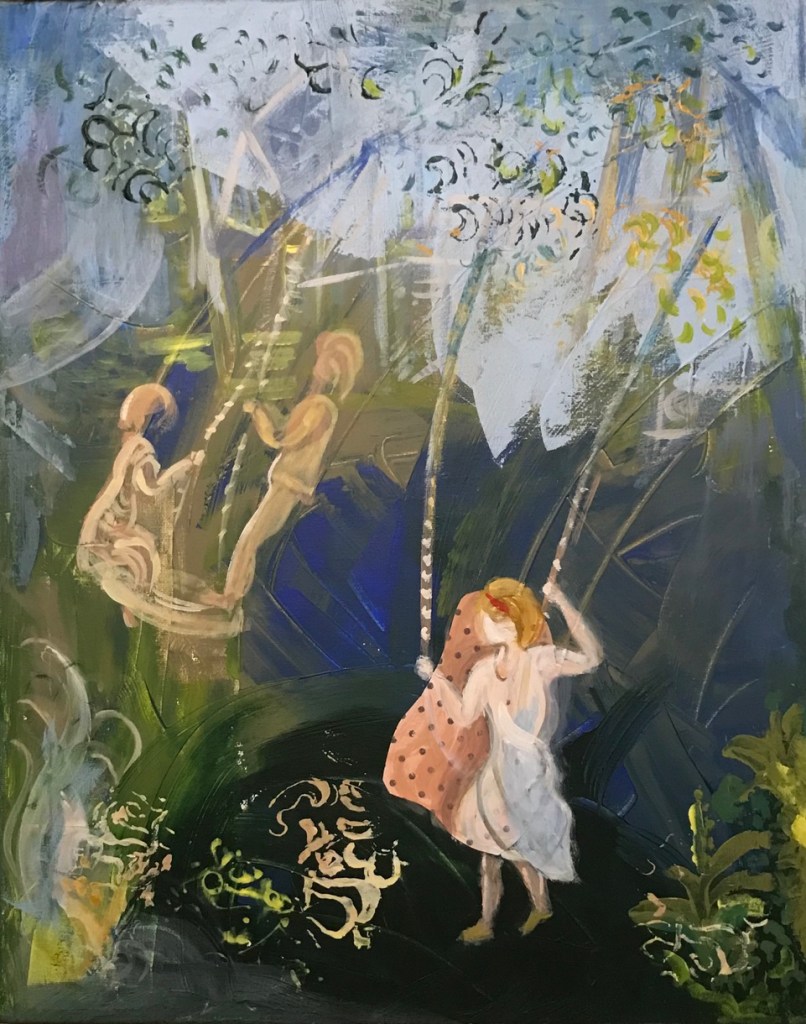
Irina Grinevitsky’s second solo show at Longyear, entitled “Playground,” consists of 35 acrylic paintings and mixed-media works depicting New York City’s parks, backyards, and gardens– not as green spaces hemmed in by concrete but as magical domains where fountains splash, children play and dream, and hammocks sway. “My idea is to see New York through its playgrounds, how children and people communicate in these spaces,” she said. “Besides skyscrapers, the city has a lot of green spaces, which inspired me to watch my granddaughter playing”—the subject of many of her works. One is reminded of the fetes of Watteau, although instead of elaborately costumed courtiers, the main protagonist is a young girl, often shown alone, in a contemplative pose, in the house as well as playground. “I wanted to show a mood, of a girl sitting by herself … she is a little bit lonely.”
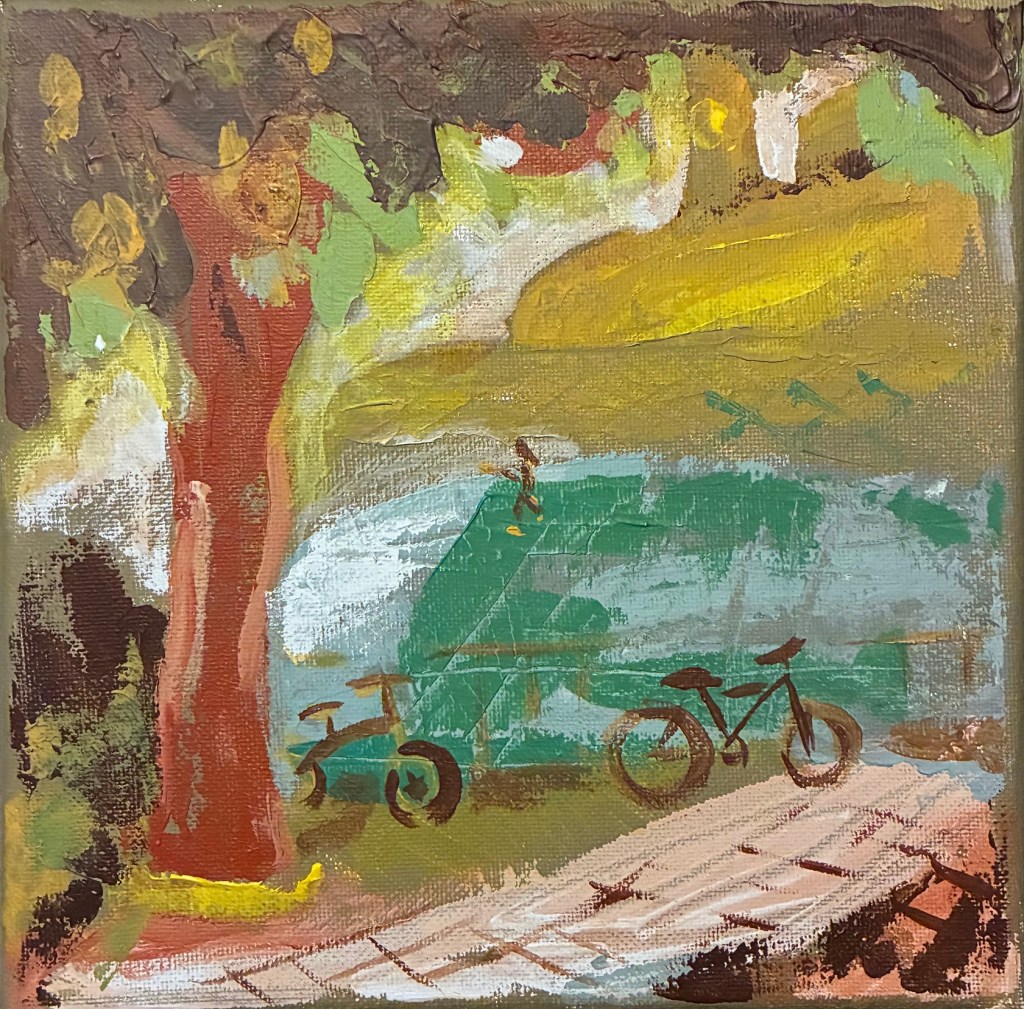
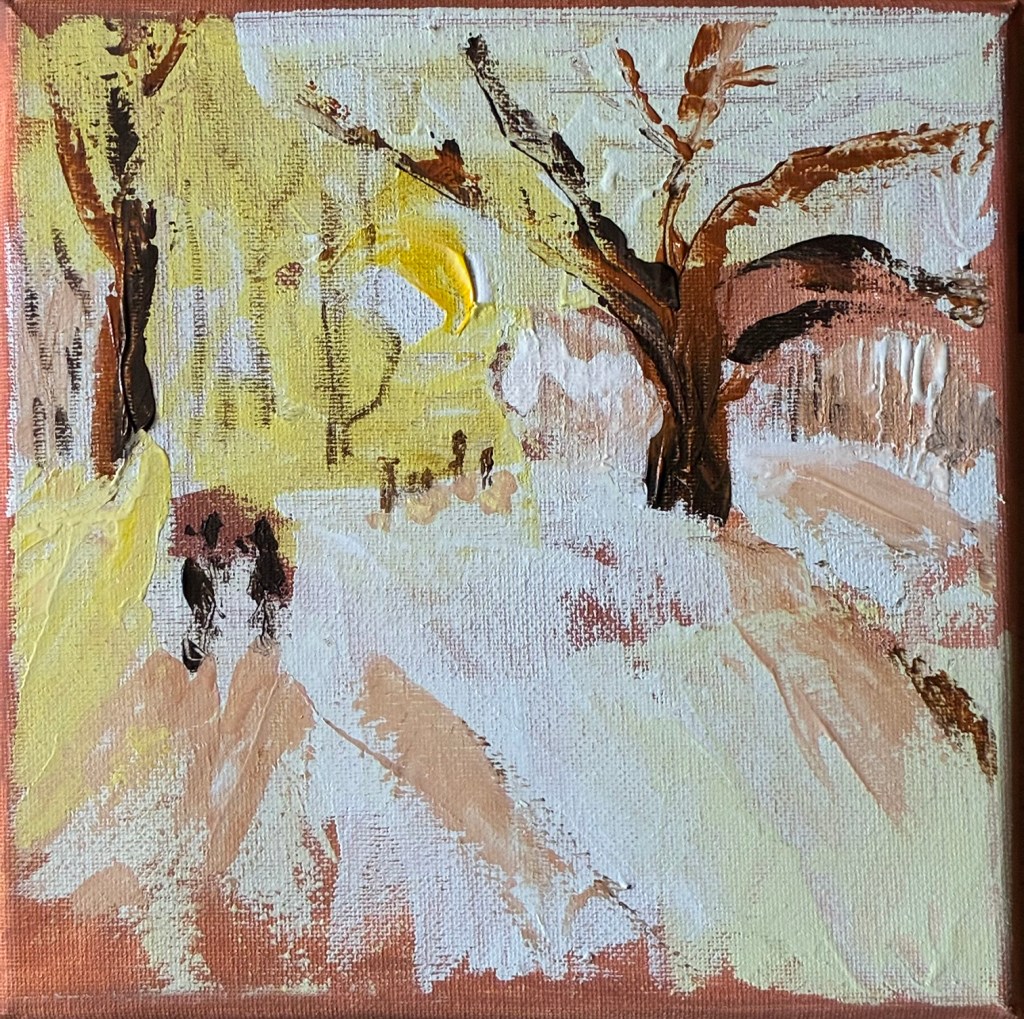
The parks painted by Irina include McCarren, Josepha C. Sauer, Fort Greene, and Herbert Von King. Besides leafy playgrounds, in this body of work she has depicted a blooming magnolia and the parks in winter, in which trees cast long shadows and a hill is covered in snow. Even her industrial scenes are imbued with lyricism: inspired by old photographs of water towers, the mixed-media works were created by a special technique, derived from ceramics, in which the artist pressed lace, fabric, and other objects covered in paint onto gesso, forming a kind of relief. The patterned textures dematerialize her depiction of brick and concrete walls. They appear to have been painted on old tin ceilings, lending an antique quality.
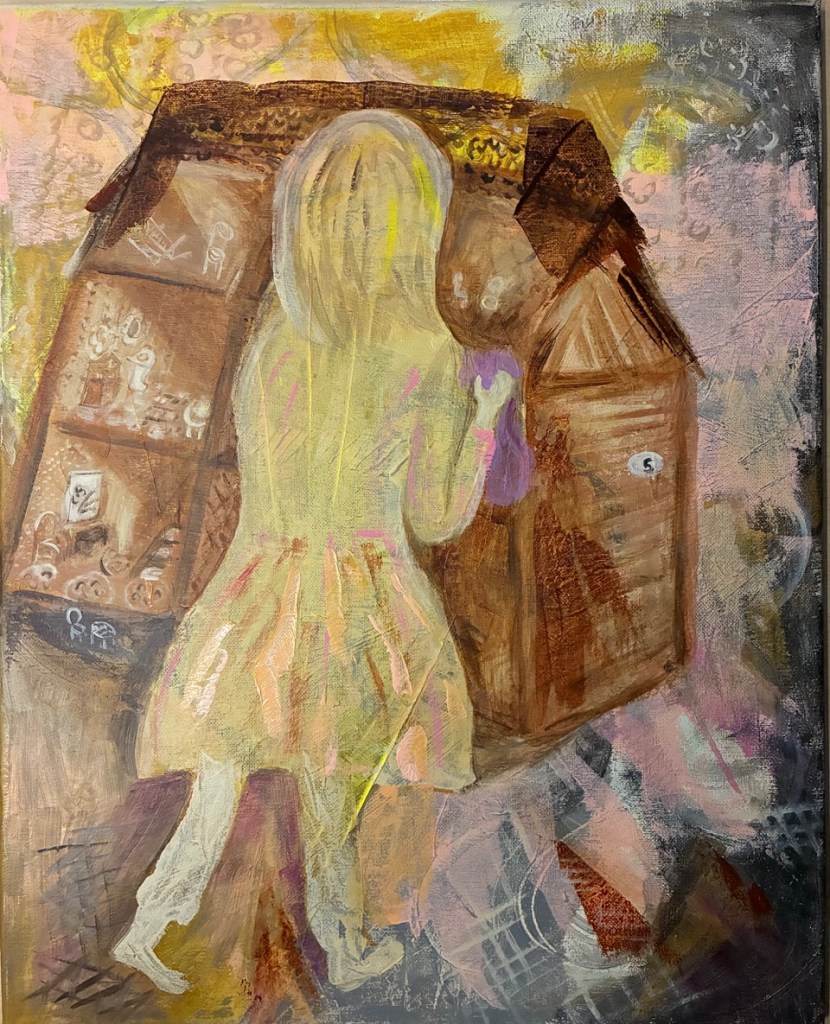
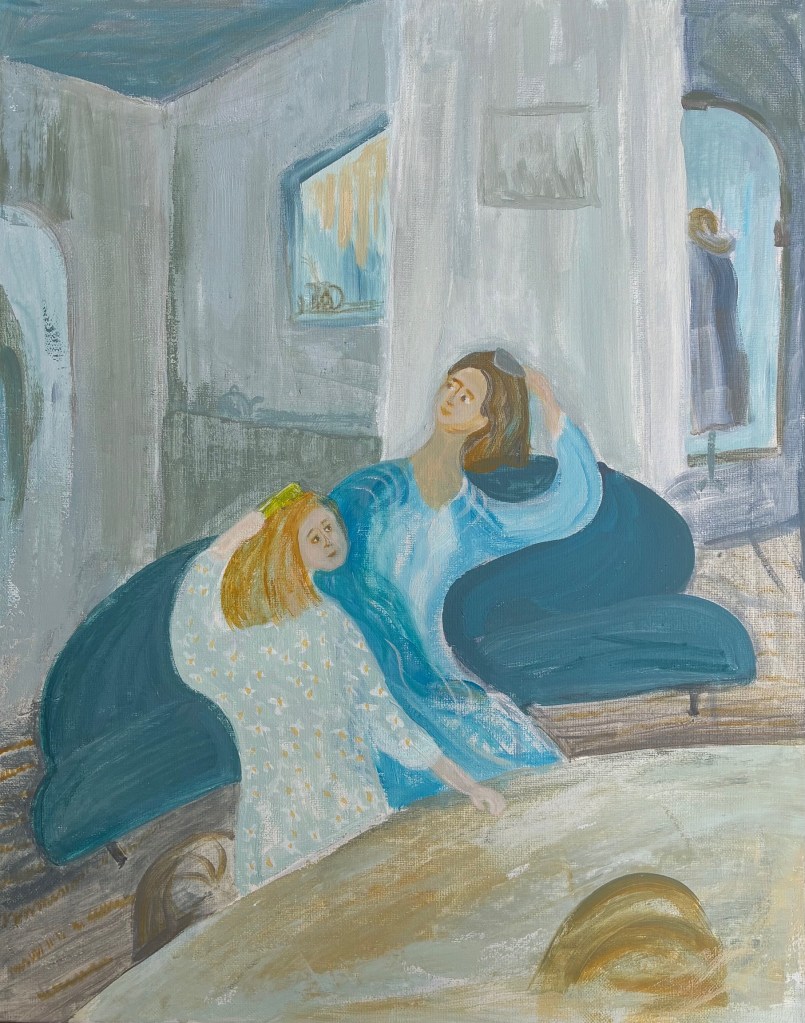
In other works, such as “Doll House” and “Blue Evening,” she first made a collage, using different papers and colors, before making the final painting. Inspired by Matisse’s cutouts, she traced the shape of the two figures in “Blue Evening” from cut paper onto the canvas and then painted them. The figures form two graceful arabesques, a musical counterpoint to the geometric structure of walls and windows in the background. The image was based on a photograph of herself and her granddaughter brushing their hair, a mundane activity she transforms into a kind of dance. In yet another series of smaller, 8×8” paintings, Irina portrays trees and lawns in bold, gesturing brushstrokes. The colorful compositions verge on abstraction.
Born and raised in Moscow, Irina graduated from Moscow State University with degrees in science and math. Although she worked as a computer programmer, she inherited an interest in crafts from her father and sold her wooden and leather jewelry during the holidays. She also was a ceramist and after moving to Chicago in the 1990s, participated in annual shows. In 2004 she and her family moved to New York City and later bought a house in Halcottsville. Since 2015, Irina has published an annual calendar featuring her artwork and has also published her illustrations in numerous regional publications. Besides painting, community gardening, which she does in her neighborhood of Bed-Stuy, is also a passion. “I try to work every day on watercolors”—a selection of which are included in her show.


Leave a Reply