
by Lynn Woods
“DRAWING – Take a Line for a Walk,” the special exhibit on view through April 19 featuring the work of 20 Longyear members, inspired many of the participating artists to take a fresh approach.
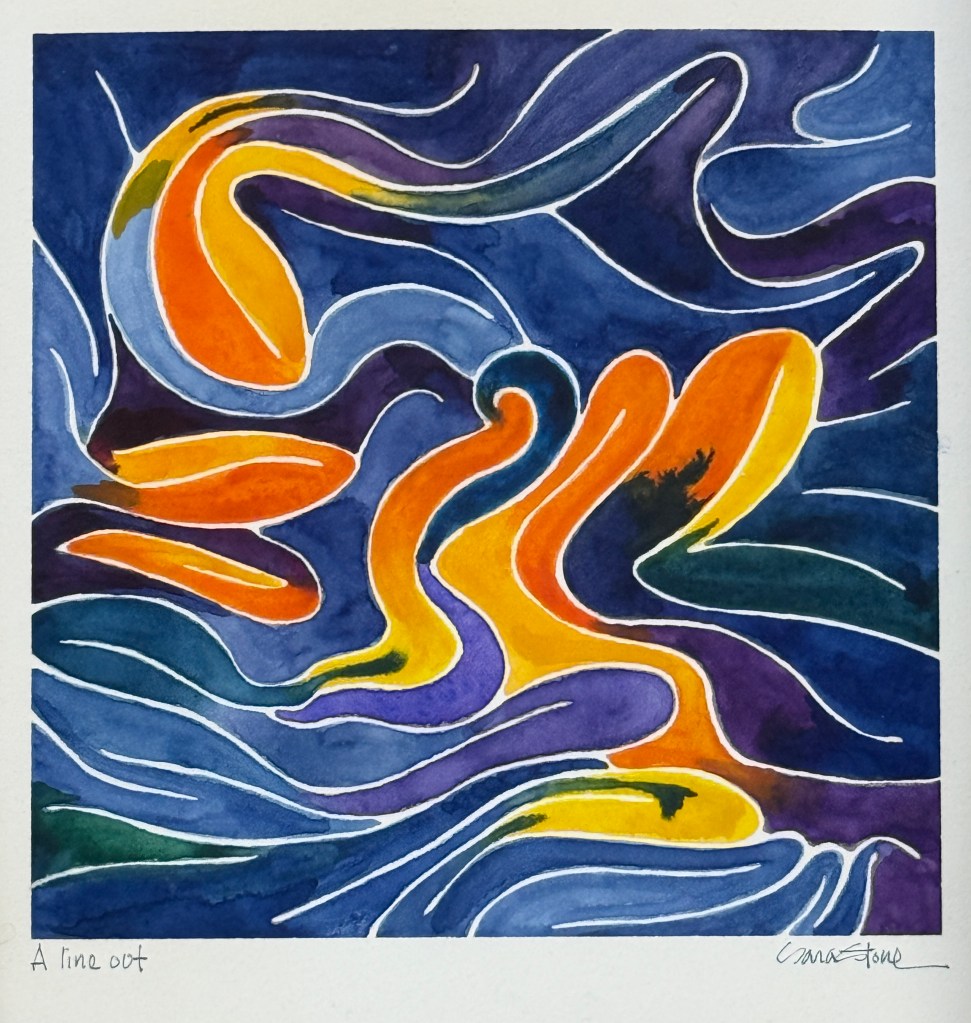
For example, Sara Stone literally “took a line for a walk” by starting her small, 9×9” square watercolor pieces with the application of a single color, letting her brush meander across the paper in a pleasing configuration, followed by another swath of adjacent color and then another, building up the composition. “I could get cool things happening with the transitions,” she says, that is, in the switch from one color to another, from dark to light, pale to saturated, and even within the application of a single color as she lightened or darkened the tone. Separating each undulating shape are thin white lines, consisting of the unpainted underlying paper, which gives the pieces a mosaic-like quality. Varying from compositions consisting of lighter, floral-like colors to dramatic contrasts of rich, warm hues against dark blues and purples, the pieces are magical, their glowing chromatics perpetually in motion, suggesting the latent forces of nature.
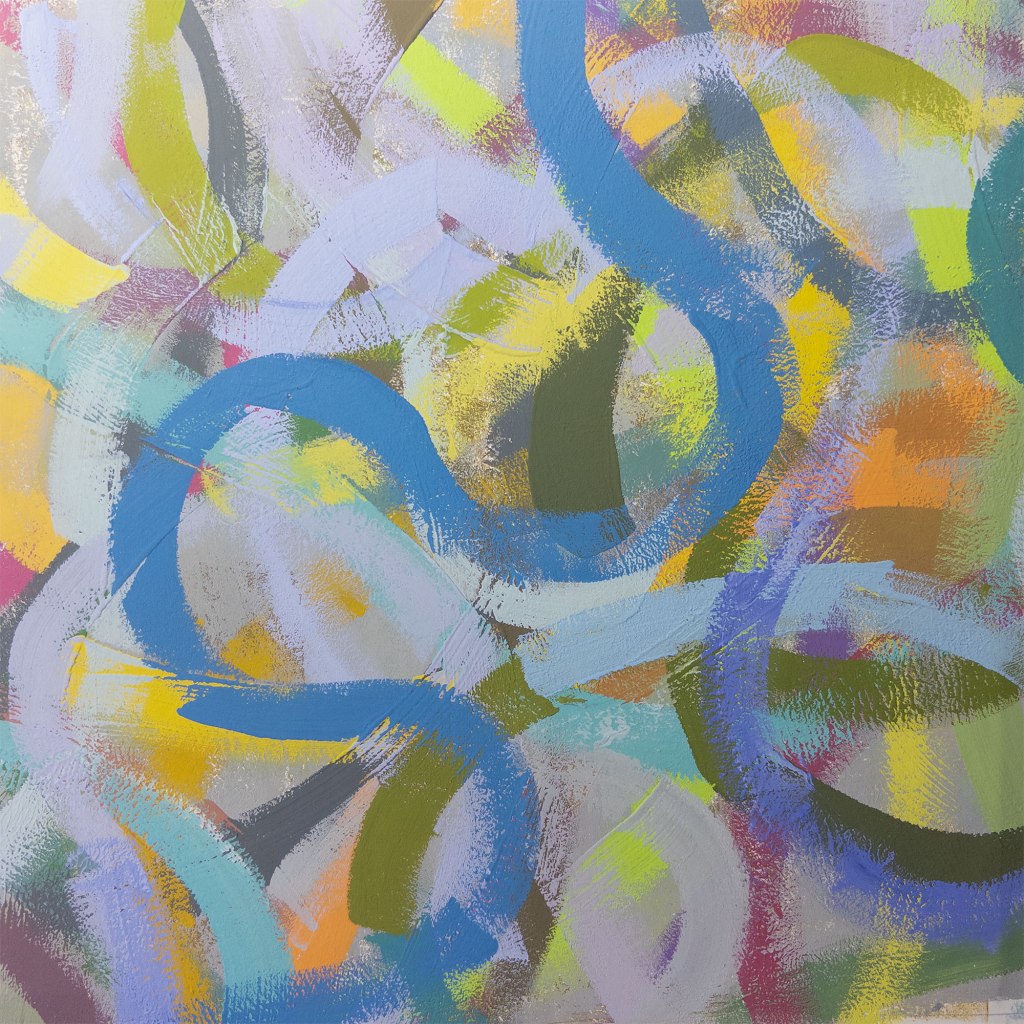
Line is similarly conceived as color forms in Sheila McManus’s series of nine square paintings, which are shown clustered together, as sections of a single painting. Crescents and swirling strips of muted greens, yellows, blues, russets, oranges and lavender overlap in a dense, tangled field emerging from a dark, mysterious ground. The color harmonies are exquisite and the brushwork crisp yet spontaneous.
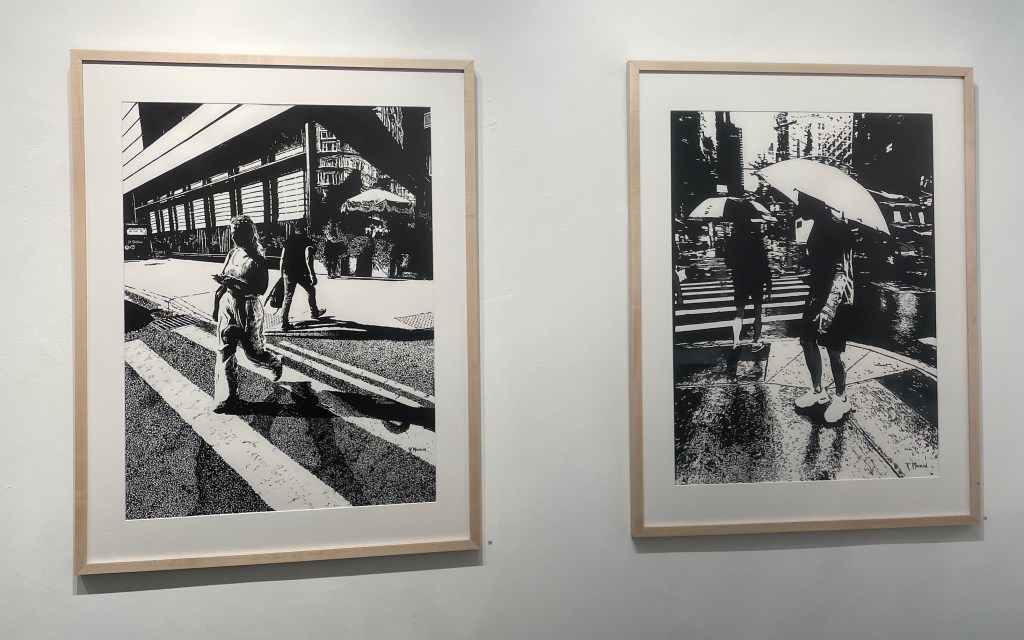
Ron Macklin also took the theme of the exhibit as a fresh directive, in this case to simplify his palette to two tones, which give his paintings a graphic quality. “Notan”—a Japanese term referring to a design in lights and darks—”has the quality of a line drawing,” he says. Two of his paintings are of figures in an urban street scene, lent a grittiness by the stark contrasts of black and white. The third painting, even more of a departure from his hyper-realistic watercolors, is a mysterious image, until, after some scrutiny, one makes out the keys and typing guide of a vintage typewriter. Working from a photographic image in which the distorted lens exaggerated the curving and elongation of the keys, which he then tightly cropped, Ron transformed the object into a soaring stadium-like space, with the lettered keys dramatically enlarged, attenuated and falling away along the bottom edge. His use of masking fluid served to blur and smear some of the darked edges, further abstracting the image, in what is a truly original, masterful piece.
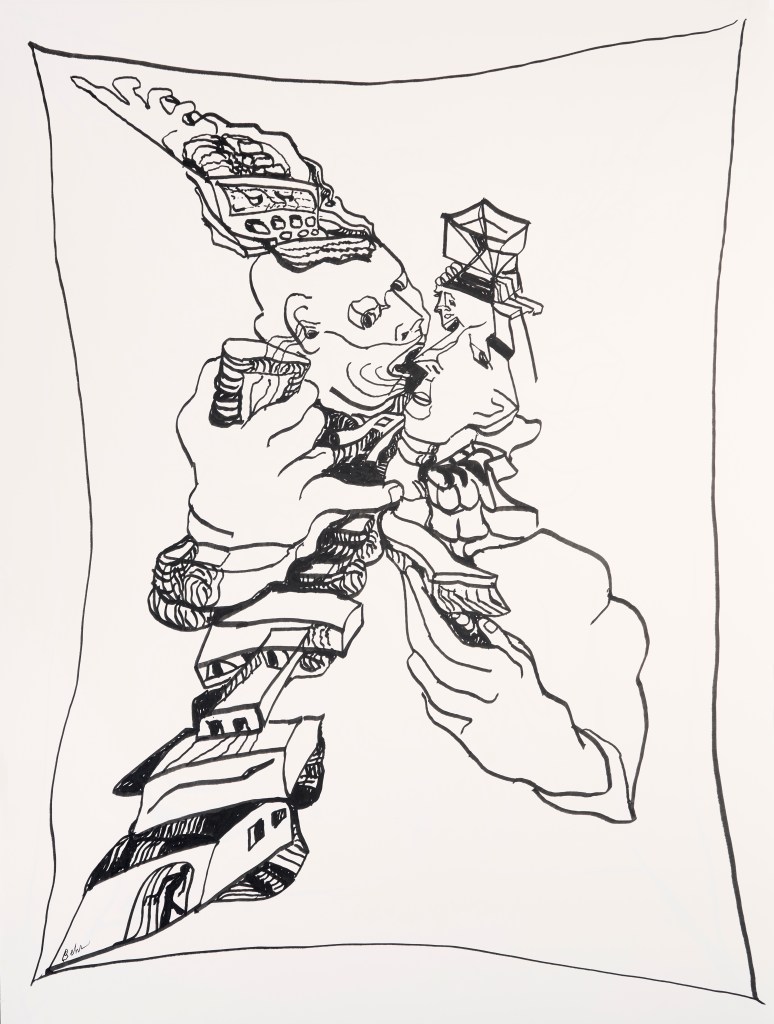
To the casual viewer, Marion Behr’s three drawings, two in pen and ink and the third done with a rapidograph, most closely adhere to the theme. Each of the images appears to be composed of a single, black, continuous line, and they clearly are influenced by the artist’s former practice of working in wire, which she used to create armatures for her sculptures. (She notes that there are some broken lines in the pieces, although “the thought process is taking a few lines on a walk.”) “Drawing has been a major part of my practice,” she says, noting that she made etchings while employed at Parsons and used to sketch people on the train while commuting from her home in New Jersey to the city. “AI” reflects “on the machine taking over people,” while “Vote” evolved from the many drawings Marion made while attending the Fourth of July fair in Margaretteville. The drawings have a wonderful, whimsical quality, and the large protruding hands in “AI” are the Picasso-like grace notes of the two oddly conflated figures, which also suggest the automatic drawings of the Surrealists and Dadaists.
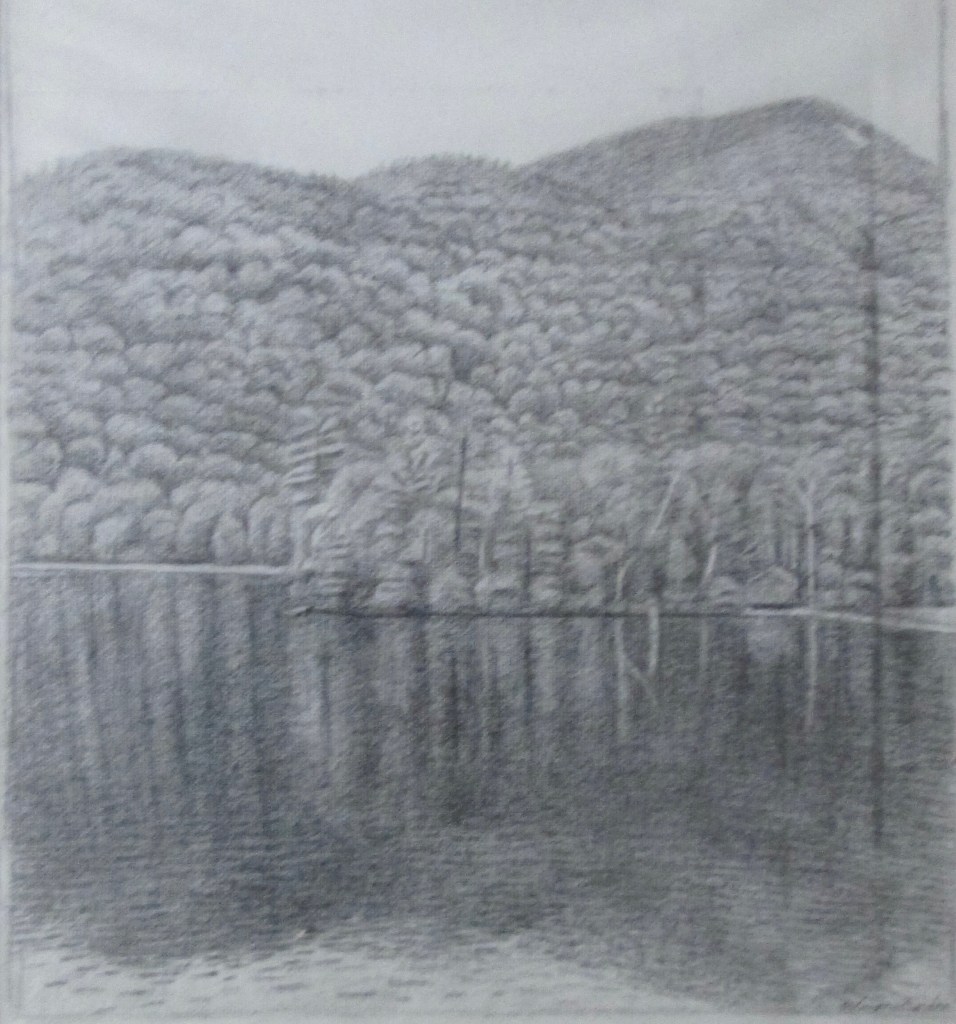
Drawing is also critical to the painting practice of Wayne Morris; he says he usually makes sketches before beginning a painting. The selection of his drawings in the show documents his range—from a rough charcoal sketch and pencil drawing of trees to a beautifully detailed view of a forested hill, in which each tree wears an aureole of light, to a pair of pencil portraits, in which the sensitively rendered tones of the heads and faces, emerging out of a lightly sketched body, convey the specific character of the sitter. Victoria Scott’s drawings, varying in size and medium, including ink and compressed charcoal, document the woods of the Catskills juxtaposed with a monument in honor of working people at a historic site in her native Philadelphia.
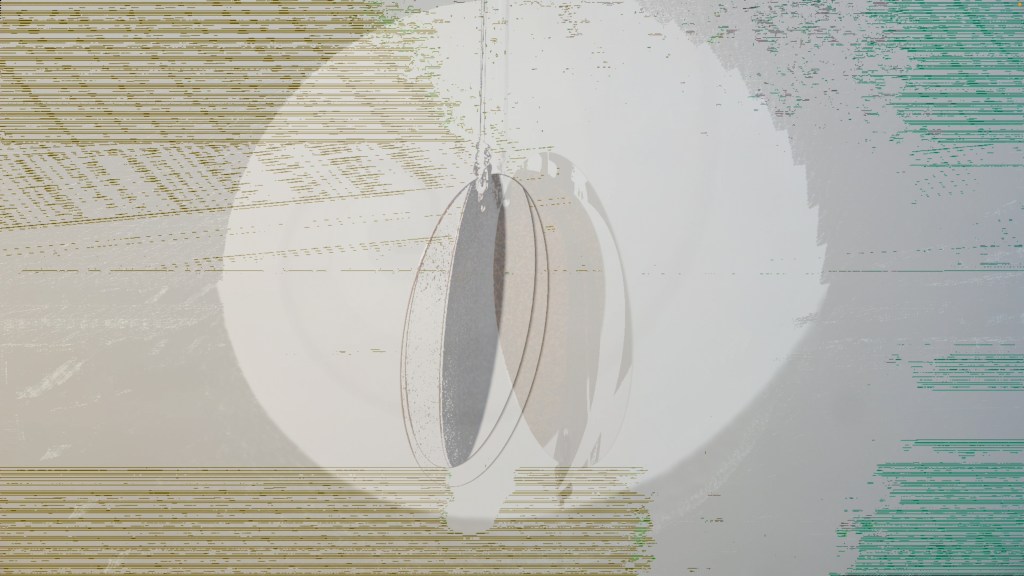
In his video entitled “Largo Florida Soundscape,” Alan Powell interpreted a line as a dancing physical string upon which hangs a flat round translucent disc nudged by the wind. The dangling disc is actually the bottom part of a windchime, which he videotaped for seven minutes on a visit to Florida. The ring of the chime, which one hears through headphones, prompts the moving image and becomes increasingly distorted thanks to Powell’s use of electronic image processing. The disc spins upside down and flashes various colors, the blues suggesting the silhouette of planet earth, the fiery oranges and pinks the sun, or perhaps a party balloon. The recorded soundscape is visceral, complete with sirens, and its distortions and the ensuing chaos of the image take on cosmic overtones. It’s a moving experience, in which a mundane moving object somehow conveys the vulnerabilities and trauma of our times.
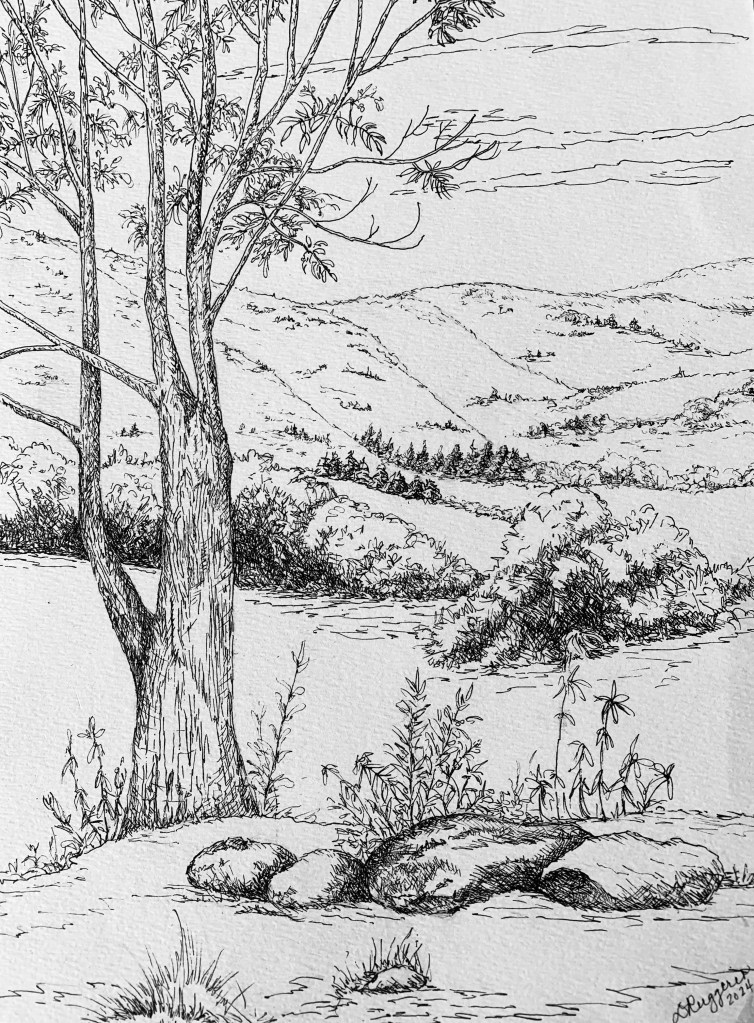
Other delights of the show are Deborah Ruggerio’s intricate, delicately toned ink drawings of the local landscape; Richard Mills’ graphite and pastel depictions of Lexington Avenue apartment brick buildings, with their rhythmic array of windows; Anthony Margiotta’s fanciful ink and gouache drawings (a personal favorite is the Steinberg-like “Tilling,” in which the lines describing the sweeping expanse of a field are shown emerging from a pen held in the grip of an elephant’s tail; a clown sits astride the beast in the foreground); the oilstick and acrylic paintings of sea, tree and leaf of Michelle Spark, in which lines serve as the life force; and the India ink paintings of Gail Freund, which in their simplicity and spontaneity of touch convey the freshness of the woods in snow and the tumbling blossoms of a plant. Other works, too numerous to describe here, are by Lariar, Mary McFerran, Gerda van Leeuwen, Hedi Kyle, Temma Bell, Neil Driscoll, and Bonnie Mitchell.
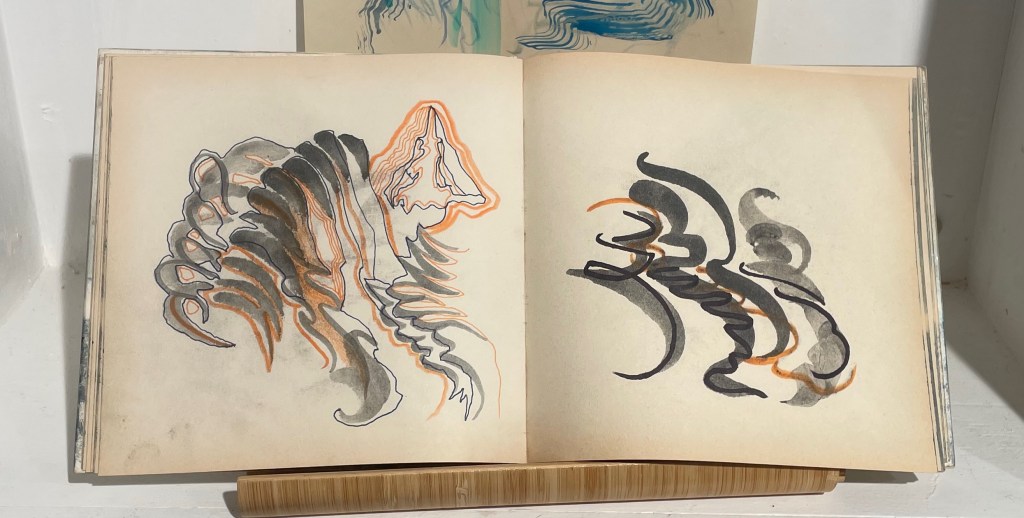
“Drawing a line can be interpreted in many ways. I chose to select a stack of cardboards, various inks, paints, and instruments such as brushes, and pencils, and pens that would create lines of different character going in all directions. I followed my intuition as how to begin, where to use color, when to stop.” Hedi Kyle
 Longyear Gallery Upcoming News and Events
Leave a comment